Evidence-Based Practice Occupational Therapy Assignment Help — CASP, PEDro and Hierarchy of Evidence

Evidence-based practice in occupational therapy assignments requires the integration of three equally weighted pillars, best available research evidence, individual clinical expertise, and patient/client values, as defined by Sackett et al. (1996). This is not optional academic content: HCPC Standards of Proficiency for Occupational Therapists mandate evidence-informed practice as a core registrant competency, and RCOT professional standards align with this requirement. OT degree programmes at Level 5, Level 6, and Level 7 assess EBP competency through critical appraisal assignments, evidence-based practice essays, literature reviews, and clinical case studies requiring evidence-supported intervention plans. This page covers every component of evidence-based practice OT assignment writing, the hierarchy of evidence, CASP critical appraisal tools, PEDro scale scoring, OT-specific databases, and EBP argument paragraph construction, for BSc and MSc OT students who need expert assignment help.
What Is Evidence-Based Practice in Occupational Therapy?
Evidence-based practice in occupational therapy defines the integration of three distinct knowledge sources: the best available research evidence (found through systematic database searching and quality appraisal), individual clinical expertise (the practitioner's accumulated knowledge and reasoning skills), and the patient's or client's values and preferences regarding their occupational performance priorities. This is Sackett et al.'s (1996) definition, which is the standard academic reference for EBP definitions in OT assignments. Failing to address all three pillars, particularly the client values pillar, is a common error that reduces marks on EBP comprehension criteria.
EBP in occupational therapy assignments is assessed as an academic competency, the ability to locate, appraise, and apply research evidence to clinical questions in OT practice. This is distinct from clinical EBP implementation in placement: in an assignment, the student is demonstrating that they can identify the right evidence, assess its quality, and make a scholarly argument for its application to a defined OT practice context. HCPC Standards of Proficiency for OT require evidence-informed practice as a registrant competency, making EBP assessment a mandatory academic focus at Level 5–7.
The Three Pillars of EBP — Research Evidence, Clinical Expertise, and Patient Values
Occupational therapy uses EBP as the framework for selecting and justifying interventions. The first pillar, best available research evidence, encompasses all published research on the effectiveness of OT interventions, classified by the hierarchy of evidence from systematic reviews (highest) to expert opinion (lowest). The second pillar, clinical expertise, refers to the practitioner's accumulated professional knowledge and reasoning, accumulated through practice experience; it is the dimension that connects research findings to individual client presentations. The third pillar, patient and client values, represents the individual's preferences, concerns, and expectations about their occupational performance and health outcomes. This third pillar is what differentiates OT EBP from biomedical EBP: a client with stroke who declines CIMT despite Level 1A evidence from Cochrane systematic reviews has made a values-based decision that the EBP model requires the therapist to respect. Overemphasising research evidence while neglecting client values in an OT assignment demonstrates incomplete EBP understanding.
Why OT Assignments Specifically Assess EBP Competency
HCPC Standards of Proficiency for Occupational Therapists require graduates to practise as evidence-informed clinicians, this requirement means that OT degree programmes at Level 6 and Level 7 typically include either a standalone EBP module or integrate critical appraisal skills into major case study and literature review assignments. Students are not assessed on whether EBP is important (it is assumed to be important), but on whether they can demonstrate the specific skills it requires: constructing a PICO research question, executing a systematic database search, appraising retrieved studies using CASP or PEDro, and constructing an EBP argument paragraph that cites evidence with both a level and a quality rating. These are testable academic skills, not philosophical commitments to evidence-informed practice.
Hierarchy of Evidence in OT Assignments — From Systematic Reviews to Expert Opinion
The hierarchy of evidence classifies research studies by their methodological design, which determines their susceptibility to bias and therefore their strength as evidence for or against an intervention's effectiveness. In OT assignments, every cited source should be classified by its evidence level, stating "research shows that CIMT is effective" is insufficient; stating "Level 1A evidence from the Cochrane systematic review (Corbetta et al., 2015) demonstrates that CIMT produces significant improvements in upper limb function post-stroke" is the academic standard.
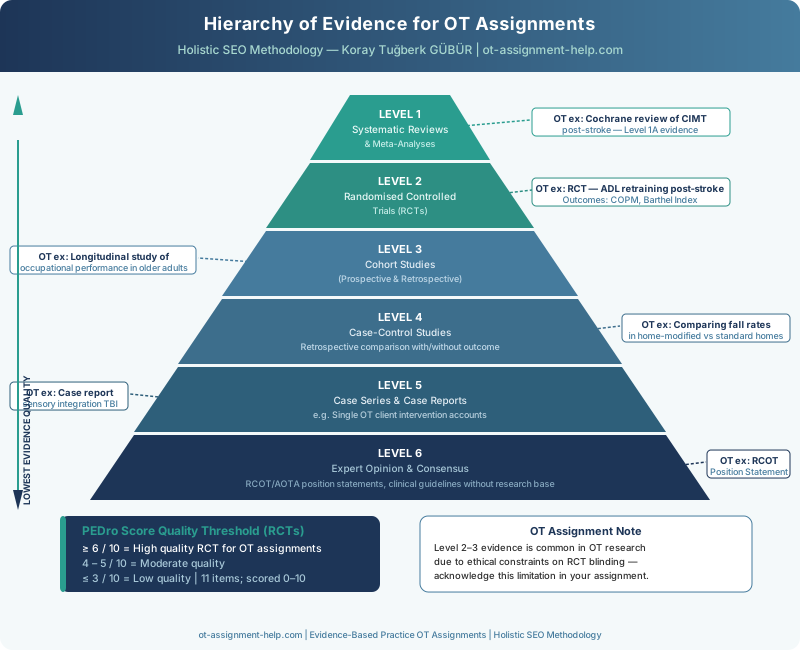
| Level | Study Type | OT Relevance |
|---|---|---|
| Level 1 | Systematic reviews and meta-analyses | Cochrane OT reviews on CIMT, ADL retraining, cognitive rehabilitation |
| Level 2 | Randomised Controlled Trials (RCTs) | AJOT and BJOT RCTs; PEDro-rated for quality; blinding constraints in OT |
| Level 3 | Cohort studies (prospective and retrospective) | Occupational performance changes in defined populations over time |
| Level 4 | Case-control studies | Retrospective comparison; less common in OT research |
| Level 5 | Case series and case reports | Rare condition or novel intervention documentation; acceptable when higher evidence absent |
| Level 6 | Expert opinion and consensus | RCOT Position Statements, AOTA practice guidelines, clinical consensus documents |
Level 1 and Level 2 Evidence — Systematic Reviews and RCTs in OT Research
Systematic reviews provide a comprehensive, reproducible search of all available evidence on a defined research question, followed by quality appraisal of each included study. Meta-analyses add quantitative pooling of results from multiple RCTs, producing a statistically aggregated effect size. OT examples at Level 1 include the Cochrane reviews on CIMT (constraint-induced movement therapy) for post-stroke upper limb recovery, systematic reviews on task-specific ADL retraining post-stroke, and cognitive rehabilitation after traumatic brain injury. Standardised OT assessment tools (COPM, AMPS, Barthel Index) are used as outcome measures in OT RCTs, making their correct interpretation in case study assignments directly connected to this evidence base.
RCTs in OT research use random allocation to treatment and control groups to eliminate selection bias, but face methodological constraints specific to occupational therapy. It is not possible to blind participants to occupational therapy intervention, a client knows whether they are receiving OT or not, and it is often not possible to blind the OT assessor, who is also typically the treating therapist. These constraints reduce PEDro scores for OT RCTs compared to pharmacological trials. Students should acknowledge this limitation explicitly in critical appraisal sections, it is a known methodological feature of OT research, not a flaw in the individual study.
Levels 3–6 — Cohort Studies, Case Reports and Expert Opinion in OT Assignments
Cohort studies follow a defined group sharing a characteristic (e.g., adults post-stroke) over time and measure changes in occupational performance using standardised tools. They are appropriate for studying how occupational engagement changes over rehabilitation episodes and are commonly found in CINAHL OT literature searches. Case-control studies compare individuals with a defined outcome (e.g., successful community OT discharge) against those without, looking retrospectively for exposure differences, less common in OT research.
Case series (Level 5) and expert opinion (Level 6) are academically acceptable when higher-level evidence does not exist for a specific OT population or intervention. In MSc-level critical appraisal assignments, the student must acknowledge when they are citing lower-level evidence and explain why: state explicitly that no Level 1–2 evidence exists for this specific population, that methodological challenges (ethical constraints, population heterogeneity, outcome measure standardisation issues) make RCT design difficult, and that the best available evidence, even at Level 5–6, should inform clinical reasoning. RCOT Position Statements and AOTA practice guidelines represent Level 6 evidence, they are not primary research, regardless of how authoritatively they are written.
CASP Critical Appraisal Tools for OT Assignments
CASP appraisal tools provide the structured framework for evaluating the methodological quality of research studies before citing them in OT assignments. CASP (Critical Appraisal Skills Programme) offers study-design-specific checklists, students must select the correct CASP tool for the study type being appraised. Applying the CASP RCT checklist to a qualitative study, or the CASP qualitative checklist to a systematic review, signals methodological confusion to the marker.
The key academic skill in CASP completion is justification, the student does not simply answer Yes/No/Can't Tell to each question but explains WHY based on evidence from the paper being appraised. "Yes, randomisation was achieved" scores minimal marks. "Yes, randomisation was achieved using computer-generated allocation concealment, which adequately protected against selection bias in this sample of 60 participants (CASP item 1: adequate; CASP item 2: adequate)" scores distinction-level marks. This distinction between tick-box completion and justified appraisal is the single most common mark differentiator in OT critical appraisal assignments.
| CASP Checklist | Number of Questions | Key Focus Areas |
|---|---|---|
| CASP RCT Checklist | 11 questions | Randomisation, allocation concealment, blinding, sample size, outcome measures, generalisability |
| CASP Qualitative Checklist | 10 questions | Research design appropriateness, recruitment, data collection, reflexivity, ethical issues, rigour, findings, transferability |
| CASP Systematic Review Checklist | 10 questions | Review question clarity, search strategy, study quality assessment, result combination, precision of results |
Using the CASP RCT Checklist for OT Evidence — All 11 Questions Explained
The CASP RCT checklist's 11 questions are grouped into three sections: validity of trial results (questions 1–2: randomisation method, allocation concealment, protecting against selection bias); validity of the results themselves (questions 3–7: blinding of participants/assessors/outcome assessors, group similarity at baseline, equal treatment apart from trial intervention, primary outcome measure, statistical precision of results); and applicability to local practice (questions 8–11: relevance of outcome measure to OT practice, generalisability of sample to the target OT population, consideration of adverse effects, overall value of results to OT clinical decision-making).
Question 11, "Is the evidence applicable to your OT practice context?", connects the clinical expertise pillar of EBP back to the appraisal process. This is the question students most frequently overlook: a highly valid, high-quality RCT may still not be applicable to the specific client population or practice setting in the assignment. Addressing applicability in the appraisal demonstrates that the student understands EBP as a three-pillar framework, not merely as a literature search exercise.
CASP Qualitative Checklist — Appraising Qualitative OT Research
The CASP qualitative checklist appraises qualitative OT research through 10 questions assessing: whether the research question is clearly stated (item 1); whether qualitative methodology is appropriate for answering it (item 2); whether the research design fits the methodology (item 3); whether the recruitment strategy is appropriate for the research question (item 4); whether data collection addressed the research question adequately (item 5); whether the researcher-participant relationship has been adequately considered, including reflexivity (item 6); whether ethical issues have been considered and addressed (item 7); whether the data analysis is sufficiently rigorous (item 8); whether there is a clear statement of findings (item 9); and how valuable the research is to OT practice (item 10).
Many OT students undervalue qualitative evidence because they associate the hierarchy of evidence with numerical ranking, incorrectly interpreting Level 3 qualitative research as "weaker" than Level 2 RCTs for all research questions. In occupational therapy, occupation-based outcomes are often best captured through qualitative methodologies. An IPA (Interpretative Phenomenological Analysis) study exploring the lived experience of occupational engagement post-stroke provides data that no RCT can generate, patient values, subjective occupational meaning, barriers to occupational identity reconstruction. For EBP assignments, the CASP qualitative checklist must be used alongside the CASP RCT checklist when the evidence set includes qualitative studies.
PEDro Scale — Rating RCT Quality in OT Assignments
The PEDro scale scores RCT methodological quality on a numerical scale, providing a quantitative quality rating that complements the CASP narrative appraisal. PEDro (Physiotherapy Evidence Database) scale has 11 items, but only 10 are scored (item 1, eligibility criteria, is not scored for quality). Score range is 0–10. Interpretation: ≥6 = high quality RCT (acceptable for OT evidence base); 4–5 = moderate quality (acknowledge limitations); ≤3 = low quality (use with significant qualification or seek higher-quality evidence).
| PEDro Item | Criterion | OT-Specific Note |
|---|---|---|
| Item 2 | Random allocation | Required for RCT validity; absence scores 0 |
| Item 3 | Concealed allocation | Critical for selection bias prevention in OT trials |
| Item 5 | Subject blinding | Often not achievable in OT — participants know they are receiving OT |
| Item 6 | Therapist blinding | Rarely achievable — OT is typically both therapist and assessor |
| Item 9 | Intention-to-treat analysis | Important for validity of results including all randomised participants |
| Item 10 | Between-group statistical comparisons | Required for treatment vs control comparison validity |
Therapist blinding (item 6) is rarely achievable in occupational therapy research because the occupational therapist is the intervention, the therapist cannot be blinded to whether they are delivering OT. This methodological constraint is a known feature of rehabilitation science research, not a flaw in individual OT studies. In assignments, the student should acknowledge items 5 and 6 as limitations while noting that the inability to blind participants and therapists does not disqualify an OT RCT from providing valid evidence, it contextualises the quality rating appropriately.
OT-Specific Evidence Databases — Where to Search for OT Research
OTseeker provides pre-appraised occupational therapy RCTs and systematic reviews, it is the most OT-specific database available and should be the first port of call for any OT evidence-based practice assignment requiring Level 1–2 evidence. OTseeker uses PEDro scale ratings for RCTs; search results therefore arrive pre-quality-rated, saving significant appraisal time in assignments with multiple studies to evaluate. OTseeker is freely accessible and covers the major OT journals and Cochrane reviews relevant to OT practice areas.
CINAHL (Cumulative Index to Nursing and Allied Health Literature) provides the most comprehensive allied health coverage including OT-specific literature across qualitative, quantitative, and mixed methods designs. CINAHL uses its own subject heading vocabulary (CINAHL headings) including OT-specific terms. OT students should use CINAHL subject headings (e.g., "Occupational Therapy," "Activities of Daily Living," "Occupational Performance") alongside title/abstract keyword searches to maximise recall. CINAHL is the primary database for qualitative OT research not captured by OTseeker.
PubMed/MEDLINE provides biomedical and clinical science coverage. For OT topics, PubMed requires MeSH (Medical Subject Headings) terms: "Occupational Therapy"[MeSH], "Activities of Daily Living"[MeSH], "Rehabilitation"[MeSH], "Cognition Disorders"[MeSH]. A search string example for a stroke ADL retraining assignment: ("Occupational Therapy"[MeSH]) AND ("Activities of Daily Living"[MeSH]) AND ("Stroke Rehabilitation"[MeSH]) AND ("Randomized Controlled Trial"[Publication Type]). Students using only keyword searches in PubMed miss a significant proportion of indexed OT literature.
The Cochrane Library provides the highest-quality systematic reviews across all healthcare, the Cochrane Rehabilitation group covers OT-relevant interventions extensively. Cochrane reviews meet the highest methodological standard for systematic review production and represent Level 1A evidence. AOTA Evidence-Based Practice Resources provide AOTA critically appraised topics (CATs) and evidence briefs, OT-specific evidence summaries organised by practice area, useful for identifying existing evidence syntheses before conducting an independent database search.
Current Evidence Levels for Key OT Interventions
Current evidence demonstrates that OT interventions vary significantly in their research evidence base, from well-established Level 1A support to contested and evolving evidence at Level 2. Understanding the specific evidence level for the intervention being discussed in an assignment is an academic requirement, writing "research supports the use of CIMT" without specifying the evidence level and quality of that research scores significantly fewer marks than specifying "Level 1A evidence from multiple Cochrane systematic reviews demonstrates significant upper limb function improvements with CIMT post-stroke."
| OT Intervention | Current Evidence Level | Key Evidence Source | Assignment Notes |
|---|---|---|---|
| CIMT (Constraint-Induced Movement Therapy) | Level 1A — strong evidence | Multiple Cochrane systematic reviews + RCT base | Primarily for upper limb post-stroke; cite Cochrane evidence specifically |
| Task-specific ADL retraining post-stroke | Level 1A — strong evidence | Cochrane systematic review; multiple AJOT/BJOT RCTs | Strongest evidence base in stroke OT overall |
| Sensory Integration (Ayres SI) | Level 2 — moderate, contested | AJOT systematic reviews (ongoing fidelity debate) | Acknowledge ongoing debate about fidelity to Ayres SI protocol vs sensory-based activities |
| Cognitive rehabilitation (post-ABI/stroke) | Level 1B — moderate evidence | Cochrane Cognitive Rehabilitation Group reviews | Evidence stronger for attention training than global cognitive rehabilitation |
| Occupation-based intervention | Level 1B — moderate evidence | AJOT systematic reviews; methodological challenges in standardisation | Acknowledge difficulty in standardising "occupation-based" across studies |
Once You Have the Evidence — How Do You Build an EBP Argument in an OT Assignment?
Once you have classified the evidence level, appraised its quality using CASP or PEDro, and identified its application to your OT clinical question, the academic challenge is converting that evidence into a coherent written argument. Most OT students can locate and appraise evidence, fewer can construct a distinction-level EBP argument paragraph that integrates claim, evidence level, quality rating, critical appraisal, and client values into a single, logically structured academic sentence set. The sections below cover EBP argument paragraph construction and PICO framework application, the specific writing skills that separate pass-level from distinction-level EBP work in OT assignments.
Not sure how to structure your EBP argument? Talk to our OT assignment experts.
Constructing an EBP Argument Paragraph in an OT Assignment
An EBP argument paragraph in an OT assignment follows a claim-evidence-warrant structure: (1) Clinical claim, state the intervention and its intended occupational purpose; (2) Evidence citation, cite the study or review with its evidence level and quality rating (e.g., "Level 1A evidence from a Cochrane systematic review of 44 studies, with included RCTs rated ≥6 on the PEDro scale"); (3) Warrant, explain why this evidence applies to the specific client population or context in the assignment (the warrant is where clinical expertise and client values connect the research to the individual case). For example: "Constraint-induced movement therapy (CIMT) is recommended for this client's upper limb rehabilitation. Level 1A evidence from the Cochrane systematic review (Corbetta et al., 2015, comprising 44 RCTs) demonstrates significant improvements in upper limb function and ADL performance post-stroke. The evidence applies to this client given the presentation of mild-to-moderate upper limb hemiplegia, and the client has expressed strong motivation to return to bilateral daily activities, aligning with CIMT's intensive engagement requirement." For related OT case study assignment support, see OT case study assignments and for literature review writing support, see our guidance on occupational therapy literature reviews.
PICO Framework for Framing OT Research Questions in Assignments
PICO frames the clinical research question that drives the literature search and evidence appraisal. In OT assignments, the Outcome element must be expressed in occupational performance terms, not purely biomedical terms. Example PICO for an OT stroke assignment: P = adults aged 40–80 with first episode ischaemic stroke and mild-to-moderate upper limb hemiplegia; I = constraint-induced movement therapy (CIMT) delivered in 2-week intensive blocks; C = conventional OT (upper limb exercises and compensation strategies); O = self-care ADL performance measured by COPM performance score and Barthel Index total score at 3-month follow-up. This PICO connects directly to CASP item 1 (clear research question) and frames the entire database search strategy. PICO construction is assessed in both EBP essays and literature review assignments at Level 5–7.
PRISMA Checklist for OT Systematic Review Assignments
PRISMA (Preferred Reporting Items for Systematic Reviews and Meta-Analyses) is the 27-item reporting checklist required for systematic review assignments in OT at Level 6–7. The PRISMA flow diagram, documenting the number of records identified, screened, assessed for eligibility, and included, is a mandatory component of any OT literature review assignment that follows a systematic search methodology. Key PRISMA items relevant to OT assignments include: item 5 (protocol and registration, PROSPERO registration for prospective systematic reviews is increasingly expected at MSc and OTD level); item 7 (information sources, must name OTseeker, Cochrane, CINAHL, PubMed as the primary search databases); item 8 (search strategy, full search string must be reported in an appendix); item 14 (study selection, inclusion and exclusion criteria must be explicitly stated); item 19 (risk of bias assessment across studies, using CASP or PEDro scores to aggregate quality across included studies). For comprehensive systematic review and literature review assignment support, see our OT literature review assignments guidance.
EBP Applied to OT Frameworks and Neurological Practice
EBP competency is assessed across multiple assignment types beyond standalone EBP essays. For applying evidence-based occupational therapy frameworks in case study and theory assignments, including the evidence base for OTPF-aligned interventions, see our guide to the OTPF as an evidence-based occupational therapy framework. For students whose EBP assignment addresses neurological populations or post-stroke rehabilitation, see our guide to applying evidence-based practice in neurological OT case studies, which covers CIMT evidence levels, NICE guidelines, and stroke phase-appropriate evidence application. For EBP assignments that require critical appraisal of standardised OT assessment tools — evaluating their psychometric properties such as reliability coefficients, sensitivity, and specificity — see our guide to psychometric properties of OT assessments.
FAQ — Evidence-Based Practice OT Assignment Questions
What is the difference between evidence-based practice and occupation-based practice in OT assignments?
EBP and occupation-based practice are not mutually exclusive, they operate at different levels. EBP is the methodology for selecting and justifying interventions through systematic evidence appraisal. Occupation-based practice is a philosophical approach to OT that centres meaningful, purposeful occupation as both the medium and the goal of therapy. In OT assignments, the strongest EBP arguments apply the EBP methodology to evaluate occupation-based interventions: "Level 1B evidence supports occupation-based intervention for improving functional independence, though methodological challenges in defining 'occupation-based' across studies limit direct comparison." The ongoing debate about standardising occupation-based practice for research purposes is a valid academic discussion point at Level 7.
How do I choose between CASP and PEDro for critiquing an RCT in my OT assignment?
CASP provides a narrative appraisal with justification for each criterion, it is better suited to assignments requiring critical discussion of a single study's quality. PEDro provides a numerical quality score, it is better suited to assignments requiring comparison of multiple studies or explicit quality ranking. Some OT assignments require both: CASP for the narrative appraisal and PEDro as a supplementary quality score. If your brief specifies one tool, use that tool. If it specifies "critical appraisal" without naming a tool, CASP is the more academically robust choice. PEDro scores ≥6 indicate high quality for OT RCTs; CASP does not produce a numeric score but allows nuanced justification that PEDro does not.
Which OT databases are most likely to return Level 1 evidence?
OTseeker and the Cochrane Library are the most likely sources of Level 1 systematic reviews specific to OT. OTseeker limits results to RCTs and systematic reviews by design and pre-rates included studies using PEDro, it is the highest-efficiency database for OT Level 1–2 evidence. The Cochrane Library contains the most methodologically rigorous systematic reviews, including those from the Cochrane Rehabilitation group covering OT-relevant interventions. For CINAHL and PubMed, apply study type filters (Systematic Review, Randomised Controlled Trial) and use MeSH or CINAHL subject headings to retrieve OT-relevant Level 1–2 studies from within their broader coverage.
How do I justify using Level 3 or Level 4 evidence in an OT assignment when Level 1 evidence does not exist?
State explicitly that the absence of higher-level evidence reflects the methodological challenges of OT research, difficulty blinding participants to an OT intervention, ethical constraints on withholding therapy, heterogeneity of occupational performance outcome measures across studies, small sample sizes in specialist populations, rather than an absence of clinical effectiveness. The academic principle is that the best available evidence should be used, even if it is not at the highest level. Pair lower-level evidence with strong clinical reasoning and explicit client-centred goal alignment to strengthen the EBP argument. Acknowledge the limitation and its implications for the certainty of the evidence claim.
What does a distinction-level EBP paragraph look like in an OT assignment?
A distinction-level EBP paragraph: (1) states the PICO question or clinical claim clearly; (2) identifies the evidence source with both level AND quality rating ("Level 1A evidence from a Cochrane systematic review of 22 RCTs; individual RCTs rated ≥6 on PEDro scale"); (3) critically appraises the evidence, stating both its strength and its specific limitations for this population or context; (4) applies the evidence to the specific client using occupational performance language (COPM scores, AMPS logit scores, OTPF performance areas); and (5) integrates client values as the deciding factor in the application decision. A pass-level EBP paragraph cites a study, states it "shows that X is effective," and moves on, no level, no quality rating, no critical appraisal, no client values application.
Get Expert Help with Your EBP OT Assignment
CASP appraisal, PEDro scoring, hierarchy of evidence, OTseeker searching, and EBP argument writing, all covered by OT-qualified specialists. BSc and MSc level support.
View All OT Assignment Services