Activity Analysis Assignment Help — Occupational Therapy Student Guide to OTPF Demand Categories
An activity analysis assignment in occupational therapy requires systematic application of the OTPF (Occupational Therapy Practice Framework, 4th edition) activity demand categories to a named activity or occupation. The assignment requires analysis across all eight demand categories, objects and their properties, space demands, social demands, sequencing and timing, required actions and performance skills, required body functions, required body structures, and contextual factors, followed by grading and adapting recommendations linked to a specified client population and client factors. This service provides expert activity analysis assignment help for BSc Level 4–5 OT students, covering every OTPF demand category with specific clinical values, grading continuum examples across client populations, and demand-to-client-factor linking.
What Is an Activity Analysis Assignment in Occupational Therapy?
An occupational therapy activity analysis assignment requires the student to deconstruct a named activity or occupation into its component demand categories, using the OTPF (Occupational Therapy Practice Framework, 4th edition) as the primary analytical framework. The assignment demonstrates two foundational OT academic skills: the ability to systematically identify what an activity demands of the person performing it, and the ability to connect those demands to specific client factors (body functions and structures) to establish performance gaps that justify clinical reasoning and intervention planning.
Activity analysis differs from a clinical case study in important ways: an academic activity analysis assignment analyses a standardised version of the activity, what the activity demands of any person performing it in typical conditions, not a specific client's performance of it. Some Level 5 and Level 6 assignments bridge both: the student first analyses the standard activity across all eight demand categories, then applies the analysis to a specific client population or vignette, establishing the demand-to-client-factor gaps that justify grading and adaptation recommendations. At Level 4, most programmes require the standard activity analysis only.
The OTPF 4th edition (AOTA, 2020) is the primary framework for activity analysis in UK, US, Australian, and Canadian OT programmes. Alternative frameworks include OTIPM (Occupational Therapy Intervention Process Model, Fisher, 2009 — focuses on natural performance context) and MOHO occupational analysis (addresses occupational form and meaning within MOHO's construct framework). Unless the assignment brief specifies an alternative, the OTPF is the required framework.
Which Activities Are Commonly Analysed in OT Assignments?
Common activities analysed in OT assignments include: cooking/meal preparation (high complexity — 8–20 or more sequential steps, multiple simultaneous demand categories, physical and cognitive demands equally prominent, applicable across all client populations and qualification levels; the most commonly set activity at Level 4–5); dressing (ADL standard — 10–15 sequential steps, bilateral upper limb demands, balance demands for lower body dressing, sensory and proprioceptive requirements); handwriting (fine motor demand-heavy, visual-motor integration central, endurance and postural demands, cognitive composition demands, used for paediatric and adult neurological populations); bathing and showering (transfer safety demands, temperature sensitivity, bilateral upper limb coordination, balance); workplace tasks (typing, assembly, filing, depending on programme emphasis); and leisure activities (gardening, card games, emphasise social and cognitive demand categories).
If the assignment brief does not specify an activity, cooking is recommended at Level 4–5 because it provides sufficient complexity across all eight demand categories to produce a comprehensive analysis. Activities that are too simple, picking up an object, standing from a chair, will not generate sufficient demand analysis for a pass-grade assignment at Level 5 and above.
OTPF Activity Demand Categories — All Eight Explained with OT Examples
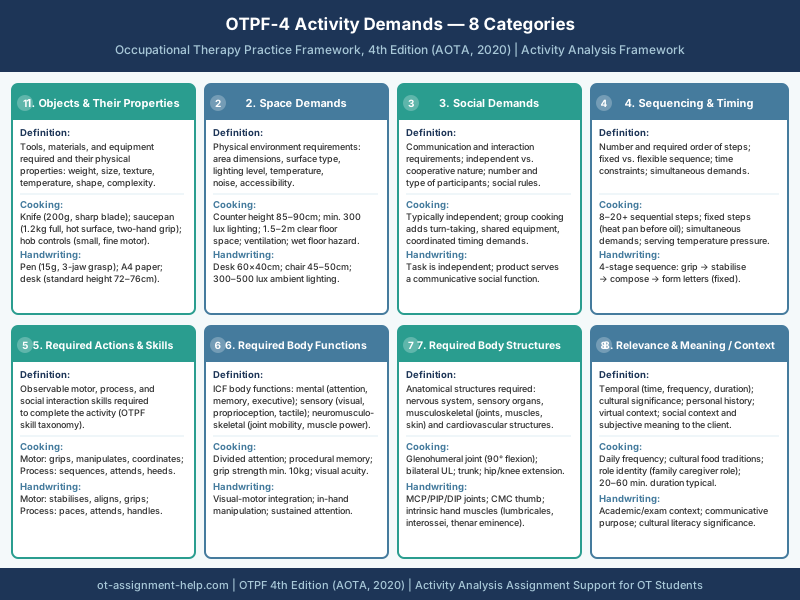
The OTPF (Occupational Therapy Practice Framework, 4th edition) organises activity demands across eight categories, each requiring specific analysis content. Every category must be addressed in a comprehensive activity analysis assignment at Level 5 and above. The specific values provided below for cooking and handwriting represent the level of clinical specificity required for distinction-level work, vague descriptions without quantified values do not constitute EAV coverage.
Objects and Their Properties, Space Demands, and Social Demands (Categories 1–3)
Cooking values: Chef's knife (sharp blade, rigid handle, approximately 200g, requires secure 5-jaw grip); standard saucepan (1.2kg when empty, increases to approximately 2.5kg filled with water, hot surface requiring thermal protection, requires two-hand grip for safe transport); hob controls (small rotary dial requiring fine motor control of ≤1cm precision, potentially low contrast for visually impaired users); oven (requires 90° shoulder flexion for overhead access, door handle requiring approximately 8kg pull force).
Handwriting values: Pen or pencil (smooth barrel, requires dynamic 3-jaw grasp, approximately 15g, length 15–19cm standard); A4 paper (requires horizontal flat surface positioning, white with black ink standard, high contrast; lined paper guides visual reference); desk (standard height 72–76cm, requires appropriate chair height for upper limb support).
Cooking values: Standard kitchen work surface height 85–90cm (seated wheelchair-accessible height 80cm); minimum clear floor space 1.5–2m around work surfaces for safe mobility; minimum 300 lux task lighting for safe food preparation; adequate ventilation for temperature regulation; wet or slippery floor surface hazard when cooking; hob at counter height (safety implication for wheelchair users, hot surfaces at upper limb level).
Handwriting values: Standard desk height 72–76cm; chair height 45–50cm (feet flat on floor for postural stability); minimum 300–500 lux ambient lighting; quiet environment, ambient noise above 65 dB reduces sustained attention and writing speed in academic contexts; right/left hand writing space allocation on desk surface.
Cooking values: Typically independent or cooperative with one other person for standard meal preparation; social demands increase significantly in group cooking (turn-taking for equipment, shared timing coordination, negotiating preferences); communication demands are minimal for solo preparation but serve a social function, the meal produced is typically shared in a social context.
Handwriting values: The writing task itself is performed independently with minimal real-time social demands; however, the product of handwriting (the written text) serves a communicative social function, the writer must consider the reader's ability to interpret the product, creating an indirect social demand for legibility and clarity.
Sequencing and Timing, Required Actions, and Body Functions (Categories 4–6)
Cooking values: Meal preparation for a hot dish involves 8–20 or more sequential steps with both fixed and flexible components, fixed sequence: heat pan before adding oil, add ingredients in the correct order for safe cooking; flexible sequence: order of vegetable preparation can vary; simultaneous task demands: monitoring heat level and timing while chopping creates dual-task attention demand; time pressure: maintaining safe cooking temperature while managing multiple steps creates performance speed demands.
Handwriting values: Four-stage macro-sequence: grip implement → stabilise paper → compose text content → form letters; letter stroke sequences are fixed (specific stroke order for each letter form, deviations affect legibility and speed); academic handwriting time pressure: lecture notes require speed that conflicts with formation accuracy; examination conditions impose strict time constraints requiring automatised letter formation.
Motor skills (cooking): stabilises (trunk and standing posture while working at counter), positions (body at counter, items on surface), reaches (into cupboards, overhead shelf access requires 90° shoulder flexion), grips (knife, power grip; lid removal, lateral pinch; jar opening, supination with grip force), manipulates (controls cutting angle and pressure), coordinates (bilateral upper limb for bowl stabilisation and stirring), moves (transfers pan from hob to counter safely).
Process skills (cooking): paces (matches task speed to cooking timeline), attends (maintains focus across multiple simultaneous tasks), heeds (stays on the task goal, completing the planned meal), initiates (begins each step without prompting), sequences (orders steps correctly), terminates (completes each sub-task before beginning the next), searches/locates (finds ingredients and equipment in kitchen), organises (arranges items on work surface efficiently), adjusts (responds to unexpected events, pan boiling over, timer going off).
Body functions (handwriting): Divided attention (monitoring letter formation accuracy while composing text content simultaneously), working memory (holding composition content in mind while forming letters), visual acuity (reading own handwriting during composition), fine motor control (intrinsic hand muscle coordination for pen manipulation), visual-motor integration (translating visual letter form knowledge into motor output), in-hand manipulation (repositioning pen within the hand between strokes without putting it down), sustained attention and endurance (maintaining performance quality over 20 minutes or more of continuous writing).
Cooking: Divided attention (monitoring multiple tasks simultaneously, a higher-order executive function); procedural memory (recall of familiar recipes without conscious step-by-step thinking); working memory (holding recipe instructions in mind while preparing ingredients); visual acuity (reading food labels, recipe cards, digital display temperatures); upper limb muscle power minimum grade 3/5 (Medical Research Council scale) for functional task completion; grip strength minimum 10kg (dynamometry measurement) for safe pan handling and knife control; proprioception (positioning and monitoring limb position without constant visual monitoring); thermal sensitivity (detecting temperature differences, hot surfaces, food internal temperature assessment).
Handwriting: Fine motor control of intrinsic hand muscles (required for precise pen positioning and pressure regulation); visual-motor integration (translating stored visual letter form knowledge into graded motor output); in-hand manipulation (MCP and PIP flexion-extension for pen repositioning); sustained attention and task persistence (endurance for 20 or more minutes of continuous writing); visual scanning (monitoring the written line and page layout); cognitive composition skills (executive function for text planning and sentence construction simultaneously with letter formation).
Body Structures, Contextual Factors, and Bringing the Eight Categories Together (Categories 7–8)
Cooking: Bilateral upper limb (shoulder glenohumeral joint: 90° flexion required for overhead cupboard access, 45° abduction for lateral reach; elbow: 0–120° flexion-extension range for full functional reach; wrist: neutral to 30° extension for functional grip patterns; hand: MCP, PIP, and DIP joints for grip and manipulation, all digits engaged); trunk structures (thoracic spine extension for upright standing posture at work surface); lower extremity (hip and knee extension for sustained standing, typically 20–30 minutes for meal preparation); peripheral nervous system (cutaneous sensation in hands for temperature and pressure feedback).
Handwriting: Hand structures specifically: MCP joints 0–90° for pen grip (3-jaw pinch requires MCP flexion of 60–70°), PIP joints 0–100° range, DIP joints 0–70° range; CMC joint of thumb (carpometacarpal, thumb opposition essential for 3-jaw pinch grasp formation); intrinsic hand muscles: lumbricales (MCP flexion, IP extension, essential for dynamic pen control), dorsal interossei (finger abduction for pen repositioning), palmar interossei (finger adduction for grip stabilisation), thenar eminence muscles (abductor pollicis brevis, flexor pollicis brevis, opponens pollicis, all required for dynamic thumb opposition in writing grip); visual system (visual acuity for tracking own handwriting, visual-motor integration pathways in posterior parietal cortex and motor planning areas).
Cooking: Temporal context, meal preparation typically performed morning (breakfast: 10–20 minutes), midday (lunch: 15–30 minutes), or evening (dinner: 30–60 minutes); frequency daily or multiple times daily; cultural context, food preparation methods, ingredients, and kitchen organisation vary significantly across cultural contexts (halal requirements, dietary restrictions, shared family cooking traditions, cultural food significance); personal context, the client's prior competence and confidence in cooking, their relationship to the activity (is it a valued role or an obligation?); virtual context, recipe app use, digital kitchen scales, talking appliances (relevant for visual impairment adaptations).
Handwriting: Temporal context, handwriting performed throughout the academic or professional day; examination conditions impose strict time constraints; cultural context, handwriting conventions differ across writing systems (direction, character formation); personal context, the client's prior proficiency and whether handwriting is a valued occupational skill or a functional necessity; virtual context, digital alternatives to handwriting (word processing, voice recognition) increasingly used as compensatory occupational forms.
In the assignment conclusion, the eight-category analysis is summarised to identify the dominant demand categories for the specific activity: "Meal preparation makes the most significant demands in terms of Sequencing and Timing [Category 4], reflecting the 8–20+ sequential and simultaneous steps, and Required Body Functions [Category 6], particularly divided attention, procedural memory, and minimum 10kg grip strength. These dominant demand categories directly inform the priority grading and adaptation recommendations for clients with cognitive impairment or upper limb weakness." This synthesis statement connects the activity analysis directly to clinical reasoning, which is required for distinction-level marks at Level 5 and above.
Grading and Adapting Activities in OT Assignments
Grading an activity in occupational therapy systematically changes one or more activity demand parameters to increase or decrease the challenge to match the client's current capacity or therapeutic goal. Grading is distinct from adaptation, a distinction that is consistently examined in activity analysis assignments and one of the most common mark-loss points.
Upgrading demands increases the complexity, weight, speed, number of steps, or dual-task requirement, used in progressive rehabilitation or skills development. Example: progressing from preparing pre-cut, pre-measured ingredients (low demand, sequencing and Category 6 body functions reduced) to peeling, chopping, and measuring whole vegetables (full demand, restoring standard sequencing and physical demands).
Downgrading demands decreases complexity, weight, number of steps, or sequence rigidity, used in early rehabilitation or for clients with significant functional limitations. Example: reducing a standard hot meal preparation to a cold meal assembly (eliminates heat hazard and reduces time-pressure simultaneous demands) for a client in early cognitive rehabilitation post-TBI.
Adaptation modifies the task, tools, environment, or method to enable participation at the standard level without the activity demand parameters changing. The three types of adaptation are: (1) task adaptation, changing the number of steps, weight of objects, or timing requirements (pre-cut ingredients, lightweight pans); (2) environmental adaptation, modifying the space, surface height, lighting, or accessibility (adjusting counter to 80cm for wheelchair access; increasing task lighting to 500 lux for low vision); (3) method adaptation, changing the sequence, tools used, or assistance level (one-handed cooking technique; seated cooking position; dycem non-slip mat for one-handed bowl stabilisation).
Grading and Adapting Activities for Specific Client Populations
Post-stroke hemiplegia (upper limb rehabilitation): Downgrading cooking, lightweight utensils (silicone-handled pans at 400g vs standard cast iron 1.8kg), pre-cut ingredients, one-handed equipment (rocker knife, jar opener, dycem mat); Upgrading, bilateral cooking tasks using affected limb as non-dominant stabiliser, progressive grip resistance (increasing jar opening resistance), dual-task demands (monitor cooking timer while chopping). Environmental adaptation, kitchen rails at counter height for standing balance support, lever taps replacing round knobs.
Cognitive impairment (dementia, TBI): Downgrading, reduce recipe to 3–5 simple steps, use visual recipe cards with photographs at each step, step-by-step verbal prompting, remove hob use for safety (microwave or cold meals initially); Upgrading, familiar simple recipes with gradual complexity increase, supervised hob use introduction with a visual timer, progressive reduction of verbal prompting as cognitive recovery allows.
Paediatric developmental OT (DCD, ASD): Downgrading handwriting, larger diameter pencil grip (triangular grip adaptor or large barrel pen, 12–15mm diameter vs standard 8mm), thicker pen line (reduces visual acuity demand for self-monitoring), pre-lined paper with raised borders (proprioceptive feedback for pencil position), shorter writing duration (10-minute maximum vs 20-minute standard); Upgrading, standard pencil, standard A4 lined paper, longer writing duration, increased letter formation complexity.
Mental health OT (depression, anxiety): Downgrading, structured task with clearly predictable outcome and low failure risk (e.g., assembling a cold lunch from ready-prepared items rather than cooking from scratch), familiar activity, short duration (10–15 minutes); Upgrading, novel recipe task, group cooking context (increasing social interaction demands), project-based cooking goal with delayed outcome (preparing food for a future shared meal).
Wheelchair users (environmental adaptation for cooking): Counter height adjusted to 80cm (standard 85–90cm is inaccessible from seated position); front-opening appliances (side-opening oven door, front-loading washing machine); accessible storage at seated reach height (maximum 120cm for overhead items, all frequently used items at 75–100cm); roll-under workspace beneath counter for knee clearance; hob with front-mounted controls to avoid reaching over hot surfaces.
Visual impairment (environmental and task adaptation): High-contrast chopping board (black board with white ingredients or white board with dark ingredients, 30:1 contrast ratio recommended); talking kitchen scales; braille-marked or tactile hob controls; task lighting increased to 500 lux minimum (standard kitchen recommendation 300 lux is insufficient for low vision); large-print recipe cards; microwave with auditory feedback for temperature cycles.
Linking Activity Demands to Client Factors — From Analysis to Clinical Reasoning
Linking activity demand findings to a specific client's body functions and structures establishes the performance gap, the difference between what the activity requires and what the client can currently do. This demand-to-client-factor analysis is the bridge between the activity analysis section and the clinical case study, intervention plan, or grading recommendations section of the assignment.
The structure of the demand-to-client-factor link follows a three-step logic: (1) the activity demands a specific body function at a specific level (Category 6: cooking demands grip strength minimum 10kg); (2) the client's assessment findings indicate a specific body function capacity (dynamometry: grip strength 6kg bilaterally); (3) the performance gap is established and justifies the specific grading or adaptation recommendation (grip strength below cooking demand minimum, lightweight utensils at 400g; dycem non-slip mat for bowl stabilisation). This three-step logic must be explicit in the assignment, writing "the client has difficulty with cooking" is not a demand-to-client-factor analysis.
Example for handwriting, Category 7 (body structures) analysis identifies that handwriting requires in-hand manipulation requiring MCP and PIP flexion-extension and CMC thumb opposition. If the client has limited MCP extension following flexor tendon repair (current active MCP extension limited to 30° vs required 70° for dynamic pen repositioning), the body structure demand analysis establishes the specific joint range of motion barrier. This establishes the clinical reasoning for a hand therapy splinting protocol as part of OT intervention and justifies a pen grip adaptor as an interim compensation while ROM is being restored. The activity analysis becomes the clinical reasoning foundation, not a standalone academic exercise.
Client factors in the OTPF are classified as body functions (mental, sensory, neuromusculoskeletal, cardiovascular, and voice/speech) and body structures (nervous system, sensory organs, eyes and ears, musculoskeletal, cardiovascular, skin). The demand-to-client-factor link connects the activity analysis Category 6 (required body functions) and Category 7 (required body structures) findings to these OTPF client factor categories, providing a fully integrated occupational therapy analysis framework.
Which Occupation or Activity Is Your Analysis Assignment Focused On, and for Which Client Population?
Most OT activity analysis assignment briefs specify either the activity, the client population, or both. If both are specified, the analysis covers the standard activity demands across all eight OTPF categories and then applies population-specific grading and adaptation recommendations based on the demand-to-client-factor gaps established by the analysis. If only the activity is specified (common at Level 4), the analysis covers the standard activity demands without client-specific application, the student demonstrates competence in the OTPF demand category framework itself. If only the population is specified, the activity is selected by the student based on clinical relevance, cooking for adult rehabilitation, handwriting for paediatric populations. The supplementary sections below provide activity-specific and population-specific guidance for the most common OT activity analysis assignment combinations.
Not sure which demand categories your brief requires? We'll review it.
Cooking and Meal Preparation Activity Analysis for OT Assignments
Cooking is the most commonly analysed activity in OT assignment briefs at Level 4–5 because it provides sufficient complexity across all eight OTPF demand categories to generate a comprehensive analysis. The dominant demand categories for cooking are Category 4 (Sequencing and Timing: 8 to 20 or more sequential steps with simultaneous demands and time pressure) and Category 6 (Required Body Functions, divided attention, procedural memory, working memory, grip strength minimum 10kg, proprioception). These two categories are the most clinically relevant for most adult rehabilitation populations and provide the clearest basis for grading and adaptation recommendations.
The cooking grading continuum moves from minimum demands (cold meal assembly from ready-prepared components, no heat, no sequencing, no dual-task demand) through intermediate levels (heated simple two-step meal, reduced complexity) to full demands (multi-component cooked meal from raw ingredients, full sequencing, dual-task, full physical demand profile). Client populations with different grading needs on this continuum include: stroke rehabilitation (downgrade for early rehab, upgrade progressively); cognitive impairment (downgrade complexity and remove heat hazard initially); mental health (downgrade to structured, predictable task for low confidence; upgrade for engagement progression); older adults with reduced grip strength and standing endurance (environmental and tool adaptation rather than task downgrade). COPM domestic activities domain identifies cooking as a priority area in many adult rehabilitation case studies, connecting the activity analysis to the standardised assessment context. For case study assignments that include cooking as a client priority, see our occupational therapy case study assignment help page.
Handwriting Activity Analysis for Paediatric OT Assignments
Handwriting is the most commonly assigned activity analysis activity for paediatric and school-based OT assignments because it concentrates the most complex fine motor, visual-motor integration, and cognitive demands of any school-age activity. The dominant demand categories for handwriting are Category 6 (Required Body Functions, fine motor control, visual-motor integration, in-hand manipulation, sustained attention) and Category 7 (Required Body Structures, intrinsic hand muscles, MCP/PIP/DIP joint ranges, CMC thumb opposition). These are the categories where paediatric OT clinical expertise is demonstrated through specific anatomical values.
Paediatric populations for handwriting activity analysis include: Developmental Coordination Disorder (DCD, motor learning difficulties affect handwriting automaticity and speed); ASD (in-hand manipulation and pen pressure regulation difficulties; sensory processing of pen-to-paper tactile feedback); Cerebral Palsy (CP, upper limb motor control and bilateral coordination for paper stabilisation); post-flexor tendon repair in older children (specific MCP/PIP ROM limitations). Grading recommendations for paediatric handwriting: triangular pencil grip adaptor (increases diameter to 12–15mm, reduces fine motor control demand), raised-line paper (proprioceptive feedback for pencil tracking), slanted writing board (10–20° inclination reduces wrist extension demand), shorter writing duration (10 minutes maximum for children with low endurance). Adaptation: word processing alternative (keyboard skills as compensatory occupational form for children with severe handwriting difficulties). Beery VMI (Beery-Buktenica Developmental Test of Visual-Motor Integration) provides the standardised assessment of the visual-motor integration body function demand for handwriting. For paediatric OT assignment support covering sensory processing, motor assessment, and developmental case study structure, see our paediatric occupational therapy assignment help page.
OTIPM and MOHO as Alternative Activity Analysis Frameworks
When the assignment brief specifies OTIPM (Occupational Therapy Intervention Process Model, Fisher, 2009) or MOHO occupational analysis instead of OTPF, the analytical framework changes while the underlying demand categories remain relevant. OTIPM focuses on analysing performance in the natural context rather than in the standardised activity, the analysis addresses how the individual person performs the activity in their own environment (observational assessment), rather than what the activity demands of any person in standard conditions. OTIPM is more commonly specified in Scandinavian OT programmes and some North American programmes; UK programmes primarily use OTPF unless the brief states otherwise. MOHO occupational analysis frames activity demands through MOHO's construct system: volition (what meaning the activity holds, relevant to motivation for engagement), habituation (whether the activity is habitual or novel, relevant to sequencing automaticity), performance capacity (physical and cognitive demands mapped to objective and subjective capacity), and environment (physical space and social context). MOHO occupational analysis overlaps significantly with OTPF Categories 6–8 but adds the motivational and habituation dimensions that OTPF does not address. For assignments requiring MOHO application, see our dedicated MOHO assignment help page. For full OTPF framework assignments beyond activity analysis, see our OTPF occupational therapy assignment help page.
Anatomy, Biomechanics, and Post-Stroke Activity Analysis
Activity analysis assignments that involve physical performance demands benefit from precise anatomical values. For guidance on applying anatomy and biomechanics in occupational therapy activity analysis, including joint ranges of motion, grip strength values, flexor tendon zone classifications, and UMN/LMN distinctions for neurological populations, see our dedicated anatomy resource. For activity analysis applied in post-stroke OT case study assignments, where activity demands are linked to OTPF body function categories and the client's neurological impairment profile, see our activity analysis applied in post-stroke OT case study assignments guide. For the OTPF performance skills framework that underpins activity analysis demand categories — motor, process, and social interaction skill taxonomies — see our OTPF performance skills framework in activity analysis assignments resource.
FAQ — Activity Analysis OT Assignment Questions
How many OTPF demand categories do I need to cover in my activity analysis assignment?
All eight OTPF activity demand categories should be addressed in a comprehensive activity analysis assignment at Level 5 and above. At Level 4, some programmes accept five or six categories with greater depth on each, check the assignment brief. If it specifies "all demand categories" or "comprehensive analysis," all eight are required. The eight categories are: (1) Objects and their properties, (2) Space demands, (3) Social demands, (4) Sequencing and timing, (5) Required actions and performance skills, (6) Required body functions, (7) Required body structures, and (8) Contextual factors. Omitting any category results in mark deductions on comprehensiveness criteria in most HCPC-approved OT programme marking rubrics.
What is the difference between grading and adapting an activity in OT?
Grading involves systematically changing one or more activity demand parameters within the standard method, for example, reducing the number of cooking steps for a client in early rehabilitation (downgrading) or introducing simultaneous dual-task demands for a client in later rehabilitation (upgrading). The activity method remains the same; the demand level changes. Adaptation involves modifying the task, tools, environment, or method to enable participation without the underlying activity demand parameters changing, for example, using a lightweight pan (400g vs 1.8kg standard, tool adaptation), adjusting counter height to 80cm for a wheelchair user (environmental adaptation), or using a one-handed cooking technique (method adaptation). Both grading and adaptation are required components of a complete Level 5 activity analysis assignment with client population application.
Can I analyse any activity for my OT assignment, or does it have to be a specific one?
Most OT activity analysis assignment briefs either specify the activity or provide a choice from a defined list. If you have a free choice, cooking (meal preparation) is recommended for Level 4–5 because it provides sufficient complexity across all eight OTPF demand categories. Handwriting is recommended if the assignment has a paediatric or school-based focus. Dressing is well-suited to physical rehabilitation population analyses. Avoid activities that are too simple, picking up an object, opening a door, as they will not generate sufficient demand analysis for Category 4, 5, 6, and 7 coverage at pass level. If unsure, check with your programme tutor or contact this service for guidance on activity selection before beginning.
Do I need to link my activity analysis to a specific client for the assignment?
This depends on the qualification level and assignment brief. Level 4 activity analysis assignments often require analysis of the standard activity without client application, the task is to demonstrate competence in OTPF demand categories. Level 5 and Level 6 assignments typically require client application: first the standard activity demands are analysed across all eight categories, then linked to a specific client's assessment findings (body functions and structures), and grading and adaptation recommendations are made based on the demand-to-client-factor performance gap. This two-stage structure, activity demands → client factors → grading/adaptation, is the standard format at Level 5 and above and is the section where clinical reasoning marks are awarded.
What are the most common errors OT students make in activity analysis assignments?
The five most common errors are: (1) Incomplete demand category coverage, omitting Category 3 (Social demands) or Category 8 (Contextual factors), which are less obvious than physical demands but explicitly required; (2) Describing performance skills without naming the OTPF motor or process skill terms, writing "the person holds the pan" instead of "grips, the activity requires a palmar grasp with sustained grip force of approximately 10kg"; (3) Grading recommendations without linking to a specific demand category, saying "make the task easier" without identifying which category is being downgraded and by how much; (4) Adaptation recommendations without specifying the adaptation type (task/environment/method) and the specific modification value (e.g., lightweight pan 400g, not just "lightweight pan"); (5) Ignoring the contextual category entirely, temporal, cultural, personal, and virtual contextual factors are consistently underweighted in student assignments.
Get Expert Help With Your Activity Analysis Assignment
All 8 OTPF demand categories covered with specific clinical values. Grading and adapting for your specified client population. BSc Level 4–5 and postgraduate support.
View All OT Assignment Services