Occupational Therapy Case Study Assignment Help — From Assessment to Intervention Planning
An occupational therapy case study assignment requires the student to produce an academically structured document that integrates a standardised occupational profile of a real or vignette client, scored assessment tool results (COPM, AMPS, MOHOST, FIM, or Barthel Index) with clinical interpretation, applied clinical reasoning articulated across at least two named reasoning types, occupational performance goals in SMART format, and an evidence-based intervention plan with peer-reviewed citations. An OT case study differs fundamentally from a clinical case note, it is an academic argument using a client as evidence, not a clinical record. This service provides expert occupational therapy case study assignment help for every component of this structure, from Level 5 BSc to Level 7 MSc.
What Is an Occupational Therapy Case Study Assignment?
An occupational therapy case study assignment requires the student to demonstrate integration of OT theory, standardised assessment skills, clinical reasoning, goal-setting, and evidence-based practice within a structured written format. It is not a clinical case note, the key academic distinction is that a case study requires explicit theoretical model application (naming the model and connecting its constructs to case evidence), identification of clinical reasoning types by name, and in-text citation of peer-reviewed OT evidence for every intervention claim. A clinical case note records facts; an academic case study constructs an argument. OT programmes at Level 5 BSc require applied OT model use and standardised assessment documentation; Level 6 BSc requires independent clinical reasoning with systematic evidence; Level 7 MSc requires critical synthesis across complex clinical reasoning and multiple evidence sources.
OT Case Study vs Clinical Case Notes — Academic Requirements
An OT case study assignment differs from a SOAP or DAP clinical note in every academic criterion that attracts marks. A case study must cite a minimum of 3–5 peer-reviewed sources from OT-specific databases (AJOT, BJOT, OTseeker, CINAHL) for every evidence-based intervention claim; must name and apply a theoretical model by explicitly connecting its constructs to case data (not merely mentioning the model name); must articulate clinical reasoning using named reasoning types (procedural, conditional, narrative, interactive, pragmatic) rather than describing what the therapist did; must use academic language and consistent perspective; and must be submitted as a structured essay with section headings corresponding to the occupational profile, assessment, clinical reasoning, goal-setting, and intervention planning stages, not in clinical note format. SOAP and DAP notes are the wrong format for academic OT case study assignments; submitting in this format typically results in significant structural mark penalties.
Structure of an Occupational Therapy Case Study Assignment
Occupational therapy case study assignments follow a structured sequence of six sections, each with specific content requirements. This structure is consistent across most HCPC-approved UK OT programmes, though word count allocation and section weighting may vary by institution and qualification level.
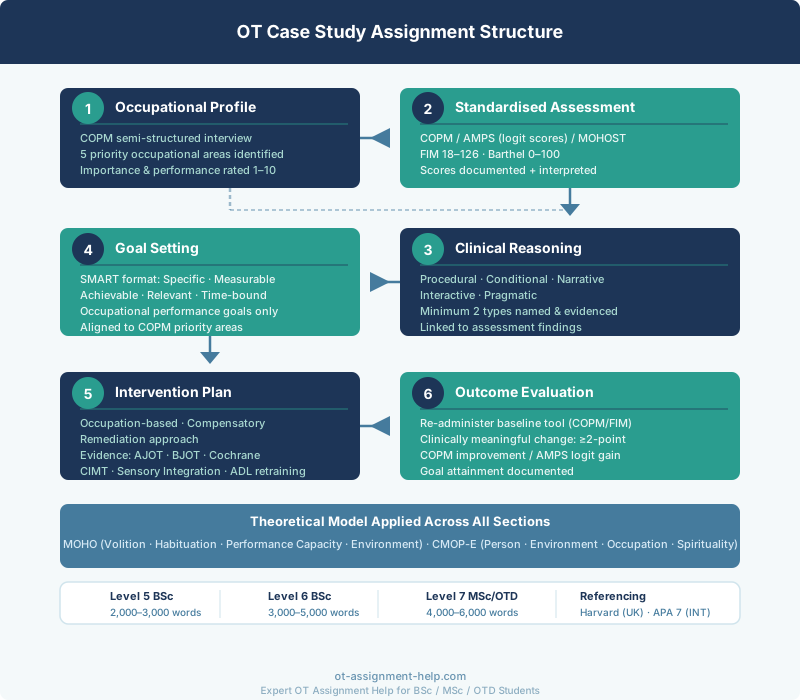
| Section | Key Requirements | Primary Assessment Focus |
|---|---|---|
| 1. Occupational Profile | Client background, occupational history, current performance issues (COPM interview), environmental context | Client-centredness, occupational focus |
| 2. Standardised Assessment | Minimum one tool (COPM, AMPS, MOHOST, FIM, Barthel) with full score documentation and interpretation | Assessment documentation accuracy |
| 3. Clinical Reasoning | Minimum two reasoning types identified by name and evidenced from case data | Clinical reasoning articulation (30–40% of marks) |
| 4. Goal Setting | Minimum two SMART occupational performance goals aligned to COPM priorities | Occupational focus, SMART format accuracy |
| 5. Intervention Plan | Evidence-based approaches named and cited; frequency and duration specified | Evidence integration, OT-specific approach selection |
| 6. Outcome Evaluation | Re-assessment plan using baseline tool; clinically meaningful change defined | Evidence-based outcome measurement |
Writing the Occupational Profile Section
The occupational profile centres on what the client does or cannot do in occupational terms, not a medical history. A student who fills the occupational profile section with diagnosis information and medication history without identifying occupational performance issues has written the wrong document. The COPM interview is the standard clinical tool for eliciting the occupational profile: the occupational therapist conducts a semi-structured interview identifying up to five priority occupational performance issues, which the client rates for importance on a 1–10 scale and current performance on a 1–10 scale. These scores are documented in table format within the assignment. Environmental context, home layout, social support, assistive technology in use, is documented alongside the occupational history (what roles and occupations the client engaged in before condition onset). A well-written occupational profile section runs 400–600 words within a 3,000-word case study and provides all the case evidence that the theoretical model section and clinical reasoning section will draw upon.
Documenting Standardised Assessments — COPM, AMPS, MOHOST, FIM, and Barthel
Assessment documentation requires more than naming the tool, every assessment score must be stated, interpreted, and connected to the intervention rationale. The specific documentation requirements for each tool are as follows:
COPM (Canadian Occupational Performance Measure): Document importance scores (1–10) and performance scores (1–10) for each identified occupational performance issue in a table. State the total performance score and total satisfaction score. Clinically meaningful change is defined as a 2-point or greater improvement on performance or satisfaction scores at discharge re-administration. The COPM identifies the occupational priorities that drive the intervention plan, priorities rated ≥8/10 for importance are the highest priority targets.
AMPS (Assessment of Motor and Process Skills): Document the motor ability logit score against the 2.0 logit independence cutoff, and the process ability logit score against the 1.0 logit cutoff. Name the two ADL tasks administered. State what scores indicate regarding IADL independence, a motor score of 1.8 logits indicates motor performance at the threshold of independent IADL function; a process score of 0.8 logits indicates process skill impairment affecting IADL independence. Note that AMPS administration requires an AMPS-certified assessor.
MOHOST (Model of Human Occupation Screening Tool): Document section-level ratings across all six sections (Motivation for Occupation, Pattern of Occupation, Communication and Interaction Skills, Process Skills, Motor Skills, Environment) using the F/A/I/R scale: F (Facilitates) = occupation enabled; A (Allows) = occupation possible without significant barriers; I (Inhibits) = occupation limited or disrupted; R (Restricts) = occupation severely compromised. Identify sections rated I or R as priority areas for intervention, these are the MOHO constructs requiring therapeutic attention.
FIM (Functional Independence Measure): Document the total score (range 18–126) and identify items rated 3 or below (maximal assistance) as primary intervention priorities. The 18 items include 13 motor subscale items (feeding, grooming, bathing, upper body dressing, lower body dressing, toileting, bladder management, bowel management, transfers bed/chair/wheelchair, toilet transfer, tub/shower transfer, locomotion walk/wheelchair, stairs) and five cognitive subscale items. Score 1 = total assistance required; score 7 = complete independence.
Barthel Index: Document the total score (0–100) and item-level scores. Items are scored 0, 5, 10, or 15 per item depending on the activity. Total score classification: 0–40 = dependent (primary care needs); 40–60 = moderately dependent; 61–90 = mildly dependent; 91–100 = independent. Item-level scores identify the specific ADL tasks requiring OT intervention focus.
Applying OT Theoretical Models to a Case Study — MOHO and CMOP-E
Applying a theoretical model to an OT case study assignment requires more than naming the model, it requires connecting every major construct to specific case evidence gathered from the occupational profile and assessment sections. The two most commonly required models in UK OT programme case studies are MOHO (Model of Human Occupation) and CMOP-E (Canadian Model of Occupational Performance and Engagement).
Mapping MOHO Constructs to Assessment Findings
MOHO application in a case study requires explicit construct-to-case-evidence mapping across all four constructs. Volition comprises personal causation (belief in one's own capacities and effectiveness), values (what the client finds meaningful and how they feel obligated to act), and interests (what the client finds attractive and enjoyable). In the assignment, volition is mapped to assessment and profile evidence: a COPM performance score of 3/10 for a task the client previously performed independently signals a personal causation deficit within volition; the client's stated occupational priorities in the COPM interview document their values; their identified interests from the occupational history document their attraction to specific occupations.
Habituation maps to the occupational history section: disrupted roles (worker, parent, carer) and disrupted habits (morning routine, medication management sequence) are documented as evidence of habituation disruption. The student must name the specific role or habit, "the client's worker role has been disrupted", not merely state that "daily routines are affected."
Performance capacity maps to standardised assessment scores: an AMPS motor logit score below 2.0 indicates motor performance capacity impairment in IADL; FIM and Barthel scores document the ADL performance capacity level. Critically, MOHO's performance capacity construct includes a subjective lived body component, how it feels to attempt occupation, which must be addressed in the occupational profile narrative alongside objective assessment scores.
Environment (physical: home layout; social: family support, social isolation; occupational: available activity opportunities) is mapped from the occupational profile environmental context documentation.
Using CMOP-E's Person-Environment-Occupation Framework in Case Studies
CMOP-E applies the person-environment-occupation model to OT case studies. The person domain comprises three components: affective (emotional response to the condition and its occupational consequences), cognitive (attention, memory, executive function, mapped to MoCA or MMSE scores if administered), and physical (sensorimotor and motor capacities, mapped to AMPS motor logit score or FIM motor subscale score). The environment domain includes physical environment (home accessibility, assistive technology access), social environment (family involvement, carer availability), cultural environment (occupational norms and cultural expectations), and institutional environment (healthcare service availability, care setting constraints). The occupation domain identifies disrupted self-care (COPM self-care priority items), productivity (work or homemaking roles), and leisure (identified interests disrupted by condition).
The spirituality construct within CMOP-E is frequently misunderstood by students, it is not religious belief. Spirituality in CMOP-E refers to the personal meaning the client draws from their occupations: what gives their daily activities significance and purpose. Addressing spirituality in the occupational profile using the client's own language about what matters most to them (captured in the COPM importance ratings and the occupational history narrative) is required for full CMOP-E application. Students who omit spirituality typically lose marks on theoretical model application criteria.
Clinical Reasoning in OT Case Study Assignments
Clinical reasoning in an occupational therapy case study assignment must be made explicit, identified by name, demonstrated with case evidence, and connected to the assessment findings and intervention decisions. The five clinical reasoning types recognised in OT academic literature are not equally prominent in every case study, but a minimum of two must be explicitly named and evidenced for distinction-level marks.
Procedural and Conditional Reasoning — Physical and Occupational Future Contexts
Procedural reasoning focuses on the client's physical or cognitive impairment, the "condition" being treated, and justifies intervention approaches that address underlying impairments. In an academic case study, procedural reasoning is demonstrated when the student explicitly identifies the reasoning type and connects it to assessment data: "Applying procedural reasoning, intervention planning addresses the client's reduced AMPS motor logit score of 1.8, indicating motor performance capacity impairment in IADL tasks. The compensatory kitchen adaptation approach is selected to enable safe IADL performance while motor capacity is addressed through task-specific training."
Conditional reasoning focuses on the client's future occupational life, who the person will become, what contexts they will return to, and justifies occupation-based, forward-looking goals. In academic writing: "Conditional reasoning acknowledges that the client's identified priority is to return to the worker role within three months. Intervention planning must account for the process skill demands of the work environment (AMPS process logit 0.8) alongside the physical environment modifications the client's employer can provide." The distinction between procedural and conditional reasoning is one of the most frequently tested markers of clinical reasoning sophistication in OT case study assignments.
Narrative, Interactive, and Pragmatic Reasoning in Case Study Writing
Narrative reasoning uses the client's occupational life story, documented in the occupational profile, to contextualise why certain occupations hold priority for intervention. In academic writing, narrative reasoning is explicitly named: "Narrative reasoning is employed to understand the significance of meal preparation for this client, whose occupational history identifies it as the primary means of family role expression and social engagement over the preceding 40 years." This sentence demonstrates that the student understands narrative reasoning as a reasoning type, not merely as background information.
Interactive reasoning focuses on the therapeutic relationship and how the occupational therapist understood the client's perspective through the COPM interview process. It is demonstrated in the occupational profile section when the student reflects on how occupational priorities were established collaboratively with the client rather than assigned by the therapist.
Pragmatic reasoning addresses practical service constraints: discharge timeline, available equipment, carer capacity, length of hospital stay, outpatient session frequency. In intervention planning: "Pragmatic reasoning acknowledges that the client's inpatient episode is 14 days; home assessment is scheduled for week three. Goals and frequency of intervention are calibrated to this timeline, two kitchen assessment sessions in hospital, followed by one supported home cooking session in week four." Pragmatic reasoning is a legitimate named reasoning type that must appear in the intervention plan section; students who omit it typically lose marks on clinical reasoning criteria.
SMART Goals and Evidence-Based Intervention Planning in OT Case Studies
SMART goals in occupational therapy case study assignments specify not just what the client will achieve, but the exact occupation, the measurable criterion, the achievable parameter within the client's current capacity, the relevance to the client's identified occupational priorities, and the time frame tied to the intervention plan. All five SMART elements must be demonstrably present in every goal stated in the case study.
Writing Occupational Performance Goals — Not Impairment Goals
An occupational performance goal targets the occupation the client wants or needs to perform, not the underlying body function or impairment. The distinction is critical for OT case study marking: "Mrs J will independently dress her upper body daily within 10 minutes by week four of intervention, achieving a COPM performance score of ≥6/10 for this task" is a correctly framed SMART occupational performance goal. "Mrs J will improve shoulder flexion to 90° within four weeks" is an impairment-level goal, it targets a body structure/function (shoulder ROM), not an occupation, and is appropriate to physiotherapy scope of practice, not OT. OT case studies that set only impairment-level goals typically receive low marks on theoretical model application criteria because they do not reflect occupational therapy's occupational focus. Every goal in an OT case study should connect directly to a priority occupation identified in the COPM assessment.
Evidence-Based Intervention Planning — What to Cite and How
Each named intervention approach in the intervention plan section requires citation with at least one peer-reviewed study demonstrating efficacy for the specific client population. The OT-specific evidence hierarchy is: systematic reviews and meta-analyses (Level 1, highest evidence), RCTs (Level 2), cohort studies (Level 3), case-control studies (Level 4), case series and case reports (Level 5), expert opinion (Level 6). Quality appraisal of cited studies using the CASP checklist improves the academic rigour of the evidence rationale.
OT-specific evidence sources for intervention plan citations include: OTseeker (pre-appraised OT RCTs and systematic reviews, free access), AJOT (American Journal of Occupational Therapy), BJOT (British Journal of Occupational Therapy), the Cochrane Occupational Therapy Field, and CINAHL searches filtered by study type. Example evidence bases by intervention approach: constraint-induced movement therapy (CIMT) for upper limb stroke rehabilitation, Level 1A evidence from Cochrane systematic reviews (2015 and subsequent updates); sensory integration therapy for ASD, Level 2 evidence (ongoing debate in AJOT about fidelity criteria); task-specific ADL retraining post-stroke, Level 1A evidence from multiple RCTs and systematic reviews; cognitive rehabilitation post-TBI, Level 1B evidence (stronger for attention training than global cognitive rehabilitation).
Which Client Population Does Your OT Case Study Focus On?
While the structure of an OT case study assignment is consistent across populations, the specific assessment tools, theoretical model emphasis, and intervention evidence differ significantly by client group. A stroke rehabilitation case study uses FIM for ADL function baseline and ARAT for upper limb measurement, with CIMT as the Level 1A evidence-based approach. A paediatric ASD case study uses Sensory Profile 2 and Beery VMI as primary assessment tools, with sensory integration and neurodevelopmental interventions. A mental health case study emphasises MOHO's volition constructs (personal causation deficits in psychosis, values disruption in depression) and uses MOHOST as the primary assessment tool. The supplementary sections below provide population-specific guidance for the most common OT case study client groups.
Adult Physical Rehabilitation OT Case Studies — Stroke, Upper Limb, and Neurological
Physical rehabilitation OT case studies cover a range of conditions: stroke (CVA), upper limb injury including hand therapy, spinal cord injury (SCI), traumatic brain injury (TBI), and other neurological conditions. Primary assessment tools in physical rehabilitation contexts include FIM (overall ADL function, 18-item, total 18–126), Barthel Index (0–100 for ADL independence), AMPS for IADL motor and process ability (logit scores against 2.0 and 1.0 cutoffs), and COPM for client-identified occupational priorities. ARAT (Action Research Arm Test) documents upper limb function specifically in stroke rehabilitation cases. Intervention approaches with strong evidence bases in physical rehabilitation include CIMT for post-stroke upper limb recovery (Level 1A, Cochrane systematic review evidence), occupation-based ADL retraining using task-specific practice (Level 1A), environmental modification and assistive technology, and sensorimotor approaches for neurological populations. For dedicated neurological and physical rehabilitation case study support, see our stroke occupational therapy case study assignment help page, and our broader neurological occupational therapy assignment help page covering TBI, MS, Parkinson's, and SCI.
Mental Health OT Case Studies — MOHO, Recovery Model, and Occupation-Based Practice
Mental health OT case studies use the same structural template as physical rehabilitation cases but emphasise different model constructs and assessment tools. MOHO is the dominant theoretical model in mental health OT, with volition constructs particularly prominent: personal causation deficits are characteristic of psychosis (reduced belief in ability to engage in meaningful occupation); values and interests disruption is characteristic of depression (loss of engagement with previously meaningful activities); habituation disruption (disrupted roles and daily routine patterns) is relevant across most mental health presentations. MOHOST is the primary MOHO-aligned assessment tool in mental health settings, covering all six sections, Motivation for Occupation directly reflecting MOHO's volition construct. The Recovery Model (Repper and Perkins, hope, opportunity, control) provides a complementary framework for goal-setting. Community mental health case studies differ from acute inpatient cases in time frame, goal scope, and environmental context. For dedicated mental health case study support, see our mental health occupational therapy assignment help page.
Paediatric OT Case Studies — Developmental, Sensory, and School-Based
Paediatric OT case studies require different assessment tools from adult populations. Sensory Profile 2 (caregiver questionnaire version: 86 items, 8 sensory processing patterns, seeking, avoiding, sensitivity, registration, each scored for sensory processing patterns) assesses sensory processing in children. Beery VMI (Beery-Buktenica Developmental Test of Visual-Motor Integration) provides visual-motor integration standard scores and percentiles, critical for handwriting and fine motor case studies. BOT-2 (Bruininks-Oseretsky Test of Motor Proficiency, 2nd edition) provides motor proficiency scores across fine motor, upper limb coordination, balance, running speed, and strength domains. Conditions covered in paediatric case studies include ASD, developmental coordination disorder (DCD), cerebral palsy (CP), ADHD, and school-based participation difficulties. Intervention approaches include sensory integration (Ayres Sensory Integration, Level 2 evidence, contested in current literature), neurodevelopmental treatment, task-specific training for handwriting, and school-based OT accommodations.
Stroke Case Studies, OTPF Framework, and CMOP-E Model
For specialist neurological OT case study support covering Barthel Index interpretation, CIMT eligibility criteria, neglect assessment selection, and stroke phase-appropriate goal-setting, see our dedicated stroke occupational therapy case study assignment help page. For US OT and OTA students structuring case studies using the AOTA framework, our guide to structuring OT case studies using the OTPF framework covers the occupational profile sequence, domain components, and seven intervention types. For assignments requiring CMOP-E rather than MOHO, see our full guidance on applying the CMOP-E model in OT case study assignments, including COPM scoring, spirituality construct application, and CPPF eight action point documentation.
Dementia, Autism, and OT Assessment Tools in Case Study Assignments
For case studies involving older adults with cognitive decline, see our dementia OT case study help page covering Kitwood's personhood model, DCM methodology, and cognitive assessment tool selection. For paediatric case studies involving sensory processing and developmental concerns, see our autism occupational therapy case study help page. For guidance on selecting, documenting, and psychometrically evaluating the assessment tools used in any OT case study assignment, see our resource on OT assessment tools in case study assignments, which covers reliability, validity, and clinical utility across COPM, AMPS, FIM, Barthel, and MOHOST.
Frequently Asked Questions About OT Case Study Assignments
How many standardised assessments do I need in an OT case study assignment?
Most OT programme marking rubrics require at least one standardised assessment fully documented with score interpretation. Higher marks (distinction or first class) typically require two or more assessments, with the selection justified by the client's presentation. For example, a stroke case study might use FIM (overall ADL function, total score out of 126) and COPM (occupational priorities from the client's perspective, performance and satisfaction scores 1–10). The key requirement is not the number of tools but the quality of documentation, scores must be stated, interpreted, and connected to the intervention rationale. Check the assignment brief for specific requirements before selecting tools.
Can I use a fictional client vignette or does the OT case study need to be a real client?
Most OT assignment briefs at BSc Level 5 and Level 6 accept either a fictional vignette or a real anonymised client. If using a real client, anonymisation is mandatory (NHS and university ethical guidelines require removal of all identifying information, name, date of birth, ward, location). If using a fictional vignette, the clinical presentation must be realistic and internally consistent, invented impairments must align with the named diagnosis and assessment scores must fall within realistic ranges for that condition. A fictional stroke case study with a FIM score of 118/126 on admission is clinically implausible. Dissertations at Level 7 involving real client data require formal university ethics committee approval.
What is the difference between an occupational performance goal and an impairment goal in OT?
An occupational performance goal targets the occupation the client wants to perform: "will dress upper body independently within 10 minutes by week four", correct OT format. An impairment goal targets underlying body functions: "will improve shoulder flexion to 90° within four weeks", physiotherapy scope, not OT. OT marking rubrics typically deduct marks when students set only impairment goals because they do not reflect occupational therapy's occupational focus. SMART occupational performance goals must connect to the client's top-priority COPM items and specify both the occupation and the measurable performance criterion.
How do I link MOHO to my OT case study assessment findings?
MOHO constructs must be explicitly connected to specific case data, named and evidenced. Volition (personal causation) links to evidence that the client doubts their ability to perform occupations, a COPM performance score of 3/10 for a previously mastered task is direct evidence of personal causation deficit. Habituation (roles/habits) links to the occupational history, a disrupted morning routine documents habit breakdown; loss of the worker role documents role disruption. Performance capacity links to standardised assessment scores, AMPS logit scores, FIM item scores. Environment links to home assessment findings or observation of the care setting. Each construct must be named and connected to a specific piece of case evidence; writing "MOHO was applied" without this mapping scores minimal marks on model application criteria.
Do OT case study assignments need to follow a specific referencing style?
Yes, most UK OT programmes require Harvard referencing for case study assignments. Australian and North American OT programmes typically use APA 7th edition. The assignment brief will specify the required format. In-text citations are required for every evidence-based claim in the intervention plan section, each named intervention approach must be supported by at least one peer-reviewed citation from OT-specific sources (AJOT, BJOT, OTseeker, CINAHL). The reference list must include DOIs or accessed dates for online sources. Referencing errors are a common mark-loss area that the service corrects in every case study produced.
Get Expert OT Case Study Assignment Help
Assessment documentation, MOHO and CMOP-E application, clinical reasoning, SMART goals, and evidence-based intervention planning, all covered by OT-qualified specialists.
View All OT Assignment Services