Occupational Therapy Reflective Essay Help — Practice Placement Journals and HCPC Standards

An occupational therapy reflective essay requires the application of a structured reflective model, Gibbs Reflective Cycle, Schon's Reflection-in-Action and Reflection-on-Action, or Johns Model of Structured Reflection, combined with explicit reference to HCPC Standards of Proficiency by code, critical self-analysis of a specific practice scenario, and demonstration of professional learning. This service provides expert reflective writing help for BSc and MSc occupational therapy students completing practice placement journals and standalone reflective essays, at Level 4 through to Level 7 and OTD programmes.
What Is Reflective Practice in Occupational Therapy?
Reflective practice in occupational therapy requires more than describing what happened during a placement interaction. HCPC requires registered occupational therapists to engage in reflective practice under Standards of Proficiency 14.1, which specifies that the practitioner must "draw on appropriate knowledge and skills to inform practice, including through reflective practice." This standard is not a recommendation, it is a registration requirement. RCOT's Code of Ethics reinforces this obligation through its professional development provisions, which identify ongoing reflection as an ethical duty of OT practitioners. OT students must demonstrate reflective practice capacity in academic assignments specifically because this capacity is assessed as part of the qualification pathway toward HCPC registration.
Reflective practice in OT carries a distinct academic assessment purpose: it evaluates whether the student can critically analyse their own practice, identify gaps in knowledge, and commit to professional development actions. A reflective essay differs from a general academic essay in a fundamental way, it focuses on a specific practice experience rather than a general topic, and it evaluates the student's ability to use theory to make sense of lived clinical experience. This is not a description of what the student knows about OT theory in the abstract; it is an examination of how theory illuminates a specific real interaction.
Both academic and professional obligations require reflective practice to be evidence-informed. The student who reflects on a client interaction must connect what happened to the knowledge base, OT models, HCPC standards, and published evidence, not merely to personal feeling. The assignment demands critical engagement, not therapeutic disclosure.
Why Reflective Essays Are Difficult for OT Students
OT students default to descriptive writing when first encountering reflective assignments, recounting events without analysis. Marker feedback most commonly references "insufficient analysis" and "lack of critical self-reflection" as the primary reasons for mark loss. The sections where marks are most consistently lost are the Gibbs Analysis stage (stage 4) and the Johns Influencing Factors cue (cue 3), precisely the sections that require theoretical knowledge and HCPC standard application. These are the academically demanding sections that students skip in favour of extending their Description and Feelings content, which is easier to write but worth significantly fewer marks.
The requirement to reference HCPC standard codes in academic writing is unfamiliar to students without prior regulatory knowledge. Writing "(HCPC, 2013: Standard 9.1)" in a reflective essay feels clinical and technical against the personal voice that the reflective format encourages, yet academic markers require exactly this combination. Writing honestly about personal feelings and professional identity also challenges the academic writing conventions students have practised in literature-based essays. These tensions, personal and professional, descriptive and critical, subjective and evidence-referenced, make OT reflective assignments genuinely difficult to execute at distinction level without structured support.
Reflective Models for OT Assignments — Gibbs, Schon, and Johns
Occupational therapy reflective assignments require the application of a structured reflective model to organise the student's engagement with practice experience. The three models this service applies, Gibbs Reflective Cycle, Schon's Reflection-in-Action and Reflection-on-Action, and Johns Model of Structured Reflection, each structures the reflective essay differently, produces different analytical emphases, and suits different OT assignment contexts.
Model selection requires attention to assignment level and scenario type. Gibbs suits students new to reflective writing or writing about straightforward practice scenarios, its six-stage structure provides explicit scaffolding. Schon suits documenting real-time clinical decision-making during complex interventions, and is most appropriate at Level 5–7 when students have sufficient clinical experience to identify genuine in-action adjustments. Johns suits ethically complex scenarios involving professional dilemmas or conflicting values, its five cue structure is designed to surface the underlying knowledge and assumptions that shaped the decision. Where placement journals do not specify a model, Gibbs is the safest default for BSc students; Johns is preferred for MSc and OTD assignments.
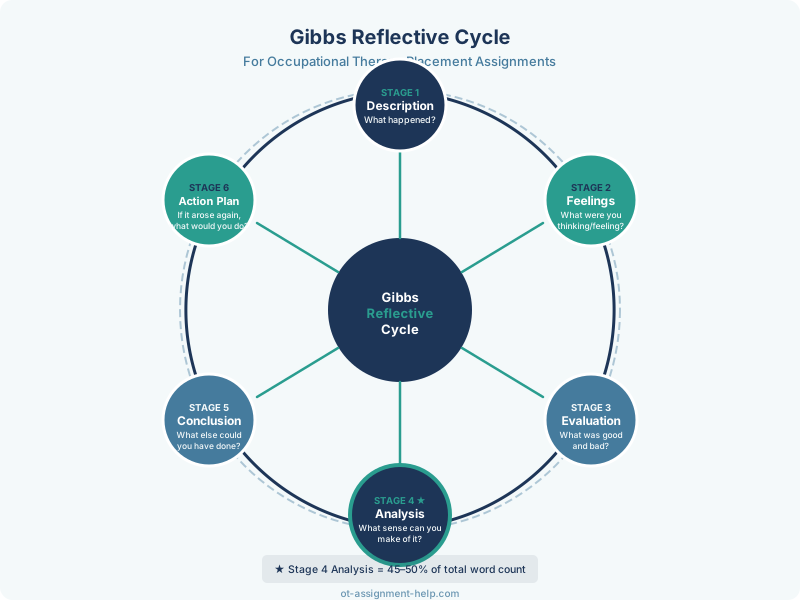
Gibbs Reflective Cycle — Six Stages for OT Placement Reflection
Gibbs Reflective Cycle structures the reflective essay across six stages, each corresponding to a paragraph section with a stage-identifying topic sentence. Stage 1 (Description) provides a factual account of the specific practice scenario: who was present, what happened, what was the student's role. Stage 2 (Feelings) provides an honest account of the emotional response during and after the event. Stage 3 (Evaluation) addresses what went well and what did not go well in the interaction or intervention. Stage 4 (Analysis) is the academic core of the essay: which theoretical framework or OT model explains what occurred, which HCPC standard is relevant to this scenario, and what research evidence supports a different approach, citations must appear in this stage. Stage 5 (Conclusion) addresses what could have been done differently. Stage 6 (Action Plan) commits to a specific professional development action for future similar scenarios.
The word count allocation across Gibbs stages is a critical marking principle. Description and Feelings combined should occupy no more than 15% of the total word count. Evaluation warrants approximately 15%. Analysis should receive 45–50% of the total word count, this is where HCPC standard codes, OT theory citations, and evidence-based arguments belong. Conclusion and Action Plan together warrant 20–25%. A 2,000-word reflective essay at distinction level allocates 900–1,000 words to the Analysis stage.
Schon's Reflection-in-Action and Reflection-on-Action for OT Practice
Schon's model addresses two distinct temporal modes of reflection that are directly applicable to clinical OT practice. Reflection-in-Action describes the cognitive process occurring during the clinical encounter itself: recognising an unexpected outcome, adjusting approach in real time, testing a new hypothesis within the session. In OT academic writing, Reflection-in-Action is documented retrospectively as first-person narrative: "At the moment the client refused the dressing task, I recognised that my initial assumption about motivation was incorrect, I adjusted my approach by offering the client a choice of starting point."
Reflection-on-Action is the retrospective analysis conducted after the session: identifying which knowledge framed the initial approach, why the in-action adjustment was made, and what theoretical framework explains the decision. Schon is most applicable at Level 5–7 when students have sufficient clinical experience to document genuine in-action adjustments and name the theoretical knowledge that should have informed their initial approach.
Johns Model of Structured Reflection — Five Cues for Ethically Complex OT Scenarios
Johns Model of Structured Reflection structures reflection around five cue categories. Cue 1 (Description) describes the experience. Cue 2 (Reflection) addresses what the student was trying to achieve and the consequences. Cue 3 (Influencing Factors) asks what internal factors influenced the student's decision, prior knowledge, values, assumptions, and what knowledge was available that should have informed them. Cue 4 (Could I Have Dealt Better) examines what other choices existed. Cue 5 (Learning) addresses how this experience changes the student's ways of knowing.
Cue 3, Influencing Factors, is the most academically demanding. This is where HCPC standard references belong, the student must identify the specific regulatory or theoretical knowledge that should have informed the decision. Johns is particularly appropriate for scenarios involving professional dilemmas, ethical decisions, or complex MDT interactions.
HCPC Standards of Proficiency in OT Reflective Writing
HCPC Standards of Proficiency set the professional competency baseline that OT reflective essays must reference. For reflective writing assignments, the most relevant standards are those that directly address professional decision-making, scope of practice, and learning from experience.
Standard 1.1 — best interests of service users, applies when reflecting on balancing client autonomy with safety. Standard 2.1 — safe and effective practice within scope, applies when reflecting on recognising and responding to the limits of personal competence. Standard 4.1 — assess, plan and implement interventions, applies to clinical reasoning during assessment. Standard 9.1 — working with others, applies to MDT interactions and collaborative working. Standard 10.1 — accurate records, applies when reflecting on documentation practices. Standard 14.1 — the foundational standard for all reflective writing, requires drawing on appropriate knowledge and skills through reflective practice. Standard 14.2 — value learning, reflection and professional development, is cited in the Action Plan stage of Gibbs or the Learning cue of Johns.
Matching HCPC Standards to Common Placement Scenarios
| Placement Scenario | Primary HCPC Standard | Secondary HCPC Standard | Example Citation Sentence |
|---|---|---|---|
| First client contact | 1.1 — best interests | 4.1 — assessment and planning | "Standard 4.1 applies because the initial contact required assessment planning under significant time constraint." |
| MDT meeting participation | 9.1 — working with others | 2.1 — scope of practice | "Standard 9.1 applies because the MDT meeting required me to communicate COPM findings in accessible language to the medical team." |
| Ethical dilemma | 1.1 — best interests | 3.1 — maintain fitness to practise | "Standard 1.1 and the RCOT Code of Ethics principles of beneficence and non-maleficence both frame this dilemma." |
| Documentation task | 10.1 — accurate records | 2.1 — scope of practice | "Standard 10.1 requires that documentation accurately reflects the client's occupational performance status." |
| Recognising limits of competence | 2.1 — safe and effective practice | 14.1 — knowledge and reflection | "Recognising the limits of my competence in splinting reflects Standard 2.1 and generated the learning identified in Standard 14.1." |
Tell Us Your Placement Scenario — We'll Structure It
HCPC standard code mapping, reflective model selection, and critical analysis, delivered by OT-qualified professionals.
Get a QuoteLevels of Reflection — Descriptive, Analytical, and Critical Reflective Writing
Level 1 (Descriptive) recounts events without analysis, theory, or learning identified. No marks are awarded for analytical criteria in Level 1 writing.
Level 2 (Analytical) connects the experience to theory or evidence and identifies what worked and why. An example: "The collaborative approach to priority setting through the COPM interview reflects the client-centred principle articulated in CMOP-E's focus on occupational engagement."
Level 3 (Critical/Transformative) demonstrates critical self-analysis by challenging underlying assumptions. An example: "On reflection, I recognise that my initial assumption that the client would prioritise self-care over leisure reflects a medically-influenced view of rehabilitation outcomes. The client's stated priority, resuming social participation, challenges this assumption and aligns with RCOT's person-centred practice standard and the concept of occupational justice." Level 3 reflection is required for distinction marks (70%+) at Level 6 and Level 7.
Structure of an OT Practice Placement Journal
A practice placement journal documents professional development across a placement block. Each journal entry documents a specific practice scenario using: a title identifying the placement date, setting, and scenario type; a scenario description of no more than 100–150 words; a reflective analysis of 300–600 words; at least one HCPC Standard of Proficiency referenced with code and descriptor; at least one OT model or evidence citation; and a specific, measurable, forward-facing professional development action.
The portfolio arc requires that entries show development over time. Entry 1 should establish a baseline of professional self-awareness. Entries 5–6 should demonstrate development from earlier entries with explicit cross-referencing. The final entry should synthesise learning across the full placement block.
Is your reflective assignment for a specific practice placement type, acute hospital, community, mental health, or paediatric, or is it a standalone academic module based on a hypothetical or historical scenario?
Acute Hospital OT Placement Reflective Journal Help
Acute hospital OT placements generate a distinctive reflective writing challenge: the pace of clinical work, rapid ADL assessment on a ward with high patient turnover, FIM scoring, MDT ward rounds, and discharge planning, produces multiple scenario options for journal entries but limits the depth of individual therapeutic relationships. HCPC Standard 9.1 (MDT working), Standard 10.1 (record-keeping in acute documentation systems), and Standard 2.1 (scope of practice) are the standards most commonly activated in acute placement scenarios. For further support specific to practice placement documentation, see our occupational therapy practice placement assignment help page.
Community OT, Mental Health, and Paediatric Placement Reflective Help
Community OT placements involve home visit scenarios, carer communication, equipment prescription, and community independence assessments, generating reflective material around client autonomy versus safety (Standard 1.1). Mental health OT placements activate MOHO's volition construct most directly, personal causation in clients experiencing psychosis or depression produces high-quality Level 3 reflective writing when connected to MOHO theory and HCPC Standards 1.1 and 3.1.
Linking OT Theory to Reflective Practice
Theory integration in OT reflective essays requires connecting a named OT model to the specific scenario. MOHO's personal causation construct explains a client who refused a task from a motivational rather than a physical explanation. CMOP-E's environment domain explains a home visit in which access barriers were the primary occupational performance constraint. Citing a BJOT or AJOT paper in the Analysis stage of Gibbs establishes that the student connects the scenario to the published evidence base. For MOHO-specific assignment support, see our MOHO assignment help page. For accurate professional standards referencing, see our dedicated guides to HCPC Standards of Proficiency referenced in OT reflective essays and the RCOT Code of Ethics in occupational therapy reflections. For students on mental health OT placements, reflective writing that draws on CHIME, MOHOST, and occupational formulation theory is covered in our mental health OT reflective practice assignments resource. For students completing paediatric OT placement reflective assignments, including reflection on sensory integration sessions, school-based OT, and developmental case reasoning, see the dedicated paediatric OT page.
Ready to Get Expert Help With Your OT Reflective Essay?
HCPC standard codes, reflective model stages, critical analysis levels, all delivered with clinical precision. Available for BSc Level 4 through to MSc and OTD.
Get Expert Help NowFrequently Asked Questions — OT Reflective Essay and Practice Placement Journal
Which reflective model should I use for my OT placement journal — Gibbs, Schon, or Johns?
Check your assignment brief first, most programmes specify the required model. If unspecified: use Gibbs if you are at Level 4 or 5 and new to reflective writing, as its six-stage structure provides clear scaffolding for any placement scenario. Use Schon if you want to capture real-time clinical decision-making during a complex intervention, this model suits Level 5–6 students who can name the knowledge that informed an in-action adjustment. Use Johns for ethically complex scenarios involving professional dilemmas, client autonomy challenges, or conflicting values.
How many HCPC standards do I need to reference in a reflective essay?
Most OT programme marking rubrics require a minimum of one HCPC Standard of Proficiency per reflective entry. For distinction-level work, two or more standards should be referenced with explicit connection to the scenario. The most commonly applicable standards are 1.1 (best interests), 2.1 (scope of practice), 9.1 (working with others), 10.1 (record-keeping), and 14.1 (reflective practice). Each standard must be cited accurately, "(HCPC, 2013: Standard 1.1)", and the specific relevance to the scenario must be explained.
What is the difference between a reflective essay and a practice placement journal in OT?
A reflective essay is typically a standalone academic assignment reflecting on one significant practice experience in depth, usually 1,500–3,000 words. A practice placement journal is a portfolio of multiple shorter reflective entries, typically 5–10 entries of 500–1,000 words each, written throughout a placement block, demonstrating professional development over time. Both require reflective model application, HCPC standards, and theory linkage, but at different depths per entry.
Can I reflect on a challenging or difficult placement experience in my OT reflective essay?
Yes, challenging experiences often produce the strongest reflective essays. Ethical dilemmas, difficult client interactions, moments of uncertainty, or situations where you recognised the limits of your competence are all appropriate for academic reflection. The key academic requirement is that the analysis connects the challenge to specific HCPC standards and OT theory, not only to personal feelings.
Does my OT reflective essay need to include citations and a reference list?
Yes, citations are required in the Analysis stage (Gibbs stage 4) and the Influencing Factors sections of other models. Citations should reference: HCPC Standards of Proficiency (HCPC, 2013); RCOT professional standards; OT theoretical model sources (Kielhofner, 2008 for MOHO; Townsend and Polatajko, 2013 for CMOP-E); and peer-reviewed evidence from AJOT, BJOT, and OTseeker. A Harvard reference list is required.