Occupational Therapy Practice Placement Assignment Help — Portfolio, Reflective Journals and HCPC Standards

Occupational therapy practice placements require students to produce specific academic documentation, including reflective journals using the PARO framework at a minimum of two entries per week, a placement portfolio assessed against the RCOT placement competency framework's four domains, and objective evidence against HCPC Standards of Proficiency, while simultaneously performing clinically. This service provides expert OT practice placement assignment help for BSc Years 1–3 and MSc students completing fieldwork across all placement settings.
Academic Requirements of OT Practice Placement — What You Must Produce
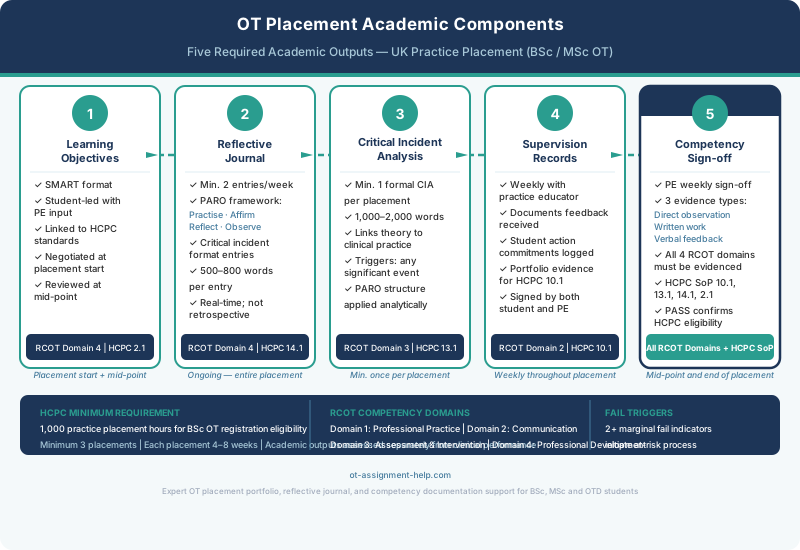
Occupational therapy practice placements require students to produce four primary academic output types. The first is the reflective journal, a structured series of written entries documenting clinical learning and professional development throughout the placement block. The second is the placement portfolio, a curated collection of evidence demonstrating competency against RCOT domains and HCPC standards. The third is competency evidence documentation, the specific records that provide objective proof of skill demonstration to the clinical educator. The fourth is the critical incident analysis, a formal structured reflection on a significant clinical event that connects theory to practice.
Students frequently confuse the portfolio with the reflective journal, they are separate components with separate assessment criteria. The portfolio is the overarching document that contains the evidence; the reflective journal is one component within it. Both must confirm a pass for the placement to be successfully completed. The consequences of placement academic failure are significant: failure to demonstrate HCPC competency can affect fitness to practise eligibility and HCPC registration.
OT Placement Types — Duration and Academic Demands by Setting
Acute hospital OT placements run 6–8 weeks and focus on physical rehabilitation, MDT working, discharge planning, and rapid assessment. The academic challenge in acute placements is the pace, high patient turnover requires frequent reflective journal entries about complex clinical decisions made under time pressure.
Community OT placements run 6–8 weeks and focus on home assessment, equipment prescription, and community independence support. Mental health OT placements run 6–8 weeks, academic challenges centre on professional boundaries and therapeutic relationship reflection. MOHO's volition construct is particularly relevant here, with personal causation in clients experiencing psychosis or depression as a recurring reflective theme.
Paediatric OT placements run 6–8 weeks and focus on developmental milestones, family-centred practice, and school-based OT. Specialist and elective placements run 4–6 weeks, academic challenges involve applying standard OT models to non-standard settings.
| Placement Type | Duration | Primary Clinical Focus | Key Academic Challenge | Primary RCOT Domain |
|---|---|---|---|---|
| Acute Hospital OT | 6–8 weeks | Physical rehabilitation, MDT, discharge planning | High turnover requires frequent reflective entries on complex rapid decisions | Domain 3 — Assessment and Intervention |
| Community OT | 6–8 weeks | Home assessment, equipment, community independence | Longitudinal case documentation across multiple visits | Domain 3 — Assessment and Intervention |
| Mental Health OT | 6–8 weeks | Recovery model, occupation in mental health, risk | Professional boundaries, therapeutic relationship reflection | Domain 1 — Professional Practice |
| Paediatric OT | 6–8 weeks | Developmental milestones, family-centred practice | Parental consent, child-centred goal writing | Domain 2 — Communication |
| Specialist / Elective | 4–6 weeks | Variable (hand therapy, neurological rehab, vocational) | Applying OT models to non-standard settings | Domain 4 — Professional Development |
RCOT Placement Competency Framework — Four Domains Assessed
The RCOT placement competency framework assesses students across four domains that structure both portfolio evidence requirements and clinical educator sign-off criteria.
Domain 1 — Professional Practice covers professional conduct, ethics, duty of care, and professional identity. Evidence includes professional behaviour observations from the clinical educator and reflective journal entries addressing ethical decision-making. Domain 2 — Communication covers verbal and non-verbal communication with clients, carers, and MDT members, as well as written documentation standards. Domain 3 — Assessment and Intervention covers occupational profile construction, standardised assessment selection, goal setting, intervention planning, and outcome evaluation. This domain is the most academically demanding to evidence fully. Domain 4 — Professional Development covers self-directed learning, use of supervision, reflective practice, and response to feedback. The reflective journal is the primary evidence source for Domain 4.
The most common portfolio construction error is collecting evidence without cross-referencing it explicitly to the domain it demonstrates. Clinical educators do not extrapolate, the student must signpost which domain each piece of evidence addresses.
Domain 3 — Assessment and Intervention: The Most Academically Demanding Domain
Domain 3 requires students to demonstrate competency across the full clinical reasoning sequence: occupational profile construction using COPM or an equivalent client-centred tool; standardised assessment selection with documented rationale; clinical reasoning documentation connecting assessment findings to problem identification; SMART goal formulation linked to assessment scores; evidence-based intervention selection with literature support naming the evidence level; and outcome evaluation using pre- and post-assessment scores with clinically meaningful change thresholds.
HCPC Standards of Proficiency — What Is Assessed on OT Placement
The HCPC Standards of Proficiency specifies fifteen proficiency domains for occupational therapists. During placement, students are assessed against HCPC standards to confirm they are developing toward registration-level competency.
Standard 10.1 specifies the practitioner must "be able to maintain professional relationships with service users and carers", evidenced through supervision records where boundary-related decisions were discussed. Standard 13.1 specifies the practitioner must "be able to assess the needs of service users", the portfolio must contain direct observation records of standardised assessment administration and written assessment reports. Standard 14.1 specifies the practitioner must "be able to plan and deliver effective treatment and/or interventions", requires documented intervention planning with evidence-referenced rationale. Standard 2.1 specifies the practitioner must "understand the limits of their practice and when to refer", the standard most commonly cited in at-risk processes.
The distinction between HCPC standards and RCOT framework is important: HCPC standards are regulatory threshold requirements for registration; the RCOT placement competency framework represents professional development standards. Students failing to meet HCPC standards risk fitness to practise consequences.
| Standard Code | Description | Evidence Type Required | Portfolio Location |
|---|---|---|---|
| HCPC 10.1 | Maintain professional relationships with service users and carers | Direct observation + supervision record of boundary-related discussion | Domain 1 (Professional Practice) and Domain 2 (Communication) sections |
| HCPC 13.1 | Assess the needs of service users | Direct observation of standardised assessment + written assessment report | Domain 3 (Assessment and Intervention) section |
| HCPC 14.1 | Plan and deliver effective treatment and/or interventions | Written intervention plan with evidence-referenced rationale + clinical educator sign-off | Domain 3 (Assessment and Intervention) section |
| HCPC 2.1 | Understand limits of practice and when to refer | Supervision record documenting professional discussion about scope + clinical educator verbal feedback record | Domain 4 (Professional Development) section |
OT Placement Portfolio — Structure, Components and Assessment Criteria
The OT placement portfolio demonstrates competency through five primary components. Component 1 — Student Self-Assessment against RCOT standards, completed at the start, mid-point, and end of placement. The self-assessment must be honest and evidence-referenced. Component 2 — Clinical educator weekly sign-off — provides progressive sign-off over the placement duration. Early sign-offs establish a baseline; later sign-offs confirm competency development. Missing sign-offs in any week undermine the evidence of developmental progress.
Component 3 — Objective evidence comprises three types: direct observation records (the clinical educator observed the student performing a specific skill), written work samples (assessment reports, intervention plans, and case notes), and verbal feedback records (documented summaries of supervision session content). All three types are required across each RCOT domain. Component 4 — Critical incident analysis requires at least one formal critical incident analysis per placement using a structured reflective framework. Component 5 — Learning agreement negotiated with the clinical educator at the start of placement, reviewed at mid-point, and finalised at end.
Reflective Journal Requirements for OT Placement — PARO Framework
The PARO framework, Practise, Affirm, Reflect, Observe, is the structured reflective format used by the majority of UK OT placement programmes. PARO is placement-specific and distinct from the Gibbs Reflective Cycle and Schon's models used in standalone academic reflective essays.
Practise asks: what did I do? A concise description of the clinical action. Affirm asks: what went well and why? The student must identify what specifically worked and why, referencing clinical knowledge or OT principles. Reflect asks: what would I do differently and why? This is the analytical core of the PARO entry, genuine critical appraisal with identification of an alternative approach and rationale. Observe asks: what have I learned and how will I apply it? A specific, actionable learning point that connects to future practice.
Common errors include: descriptive journalling without analysis; retrospective completion, writing multiple entries at the end of placement from memory, producing uniformly vague entries; and vague generalisation, "I learned a lot from this experience" earns no marks on any analytical criterion.
Pass/Fail Criteria — What Triggers a Placement Failure or At-Risk Process
Marginal fail indicators include: consistent difficulty maintaining professional boundaries; repeated inability to identify assessment priorities independently; lack of self-direction in learning; inadequate written documentation quality despite specific feedback; and failure to demonstrate progression across placement weeks.
The at-risk process is formally initiated by the clinical educator when two or more marginal fail indicators are observed consistently. A written action plan is produced with specific weekly targets, measurable outcomes, and a timeline. The distinction between academic at-risk, triggered by assignment submission failure, and clinical at-risk, triggered by competency concerns during practice, is critical: both pathways can result in placement failure.
Which aspect of your OT placement assignment is presenting the most significant challenge, the portfolio structure and RCOT cross-referencing, the reflective journal analytical depth using PARO, or the competency evidence documentation for specific HCPC standards? Each component requires a different type of academic support.
Placement Type Assignment Challenges — Acute, Mental Health and Paediatric OT
Acute hospital OT placement generates the highest volume of reflective journal material but also the greatest challenge in selecting and structuring entries. MDT documentation standards in NHS acute settings are rigorous and clinical, and students must bridge between clinical documentation conventions and the analytical academic writing required by their PARO journal.
Community OT placement requires longitudinal case documentation across multiple visits, the academic challenge is tracking and recording how the OT reasoning evolved across sessions. For neurological placement assignments that connect to stroke OT case study content, see our neurological OT placement assignments page. For structured reflective model support beyond PARO, see our OT reflective journal models page. For comprehensive guidance on the standards referenced in placement portfolios, see our dedicated pages on HCPC Standards of Proficiency in OT placement assessment and RCOT professional standards in OT placement portfolio work. For placement assignments requiring evidence-based practice justification, see our guide to evidence-based practice requirements in OT placement assignments. For students on paediatric or CAMHS placements, including reflective writing on sensory integration sessions, school-based OT, and neurodevelopmental reasoning, see our autism OT placement assignments resource and our broader paediatric OT assignment help page. For guidance on documenting standardised assessments correctly in placement portfolios, including how to record COPM, AMPS, and Barthel Index findings as academic evidence, see our standardised assessment on OT placement guide.
Clinical Educator Relationships and Supervision — What Academic Documentation Shows
The supervision record is an academic document, not simply a clinical record. It documents what was discussed in supervision, what feedback was received, and what specific actions the student commits to taking in response.
A supervision record that reads "discussed caseload and received feedback on documentation" earns no marks as portfolio evidence because it names neither the specific content of the feedback nor the specific action the student committed to. A supervision record that reads "clinical educator feedback identified that my COPM administration was client-led in structure but did not allow sufficient time for the client to explore the productivity domain fully, I committed to allocating a minimum of 10 minutes to each COPM domain in future administrations, which I will evidence in my next direct observation record" provides specific, evidence-referenced documentation. For further reflective practice assignment support, see our OT reflective practice assignments page.
Struggling with Your Reflective Journal, Portfolio, or At-Risk on Placement?
Talk to our OT assignment experts today. Confidential service. Portfolio structuring, PARO journal writing, RCOT cross-referencing, all placement assignment support available now.
Get Help TodayFAQ — OT Practice Placement Assignment Questions
How many reflective journal entries do I need for an OT placement portfolio?
The minimum is two entries per week using the PARO framework. For a 6-week placement this produces a minimum of 12 entries; for an 8-week placement, 16 entries. At least one must be a formal critical incident analysis. Quality of analysis matters more than quantity beyond the minimum: two analytically rich entries per week demonstrate more professional development than four superficial ones.
What is the RCOT placement competency framework and how does it differ from HCPC standards?
The RCOT placement competency framework has four domains, Professional Practice, Communication, Assessment and Intervention, and Professional Development, and represents professional development standards for OT students. HCPC Standards of Proficiency are regulatory threshold standards, the minimum a newly qualified OT must meet for registration. During placement, students are assessed against both: HCPC standards determine registration eligibility; the RCOT framework determines academic grade and professional growth.
What happens if I fail my OT practice placement?
A placement fail triggers a formal process involving the clinical educator, university placement coordinator, and academic personal tutor. The student may be offered a resit placement, academic support planning, or in cases of professional conduct concern, a fitness to practise referral. Students who are at risk should seek support immediately rather than waiting for formal notification.
Can I get help writing my OT placement portfolio if I have already left the placement?
Yes. Portfolio completion often extends beyond the end of the physical placement period. Academic submission deadlines are typically 2–4 weeks after placement ends. Our OT assignment help covers retrospective portfolio structuring, RCOT standard cross-referencing, critical incident analysis writing, and learning agreement completion at any point before your submission deadline.
Which HCPC Standards of Proficiency are hardest to evidence during placement?
Standard 13.1 (assessment skills) and Standard 14.1 (treatment and intervention skills) are the most academically demanding because they require documented case evidence with clinical reasoning. Standard 2.1 (professional scope of practice) is most commonly cited in at-risk processes because it requires students to demonstrate self-awareness about competency limits. Standard 10.1 (professional relationships) requires specific evidence of therapeutic boundary maintenance. Our service can assist with all four standards through structured portfolio evidence writing and supervision record documentation.