Stroke Occupational Therapy Assignment Help — Case Studies, Assessments and Evidence-Based Interventions
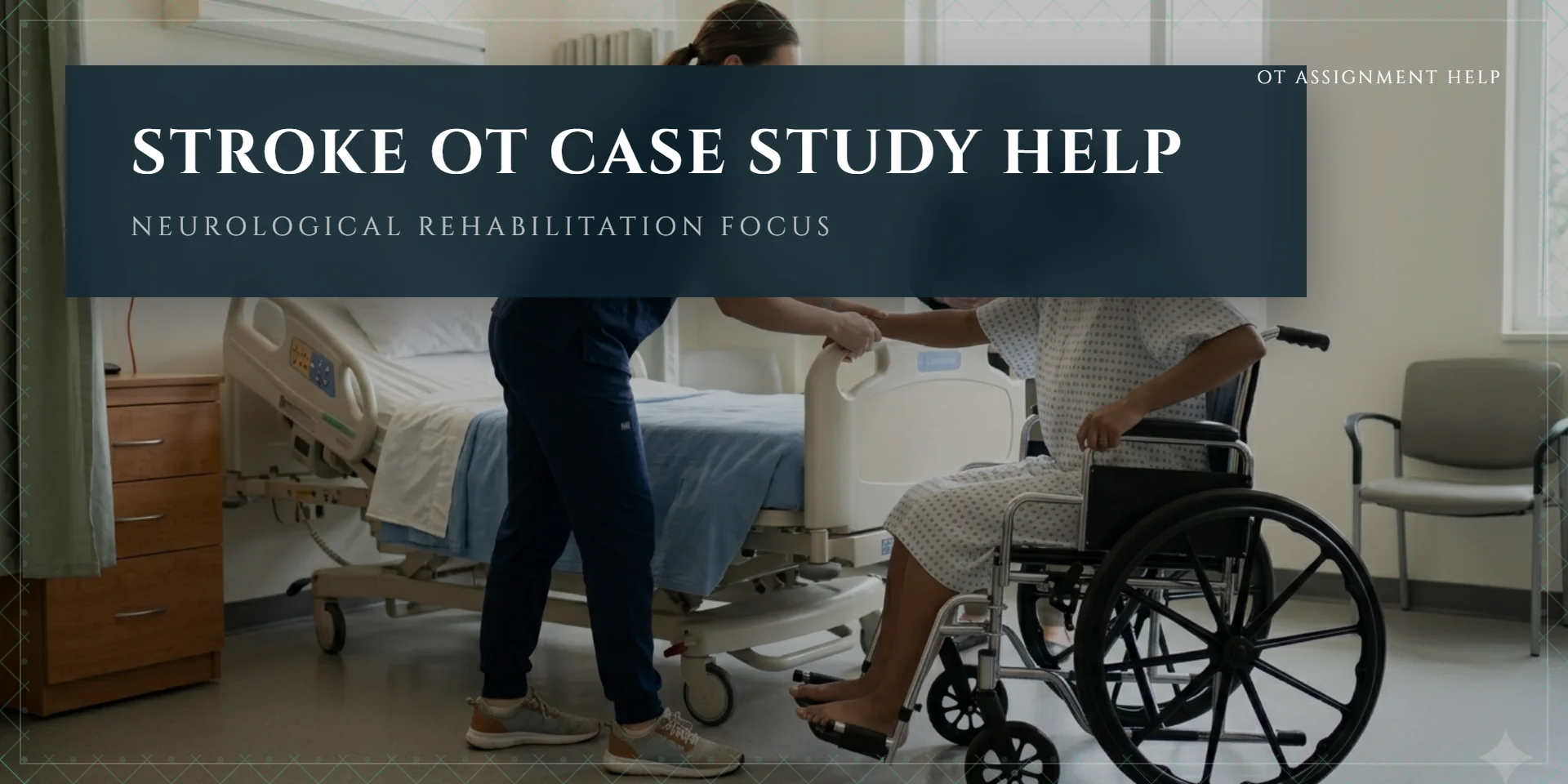
Ischaemic stroke, comprising 85% of all strokes, and haemorrhagic stroke, comprising the remaining 15%, produce distinct clinical features that occupational therapy assignments must address with specificity. The consequences most relevant to OT assessment include hemiplegia or hemiparesis contralateral to the lesion side, unilateral neglect, aphasia, cognitive changes, and post-stroke fatigue, each of which creates distinct assessment priorities and intervention approaches that case study assignments must address using named tools, documented scores, and evidence-referenced intervention selection.
Stroke Types and Consequences — What OT Assignments Must Address
Ischaemic stroke results from arterial occlusion, either thrombotic (clot formed in situ) or embolic (clot travelling from elsewhere). Left hemisphere ischaemic stroke is more common and typically produces right hemiplegia alongside aphasia or dysphasia. Right hemisphere ischaemic stroke more commonly produces left hemiplegia with unilateral neglect. Haemorrhagic stroke results from arterial rupture, either intracerebral or subarachnoid. Haemorrhagic strokes typically present as more severe and follow a different rehabilitation trajectory.
Motor consequences include hemiplegia (complete paralysis) and hemiparesis (partial weakness) contralateral to the lesion side. Perceptual consequences include unilateral neglect and hemianopia. Unilateral neglect, failure to attend to stimuli on the contralesional side, is more common after right parietal cortex stroke. Communication consequences include aphasia (impairment of language processing, understanding, reading, writing, and speaking) and dysphasia (impairment of speech production specifically). Cognitive consequences, memory impairment, attention deficits across sustained, selective, and divided attention subtypes, and executive function changes, all affect occupational performance and must be addressed through the MoCA cognitive screen.
Unilateral Neglect and Hemianopia — Assessment and Intervention Implications for OT Assignments
Unilateral neglect is defined as failure to attend to stimuli on the contralesional side of space, despite intact sensory pathways, it is not a vision problem. This is a critical distinction that examiners test at Level 6: students who describe neglect as a visual impairment misidentify the clinical mechanism. Assessment tools referenced in OT case studies include the star cancellation test and behavioural inattention test. OT interventions address scanning training, environmental cueing, and graduated attentional retraining.
Hemianopia is visual field loss resulting from damage to the visual cortex or optic tract, it is a sensory impairment, not an attentional one. Both conditions may co-exist post-stroke but require different interventions, and the case study must name which is present and justify the distinct intervention approach for each.
Post-Stroke Cognitive Changes — Executive Function, Memory and Attention in OT Case Studies
Executive function changes affect initiation of ADLs, task sequencing, and safety during home-based activities. The MoCA (Montreal Cognitive Assessment) screens for cognitive impairment with a cut-off score of 25 or below out of 30. When a stroke case study client presents with a MoCA of 25 or below, the assignment must address two specific clinical reasoning points: whether the impaired cognition affects assessment validity, and whether the intervention approach can be learned given memory impairment.
Attention subtypes produce different functional consequences. Sustained attention impairment reduces the ability to maintain focus through a multi-step ADL task. Divided attention impairment affects multi-tasking, cooking requires simultaneous monitoring of multiple ongoing tasks. Each attention subtype requires different OT intervention strategies and must be named separately in the case study.
OT Stroke Assessments — Scoring, Interpretation and Documentation
The Barthel Index measures ten ADL items, feeding, bathing, grooming, upper and lower body dressing, bowel control, bladder control, toilet use, transfers, mobility, and stair negotiation. Items are scored 0, 5, 10, or 15 depending on the item, giving a total score range of 0–100. Interpretation bands: 0–20 total dependence; 21–60 severe dependence; 61–90 moderate dependence; 91–99 slight dependence; 100 full independence. Students most commonly lose marks by reporting a Barthel score without interpreting what it means functionally and without connecting it to specific OT goals and interventions.
The FIM (Functional Independence Measure) covers 18 items: 13 motor and 5 cognitive, scored on a 7-point scale per item: 7 = complete independence, 1 = total assist. The motor subtotal ranges from 13 to 91; the cognitive subtotal ranges from 5 to 35; the total FIM score ranges from 18 to 126.
The AMPS (Assessment of Motor and Process Skills) assesses the quality of occupational performance across 16 motor skill items and 20 process skill items. Thresholds for independent functional performance: ADL motor score of 2.0 logits or above, and ADL process score of 1.0 logits or above, these exact values must appear in any case study that references AMPS. AMPS requires a certified rater.
The COPM applies client-centred priority identification with performance and satisfaction scales of 1–10; clinically significant change requires at least a 2-point improvement. The MoCA (0–30; cut-off 25) screens for cognitive impairment. The DASH (0–100; 0 = no disability, 100 = most severe) measures upper limb function.
| Assessment Tool | Items | Score Range | Key Interpretation | Setting |
|---|---|---|---|---|
| Barthel Index | 10 ADL items | 0–100 | 0–20 total dependence; 21–60 severe; 61–90 moderate; 91–99 slight; 100 independent | Acute and subacute inpatient |
| FIM | 18 (13 motor + 5 cognitive) | 18–126 | 7 = complete independence; 1 = total assist; motor 13–91; cognitive 5–35 | Inpatient rehabilitation |
| AMPS | 16 motor + 20 process skills | Logit scale | Motor ≥2.0 logits; process ≥1.0 logits = independent performance | Any; certified rater required |
| COPM | Up to 5 client-identified problems | 1–10 per scale | Clinically significant change ≥2 points on performance or satisfaction | Any; client-centred |
| MoCA | Cognitive screen | 0–30 | ≤25 indicates cognitive impairment | Acute and subacute; pre-assessment screen |
| DASH | Upper limb function | 0–100 | 0 = no disability; 100 = most severe disability | Upper limb rehabilitation focus |
Barthel Index Interpretation — Applying Score Bands to Stroke OT Case Studies
A Barthel score of 0–20 indicates total dependence: OT priorities are carer education, positioning to prevent secondary complications, equipment prescription, and early goal-setting. Barthel 21–60 (severe dependence): OT priorities shift to transfer training, basic ADL training for feeding and grooming, and home assessment planning. Barthel 61–90 (moderate dependence): OT priorities address specific ADL skill training, one-handed dressing, shower seat use, adapted equipment, alongside fatigue management. Barthel 91–99 (slight dependence): OT priorities focus on upper limb rehabilitation and return to complex IADLs. Barthel 100 (independence): OT priorities shift to chronic phase concerns, driving rehabilitation, return to work, and sustained community participation.
OT Stroke Interventions — Evidence-Based Approaches and Protocols
CIMT (Constraint-Induced Movement Therapy) constrains the unaffected upper limb using a mitt worn 90% of waking hours, approximately 13–14 hours per day, while the affected limb is trained through 3–6 hours of massed practice on task-specific activities per day, over a 10–15 day protocol. CIMT carries Level 1A evidence from multiple Cochrane reviews.
Task-specific training involves repetitive practice of meaningful functional tasks with progressive difficulty grading. It carries Level 1A evidence for ADL outcomes post-stroke. Bilateral training involves simultaneous symmetrical movement of both upper limbs and carries moderate evidence. Mirror therapy places a mirror at the body midline so that the reflection of the unaffected limb creates the visual illusion of the affected limb moving, sessions of 15–30 minutes are appropriate for hemiplegia when active movement is not yet possible.
Fatigue management employs energy conservation techniques, activity prioritisation, rest breaks, and task modification, alongside pacing and the PERT (Post-stroke Fatigue Management Programme), a structured 6-session format. Home modification, environmental assessment producing handrail, grab rail, level access, and bathroom adaptation recommendations, is relevant in the subacute phase and at discharge.
CIMT Protocol — What OT Students Must Know for Stroke Assignments
CIMT protocol parameters carry specific eligibility criteria that must be stated in any stroke assignment that recommends CIMT. The minimum eligibility threshold is 10 degrees of active wrist extension and some active finger extension in the affected limb. CIMT is therefore not appropriate for total hemiplegia, this is the most commonly missed clinical reasoning point in student CIMT descriptions. CIMT is also contraindicated in the hyperacute and early acute phases (first two weeks post-stroke) due to medical instability, and in patients with significant cognitive impairment.
Top-Down vs Bottom-Up Approaches in Stroke ADL Retraining
The top-down approach starts with the whole meaningful occupation and practices the complete task in context from the outset. Compensatory strategies are introduced immediately. This approach has the stronger evidence base for functional ADL outcomes at the subacute and chronic phases.
The bottom-up approach remediates the underlying impairment first, motor retraining, sensory re-education, cognitive rehabilitation, before progressing to functional task practice. OT case study assignments at Level 6 and Level 7 must explicitly justify the choice using assessment data, Barthel score, AMPS results, stroke phase, and evidence.
Stroke Phases and OT Role — Hyperacute to Chronic
The hyperacute phase (first 24 hours) limits OT assessment due to medical instability. OT role centres on positioning to prevent contracture and pressure ulcers, sensory stimulation, and family communication. Full standardised assessment is not appropriate in the hyperacute phase.
The acute phase (24 hours to 2 weeks) establishes the OT assessment baseline: bedside ADL assessment using the Barthel Index, early mobilisation, cognitive screening with the MoCA, early goal-setting, carer education, and preventing secondary complications.
The subacute phase (2 weeks to 6 months) constitutes the period of most intensive OT rehabilitation: full assessment using AMPS, COPM, and DASH; CIMT if eligibility criteria are met; intensive ADL retraining; fatigue management; pre-discharge home visit assessment; and home modification recommendations.
The chronic phase (greater than 6 months) shifts OT focus toward community integration: driving rehabilitation assessment and DVLA notification, return to work assessment, complex IADL retraining, and long-term adjustment support.
How do you structure a stroke OT case study assignment around assessment, intervention, and clinical reasoning, and which stroke phase does your case study client occupy?
Structuring a Stroke OT Case Study Assignment
A stroke OT case study assignment follows a five-section structure: Section 1: Occupational Profile, establishes the stroke history, social and occupational context, and initial functional presentation. This is where stroke type, hemisphere of lesion, and presenting consequences are named. Section 2: Assessment, documents standardised assessment scores with interpretation: Barthel score and band, FIM motor and cognitive subtotals, COPM performance and satisfaction scores, MoCA result and its implication for assessment validity.
Section 3: Clinical Reasoning, identifies the occupational performance problems from assessment data and prioritises them by risk and functional impact. Section 4: Goal-Setting and Intervention Plan, presents SMART goals linked directly to assessment findings, with evidence-based intervention selection including the evidence level and protocol parameters. Section 5 — Evaluation, describes the planned outcome measures and clinically meaningful change thresholds. For detailed case study structure guidance, see our OT case study assignment structure page.
Clinical Reasoning in Stroke OT Case Studies
Clinical reasoning in stroke OT case studies requires three reasoning types applied explicitly. Procedural reasoning analyses observed ADL performance difficulties using assessment scores. A Barthel of 45 indicates severe dependence and directs procedural reasoning toward transfer training and basic ADL retraining. Conditional reasoning projects forward, given the assessment data and the stroke phase, what functional trajectory is probable? Narrative reasoning understands what rehabilitation means to this specific client, what does returning to cooking or driving represent for their occupational identity?
Get Expert Help With Your Stroke OT Case Study
Barthel score interpretation, CIMT eligibility, top-down vs bottom-up approach justification, stroke phase-appropriate goal-setting, all covered by OT assignment specialists.
Request a Quote NowMOHO, OTPF, and Neuroanatomy in Stroke OT Assignments
Stroke OT case study assignments most commonly use MOHO or CMOP-E as the theoretical framework. For applying MOHO to stroke rehabilitation case study assignments, including volition and personal causation deficits post-stroke, habituation disruption from role loss, and performance capacity mapping to Barthel and AMPS scores, see our dedicated MOHO applied to stroke rehabilitation case study assignments page. For students applying the OTPF framework in neurological OT case study work, including occupation category classification, performance skill analysis, and intervention type selection, see our guide to OTPF framework applied in neurological OT case study work. For the neuroanatomical knowledge underpinning stroke assessment selection, including cortical lobe functions, corticospinal tract damage, and neglect pathophysiology, see our neuroanatomy and physiology knowledge for stroke OT assignments resource. For broader neurological OT assignment support covering TBI, MS, Parkinson's, and SCI alongside stroke, see our neurological occupational therapy assignment help page. For guidance on documenting, scoring, and justifying the assessment tools used in your stroke case study — Barthel, FIM, AMPS, and COPM — see our resource on Barthel Index and FIM assessment help.
FAQ — Stroke Occupational Therapy Assignment Questions
What Barthel Index score should I use in a stroke OT case study to demonstrate meaningful rehabilitation progress?
Clinically meaningful change on the Barthel Index is generally considered to be at least 4–5 points in research literature. In assignments, state the admission and discharge Barthel scores, calculate the change score, and interpret it functionally: "a change of 25 points representing transition from total to severe dependence, with independence now achieved in feeding, grooming, and upper body dressing." Interpretation in relation to the client's occupational goals earns marks at Level 6.
When is CIMT not appropriate for a stroke patient in an OT case study?
CIMT is contraindicated when the patient has total hemiplegia, the minimum eligibility criterion is 10 degrees of active wrist extension and some active finger movement. It is also not appropriate in the hyperacute or early acute phase (first two weeks) due to medical instability, or in patients with significant cognitive impairment. Students must justify intervention eligibility explicitly, stating CIMT is recommended without confirming the client meets the wrist extension criterion is a clinical reasoning omission that loses marks.
How do I write about unilateral neglect in a stroke OT assignment?
Define unilateral neglect accurately: failure to attend to stimuli on the contralesional side, not a visual problem. It is more common after right parietal cortex damage and manifests as left-sided ADL difficulties, incomplete left-sided grooming, bumping into objects on the left, reading from the right half of a page only. Explicitly distinguish neglect from hemianopia, an examiner at Level 6 expects this distinction as a clinical reasoning quality marker.
What is the difference between aphasia and dysphasia in an OT stroke case study?
Aphasia is impairment of language processing, it affects understanding, reading, writing, and speaking. Dysphasia is impairment specifically of speech production. The critical clinical reasoning point is what this means for assessment validity: COPM requires verbal response and may require adapted administration; Barthel Index can be completed by direct observation; AMPS is performance-based and is the least affected by communication impairment. The student must address how communication impairment affects assessment choice.
Should my stroke OT case study use a top-down or bottom-up approach — which gets better marks?
Neither is inherently better, the mark is gained by justifying the choice using assessment data and evidence. A top-down approach is better justified when the stroke is in the subacute or chronic phase and when the client's occupational goals are specific and achievable. A bottom-up approach is better justified when specific remediable impairments are identified in the early subacute phase. The best distinction assignments justify the approach chosen, acknowledge the alternative, and explain why the evidence and assessment data support the chosen direction.