MOHO Assignment Help — Applying the Model of Human Occupation in OT Case Studies and Essays

MOHO, the Model of Human Occupation, is the most widely cited occupational therapy model in UK and international degree programmes, appearing in case studies, reflective essays, theoretical essays, and clinical reasoning assignments across BSc Level 5 and Level 6, MSc Level 7, and OTD programmes. Correctly applying MOHO requires accurate definition of all four constructs (volition, habituation, performance capacity, and environment), identification and application of the sub-constructs (personal causation, values, interests, roles, habits, objective and subjective performance capacity), documentation of MOHO-based assessment results using correct notation (MOHOST F/A/I/R ratings, OPHI-II scale scores, OCAIRS domain ratings), and connection of construct analysis to occupational formulation and goal-setting.
What Is MOHO? The Model of Human Occupation Explained for OT Students
MOHO, the Model of Human Occupation, was developed by Gary Kielhofner and originally published in 1980, with substantial revisions through the 4th edition (Kielhofner, 2008). MOHO frames human beings as occupational beings whose health and well-being are fundamentally connected to their engagement in occupation. It is an open-systems model: the person is an open system whose occupational behaviour emerges from the dynamic interaction between three internal constructs (volition, habituation, and performance capacity) and the environment.
MOHO differs from biomechanical and neurological frames of reference in a fundamental way: it addresses not only what a person can physically do (performance capacity) but also why they choose to engage or disengage from occupations (volition), how their daily occupational patterns are organised (habituation), and how their environment enables or constrains occupational participation. In assignments, examiners expect MOHO to be applied, every construct connected to specific case evidence, not merely mentioned.
MOHO Core Constructs: Volition, Habituation, and Performance Capacity
Volition is the motivational construct within MOHO, it explains why a person chooses to engage in, avoid, or approach occupations. Volition comprises three sub-constructs that must each be defined with specificity in assignments.
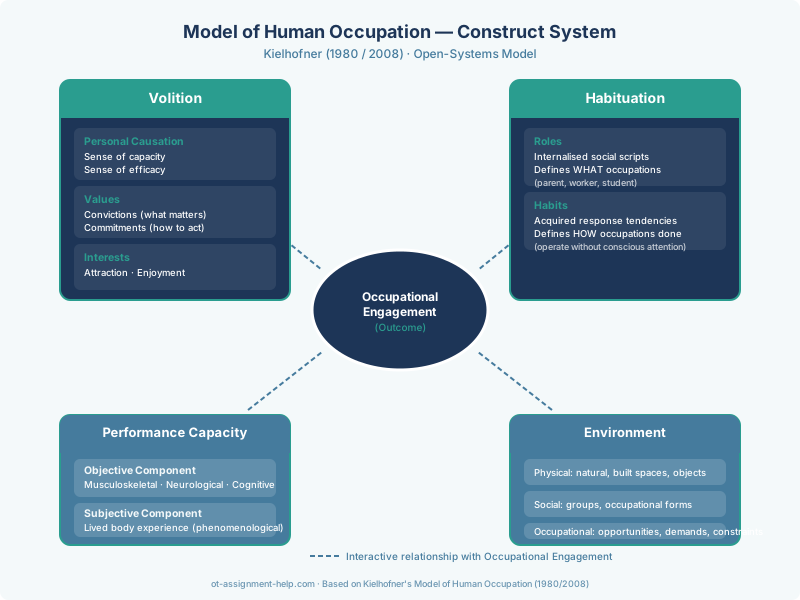
Volition — Personal Causation, Values, and Interests
Personal causation refers to the individual's sense of their own capacity and effectiveness in occupations. It comprises two components: the sense of capacity (the person's belief in their own ability to perform specific tasks) and the sense of efficacy (the person's belief that they can achieve desired outcomes through their actions). In case study assignments, personal causation is evidenced by COPM performance scores, a client who rates their performance at 3/10 for a task they previously performed without difficulty is demonstrating diminished personal causation even when objective physical capacity may partially support the task.
Values in MOHO comprise convictions (what the person believes is important and worth doing) and commitments (how the person feels obligated to act in relation to their occupational roles). Values determine which occupations carry meaning and priority for the client, they are what COPM importance ratings (1–10) measure.
Interests comprise attraction (what draws a person toward specific occupations) and enjoyment (the subjective experience of pleasure or satisfaction during occupational engagement). Interests are documented in the occupational history section of the occupational profile.
Habituation — Roles and Habits
Habituation is the structural construct within MOHO, it explains how occupational behaviour is organised and patterned into daily life through internalised roles and habits.
Roles are internalised sets of behaviours associated with a social position (parent, worker, student, carer, spouse). Roles operate as scripts, they define which occupations a person is expected to perform, in which contexts, and with what regularity. When a significant role is disrupted by illness, injury, or life change, the occupations associated with that role are also disrupted.
Habits are acquired tendencies to respond in familiar ways in familiar contexts, they operate largely without conscious attention. The distinction between roles (WHAT occupations) and habits (HOW those occupations are performed) is a common assignment error, confusing them reduces marks on theoretical model application criteria.
Performance Capacity — Objective and Subjective Dimensions
Performance capacity in MOHO comprises two distinct components. The objective component encompasses the underlying musculoskeletal, neurological, cardiopulmonary, and cognitive capacities that enable occupation, measured by standardised assessment tools (AMPS motor and process logit scores, FIM item scores, grip dynamometry). The subjective component, the lived body experience, captures how it feels to perform an occupation: the phenomenological experience of doing.
The subjective lived body is MOHO's unique theoretical contribution. A client post-stroke may have measurable grip strength (objective: 12kg dynamometry) and adequate ROM, but may describe their affected arm as "feeling like it belongs to someone else." Standard assessments do not capture this subjective experience, but MOHO requires the occupational therapist to address it in the occupational formulation.
The MOHO Environment: Physical, Social, and Occupational
Environment in MOHO is not a background context for occupation, it is an active shaper of occupational engagement. MOHO's environment construct comprises three dimensions that must each be addressed in assignments with specificity.
The physical environment encompasses natural environments, built spaces, and the objects used in occupation. The social environment encompasses the social groups the client participates in and the occupational forms, socially defined, culturally shared sequences of doing, available to the client. The occupational environment addresses what occupations the client can engage in, is expected to engage in, and is restricted from engaging in within their current context.
MOHO-Based Assessments: MOHOST, OPHI-II, OCAIRS, WRI, and OSA
MOHO generates a battery of five primary assessment tools, each designed to measure different MOHO constructs in different clinical contexts. Students who write "the MOHOST was administered" without stating the ratings and their clinical implications are not demonstrating EAV depth. Each tool's scoring system must appear in the assignment with specific values.
MOHOST — The Model of Human Occupation Screening Tool
MOHOST measures occupational functioning across six sections that directly map to MOHO's four constructs. Each section is rated using a four-point qualitative scale:
| MOHOST Rating | Full Name | Meaning | Assignment Implication |
|---|---|---|---|
| F | Facilitates | The factor actively supports and enables occupational engagement | Strength to build intervention on; document as a resource |
| A | Allows | The factor is neutral — does not create significant barriers | Maintenance goal; not a priority intervention target |
| I | Inhibits | The factor limits or disrupts occupational engagement | Priority intervention target — link to MOHO construct and intervention approach |
| R | Restricts | The factor severely compromises occupational engagement | Highest priority intervention target — immediate clinical focus |
The six MOHOST sections and their MOHO construct mappings are: (1) Motivation for Occupation → volition; (2) Pattern of Occupation → habituation; (3) Communication and Interaction Skills → performance capacity (communication); (4) Process Skills → performance capacity (process); (5) Motor Skills → performance capacity (motor); (6) Environment → environment construct.
OPHI-II — Occupational Performance History Interview
OPHI-II comprises three rating scales and a narrative component:
- Occupational Identity Scale — 11 items, score range 11–44 (4-point scale per item: 4 = exceptionally positive, 1 = extreme difficulty)
- Occupational Competence Scale — 9 items, score range 9–36 (same 4-point scale)
- Occupational Behaviour Settings Scale — 9 items, score range 9–36 (same 4-point scale)
- Life History Narrative Form, captures key life events and their impact on occupational identity over time
OPHI-II is best suited to assignments where the occupational history over time is clinically important, chronic mental health conditions, progressive neurological conditions, major life transitions. In assignments, OPHI-II scale scores must be stated per section alongside interpretation.
OCAIRS, WRI, and OSA — Additional MOHO Assessment Tools
OCAIRS rates 12 domains on a 4-point scale (1–4): Personal Causation, Values, Interests, Roles, Habits, Skills, Short-term Goals, Long-term Goals, Interpretation of Past Experience, Physical Environment, Social Environment, and Readiness for Change. Each rating connects explicitly to a MOHO construct.
WRI (Worker Role Interview) is specifically designed for vocational rehabilitation, assessing MOHO constructs in the context of return to work. The WRI comprises 17 items rated on a 4-point scale: Strongly Supports Return to Work, Supports, Interferes, Strongly Interferes.
OSA (Occupational Self Assessment) is a client self-report measure covering competence (how well the client perceives they perform each occupation) and importance (how important the occupation is). The OSA directly captures the relationship between personal causation (competence ratings) and values (importance ratings).
Occupational Identity, Occupational Competence, and Occupational Adaptation
Occupational identity is a cumulative sense of who one is and wishes to become as an occupational being, formed through a lifetime of occupational engagement, shaped by roles, interests, and values expressed through occupation.
Occupational competence is the degree to which a person sustains a pattern of occupational participation that reflects their occupational identity. Competence is not skill, it is the ongoing enactment of the occupational self.
Occupational adaptation is not a fixed state or outcome, it is the dynamic, ongoing process of constructing a positive occupational identity and achieving occupational competence in the context of one's environment and life circumstances. In reflective essays and case study conclusion sections, occupational adaptation provides the evaluative frame: has the intervention created conditions for the client to move toward positive occupational adaptation?
The MOHO Process Model — Linking Assessment to Intervention in Assignments
The MOHO Process Model guides the OT clinical process from initial assessment through to outcome evaluation. In case study assignments, it provides the logical structure: assessment → occupational formulation → goal-setting → intervention → evaluation.
The occupational formulation, MOHO's unique contribution to clinical reasoning, connects assessment findings to intervention planning with theoretical coherence, and is the element that most clearly distinguishes MOHO-informed case studies from case studies that merely name the model.
Which part of your MOHO assignment is causing the most difficulty, construct definitions, MOHOST scoring, occupational formulation writing, or distinguishing occupational identity from competence? Tell us and we'll match you with the right support.
How to Apply MOHO in an OT Case Study Assignment — Step-by-Step
- Select appropriate MOHO assessment(s) based on the client context: MOHOST for screening occupational functioning in any setting; OPHI-II when occupational history over time is clinically relevant; OCAIRS in community mental health or forensic settings; WRI for vocational rehabilitation; OSA for client-centred goal-setting. Document the rationale for tool selection.
- Document assessment results with correct notation: MOHOST results must state section name, rating (F/A/I/R), and clinical justification. OPHI-II results must state scale scores (e.g., Occupational Identity Scale 24/44) and narrative themes. OCAIRS domain ratings must be stated per domain with supporting evidence.
- Write MOHO-informed occupational formulation linking constructs to assessment findings: "Assessment findings indicate inhibited Motivation for Occupation (MOHOST: I) reflecting diminished personal causation within volition, evidenced by the client's statement that they are 'unable to do anything for themselves anymore' despite AMPS motor logit score of 2.1."
- Set MOHO-aligned goals that address the constructs identified as priorities: "The client will re-establish the meal preparation occupation (habituation, domestic role), supported by graded kitchen assessment to address personal causation within volition, within four weeks."
- Select occupation-based interventions justified by MOHO constructs and evidence-based rationale.
Common Mistakes Students Make When Applying MOHO in Assignments
- Using "motivation" instead of "volition": "Motivation" is not MOHO language. MOHO's motivational construct is "volition," comprising personal causation, values, and interests. Always use "volition" with its three named sub-constructs.
- Describing MOHO rather than applying it: "MOHO was used to understand the client's occupational engagement" without connecting specific constructs to specific case data is description, not application. Every construct named must be connected to assessment evidence.
- Stating MOHOST rating without justification: "The client scored Inhibits (I) on Motor Skills" is insufficient. The rating must be accompanied by the clinical observation that generated it.
- Conflating occupational identity and occupational competence: Occupational identity is what the person aspires to be occupationally. Occupational competence is the degree to which they enact that identity.
- Reporting only objective performance capacity: The subjective lived body component must also be documented using the client's own language about how it feels to attempt occupation.
- Treating environment as a separate add-on: Environment in MOHO is an interactive shaper of occupational engagement, it must be connected to volition and habituation throughout.
MOHO vs CMOP-E — Choosing the Right Model for Your Assignment
| Dimension | MOHO | CMOP-E |
|---|---|---|
| Origin | Kielhofner (USA), 1980; 4th ed. 2008 | Canadian OT theorists; CMOP-E formalised 2007 (Townsend & Polatajko) |
| Person components | Volition, habituation, performance capacity (with lived body) | Affective, cognitive, physical (no lived body concept) |
| Unique construct | Subjective lived body in performance capacity | Spirituality — personal meaning of occupation |
| Linked assessment | MOHOST, OPHI-II, OCAIRS, WRI, OSA | COPM primarily |
| Assessment battery depth | Most developed — 5 dedicated tools with detailed scoring | Primarily relies on COPM; CPPF for process |
For assignments requiring CMOP-E application, see our comparing MOHO and CMOP-E in OT assignments page. For case study structure support, see our occupational therapy case study guidance. For the occupational science foundations underpinning MOHO, including occupational identity, occupational justice, and Wilcock's doing-being-becoming-belonging framework, see our occupational science foundations underpinning MOHO resource. For comparing MOHO and OTPF in OT assignments, see our MOHO and OTPF compared for OT students guide. For MOHO applied to neurological case studies, see our dedicated MOHO applied to stroke rehabilitation case study assignments page. For MOHO applied to older adult case studies involving cognitive decline and personhood-centred practice, see our guide to MOHO applied to OT case study assignments in dementia care.
Frequently Asked Questions About MOHO Assignments
What is the difference between volition and habituation in MOHO?
Volition is the motivational dimension, it explains why a person chooses to engage in (or avoids) occupation through three sub-constructs: personal causation (belief in one's own capacity and efficacy), values (what the person finds meaningful), and interests (what the person finds enjoyable). Habituation is the structural dimension, it explains how occupation is organised into daily life through internalised roles and habits. Volition is about want and meaning; habituation is about pattern and structure.
How do I score the MOHOST correctly in an assignment?
The MOHOST uses a 4-point qualitative rating per section, not a numerical total score. F (Facilitates), A (Allows), I (Inhibits), R (Restricts). In an assignment, each rating must be stated with the section name AND a clinical justification. Example: "The client received an Inhibits (I) rating on Pattern of Occupation, reflecting disrupted morning routines and absence of productive role occupations since job loss six months prior."
Can I use MOHO for a physical rehabilitation case study, or is it only for mental health?
MOHO is applicable across all OT practice areas, not only mental health. In a stroke case study, MOHO explains why a patient resists ADL practice despite adequate physical capacity (volition, diminished personal causation), why losing the worker role creates distress beyond the physical disability (habituation, role disruption), and why the subjective experience of the affected limb must be addressed alongside objective motor goals (performance capacity, lived body).
What is occupational adaptation in MOHO, and how do I use it in a reflective essay?
Occupational adaptation is the dynamic process by which a person constructs a positive occupational identity and achieves occupational competence over time. In a reflective essay, occupational adaptation provides the evaluative frame: did the OT intervention create conditions for the client to move toward positive occupational adaptation? Recovery (regaining previous function) is not always possible; adaptation (building a meaningful occupational life within current capacity and context) is always the OT goal.
How does the OPHI-II differ from the MOHOST, and when should I choose each?
The OPHI-II is a semi-structured interview generating a life history narrative alongside three quantitative scales (Occupational Identity Scale, Occupational Competence Scale, Occupational Behaviour Settings Scale, each scored 1–4 per item). OPHI-II is best when occupational history over time is clinically important. The MOHOST is an observational screening tool rated across 6 sections using F/A/I/R, best for screening current occupational functioning. Choose OPHI-II to demonstrate occupational identity change over time; choose MOHOST to document current functional occupational status across all construct domains.
Get Expert MOHO Assignment Help
Volition, habituation, performance capacity, environment, MOHOST scoring, OPHI-II, occupational identity, all MOHO constructs applied correctly in your assignment. BSc, MSc, and OTD support.
View All OT Assignment Services