Occupational Therapy Assignment Help — Expert Support for BSc, MSc and OTD Students
Occupational therapy assignment help covers every written assessment across BSc Level 4, Level 5, Level 6, MSc/PgDip Level 7, and OTD programmes, from foundational activity analysis essays to 25,000-word doctoral dissertations. An OT assignment is not a general healthcare essay: it requires application of a named theoretical model (MOHO, CMOP-E, OTPF, or PEOP), documentation of standardised assessment tools (COPM, AMPS, FIM, Barthel Index) with score interpretation, demonstration of clinical reasoning types (procedural, conditional, narrative), and explicit alignment with HCPC Standards of Proficiency and RCOT professional standards. This service provides expert occupational therapy assignment help written by OT-qualified specialists across all assignment types, case studies, reflective essays, literature reviews, activity analysis, research proposals, practice placement journals, and viva preparation.
What Is an Occupational Therapy Assignment?
An occupational therapy assignment requires students to demonstrate integration of OT theory, clinical reasoning, evidence-based practice, and professional standards within a structured academic format. Unlike general healthcare essays, OT assignments carry a specific set of obligations: they require application of at least one named theoretical model per assignment, referencing of OT-specific clinical evidence (from OTseeker, CINAHL, AJOT, BJOT), and explicit alignment with HCPC Standards of Proficiency for Occupational Therapists and RCOT professional standards. At Level 4, the expectation is foundational application, describing what MOHO is and introducing how it frames a client scenario. At Level 5 and Level 6, applied clinical reasoning using standardised assessment tools is required. At Level 7, assignments demand critical synthesis, systematic evidence appraisal, and original scholarly argument.
OT degree programmes are accredited by the Health and Care Professions Council (HCPC) and informed by the Royal College of Occupational Therapists (RCOT). Every written assessment at an HCPC-approved OT programme therefore reflects the profession's regulatory standards, not just university marking criteria. This means that understanding occupational therapy assignment requirements demands both academic writing competence and specialist OT clinical knowledge, which is precisely why general essay writing services cannot adequately support OT students.
How OT Assignments Differ from General Healthcare Essays
An OT assignment requires application of a named occupational therapy theoretical model, MOHO (Model of Human Occupation), CMOP-E (Canadian Model of Occupational Performance and Engagement), OTPF (Occupational Therapy Practice Framework, 4th edition), PEOP (Person-Environment-Occupation-Performance), Kawa Model, or OTIPM, to the clinical scenario or evidence review. Generic healthcare essays do not require this level of theoretical specificity. Furthermore, OT assignments require documentation of standardised OT assessment tools by name with score interpretation: a COPM total performance score, AMPS motor and process logit scores against the 2.0 and 1.0 independence cutoffs, MOHOST section ratings using the F/A/I/R scale, FIM total score on the 18–126 scale, or Barthel Index item-level scores on the 0–100 scale. Writing "a standardised assessment was administered" is insufficient, the score must be stated and interpreted clinically.
OT assignments also require OT-specific terminology: "occupational performance," "occupational engagement," "occupational profile," "activity analysis," "grading and adapting," and "clinical reasoning types." These are not interchangeable with general nursing or physiotherapy vocabulary. A marker at an HCPC-approved OT programme will identify immediately when a student has used a generic healthcare writing service that substitutes medical language for OT-specific terminology.
HCPC Standards, RCOT Guidelines, and OT Academic Marking
OT assignment marking rubrics at HCPC-approved programmes typically weight the following criteria: clinical reasoning (25–35% of total marks), theoretical model application (20–30%), evidence integration (20–25%), professional standards alignment with HCPC and RCOT (15–20%), and academic writing and referencing (10–15%). The HCPC Standards of Proficiency for Occupational Therapists (2013, updated) are referenced explicitly in academic marking, students are expected to demonstrate understanding of which standards apply to the clinical scenario or reflective practice being described. Standard 1.1 (professional autonomy and accountability), Standard 10.1 (professional relationships and therapeutic use of self), and Standard 14.1 (reflective practice) are commonly cited in reflective essay and practice placement journal marking criteria.
RCOT professional standards and the Code of Ethics provide the ethical framework for OT academic writing. Failure to reference professional standards in case study and reflective assignments is a common mark-loss area. This service ensures that HCPC standards are correctly cited by number and descriptor, and that RCOT ethical principles are applied accurately in every assignment it produces.
Types of OT Assignments — Case Studies, Reflective Essays, Literature Reviews and More
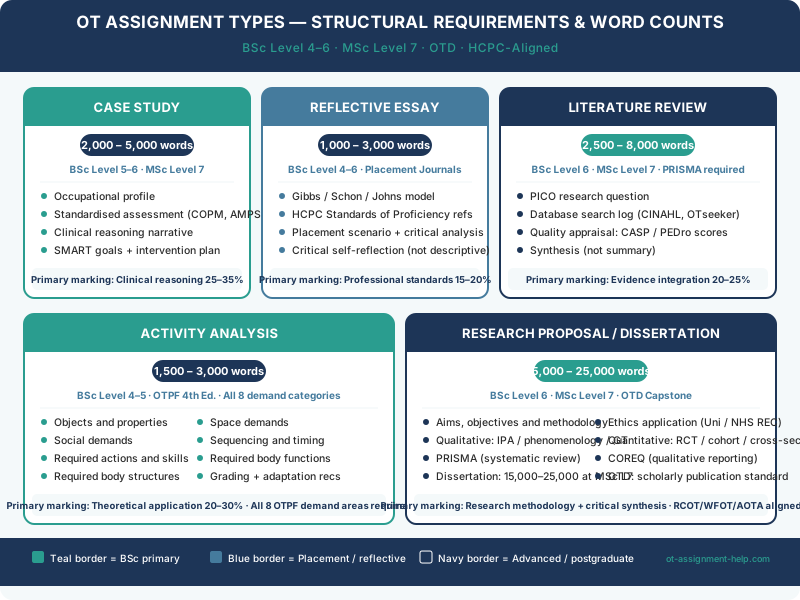
Occupational therapy degree programmes assess students across several distinct assignment formats, each of which structures the student's clinical knowledge differently. Understanding the structural requirements and primary marking focus of each type is essential for producing distinction-level work, and for understanding why each type requires specialist OT knowledge rather than generic academic writing skill.
Case Study Assignments — Assessment, Reasoning, and Intervention Planning
An OT case study assignment requires an occupational profile of a real or vignette client, a standardised assessment section documenting at least one scored assessment tool, a clinical reasoning narrative identifying and applying named reasoning types, SMART goal documentation, an evidence-based intervention plan, and an outcome evaluation method. Word count ranges from 2,000–3,000 words at Level 5 to 3,000–5,000 words at Level 6, with Level 7 case studies reaching 4,000–6,000 words.
Assessment tools documented in OT case studies include: COPM (Canadian Occupational Performance Measure, 0–10 performance and satisfaction scale identifying up to five priority occupational areas), AMPS (Assessment of Motor and Process Skills, motor and process logit scores against standardised cutoffs), MOHOST (Model of Human Occupation Screening Tool, six sections rated using F/A/I/R scale), FIM (Functional Independence Measure, 18-item scale scored 1–7 per item, total 18–126), and Barthel Index (10-item scale, total 0–100, items scored 0, 5, 10, or 15). The correct selection and documentation of these tools differentiates a specialist OT case study from a generic clinical summary.
Reflective Essays and Practice Placement Journals
OT reflective essay assignments require application of a structured reflective model, Gibbs Reflective Cycle (six stages: description, feelings, evaluation, analysis, conclusion, action plan), Schon's Reflection-in-Action and Reflection-on-Action, or Johns Model of Structured Reflection (five cues: description, reflection, influencing factors, could I have dealt better, learning), applied to a specific practice placement scenario. Word count typically ranges from 1,000–3,000 words.
Critically, reflective essays require explicit referencing of HCPC Standards of Proficiency by number and descriptor: Standard 1.1 (professional autonomy), Standard 10.1 (professional relationships), Standard 14.1 (reflective practice), and others relevant to the placement scenario. Placement types commonly covered include acute hospital ward, community OT, mental health, paediatric, and specialist services. Practice placement journals follow a similar format but document a series of reflective entries across the placement period.
Literature Reviews, Activity Analysis, and Research Proposals
A literature review assignment in OT requires construction of a PICO research question (Population, Intervention, Comparison, Outcome), a documented database search across OT-specific sources (CINAHL, OTseeker, PubMed, Cochrane), quality appraisal of retrieved studies using the appropriate CASP checklist (11 questions for RCTs, 10 questions for qualitative studies, 10 questions for systematic reviews) or PEDro scale (0–10, threshold ≥6 for high-quality RCTs), and critical synthesis rather than summary. Word count ranges 2,500–8,000 words depending on level.
An activity analysis assignment requires application of the OTPF (Occupational Therapy Practice Framework) activity demand categories, all eight demand areas (objects and properties, space demands, social demands, sequencing and timing, required actions, required body functions, required body structures, and contextual factors), to a named activity, followed by grading and adaptation recommendations linked to specific client factors. Word count typically 1,500–3,000 words at Level 4–5.
A research proposal or dissertation requires a methodology chapter, ethics application section (university ethics committee for student data; NHS REC for clinical patient data), and compliance with PRISMA reporting standards (if systematic review, 27-item checklist) or COREQ (Consolidated Criteria for Reporting Qualitative Research) if the methodology is qualitative. Word count ranges from 5,000 words (Level 6 proposal) to 25,000 words (MSc dissertation).
OT Assignment Support by Qualification Level — BSc, MSc, and OTD
Each qualification level in an occupational therapy programme demands a different type of academic writing, a different standard of theoretical application, and a different depth of clinical evidence integration. This service provides specialist OT assignment help calibrated precisely to the academic demands of each level.
BSc Occupational Therapy — Year 1, Year 2, and Final Year Assignments
BSc Level 4 (Year 1) assignments typically require foundational application of OT theory, defining models such as MOHO or CMOP-E, introducing activity analysis, and writing descriptive essays of 1,500–2,000 words. Pass mark is typically 40%. Students at this level are often working with OT concepts for the first time and may struggle to distinguish the model from the theory, or to apply OTPF demand categories with sufficient specificity.
BSc Level 5 (Year 2) assignments introduce applied clinical reasoning, students are expected to apply MOHO or CMOP-E to a clinical vignette or placement case, document a standardised assessment result (COPM, AMPS, MOHOST, or FIM) with score interpretation, and write an evidence-based intervention plan. Word count increases to 2,000–3,500 words; merit threshold is typically 60%. This is the level where many students first encounter the full complexity of OT case study writing.
BSc Level 6 (Year 3) requires independent research and critical argument. Dissertations and capstone assignments reach 8,000–12,000 words, requiring independent literature searching, PRISMA or COREQ compliance, and original critical synthesis rather than textbook summarisation. Distinction-level work at Level 6 requires a scholarly argument that extends existing OT knowledge, not merely demonstrates competence in established frameworks. The threshold is typically 70%.
MSc, PgDip, and OTD Postgraduate Assignment Requirements
MSc and PgDip Level 7 OT students are often registered OT practitioners returning to academic study. Their assignment challenges differ fundamentally from undergraduate students: rather than foundational theory confusion, MSc students typically struggle with systematic literature review methodology (PRISMA compliance, database search string construction, meta-analysis vs narrative synthesis), research ethics applications, and the expectation that their critical analysis extends to scrutinising the professional literature rather than accepting it as authoritative. Dissertations reach 15,000–25,000 words; research proposals are typically 4,000–6,000 words submitted as separate pre-dissertation assessments. Ethics applications are required before any data collection from human participants.
OTD (Occupational Therapy Doctorate) assignments require doctoral-level scholarly writing, clinical capstone projects, advanced practice portfolios, and research contributions of publishable standard. The writing expectation is an original scholarly contribution to OT practice knowledge, not synthesis of existing evidence alone.
Why Occupational Therapy Assignments Require OT-Specific Expertise
Generic academic writing services apply general essay structure to occupational therapy assignments, and this produces work that fails on clinical reasoning, theoretical model application, and professional standards criteria. The gap between a generic healthcare essay and a correctly constructed OT assignment is significant enough to cause assignment failures that would not occur if the student had access to OT-specialist support.
An OT assignment requires correct application of MOHO constructs, not merely naming the model, but mapping volition (personal causation, values, interests), habituation (roles, habits), performance capacity (objective and subjective dimensions), and environment (physical, social, occupational) to specific case evidence. A generic writer who knows MOHO by name will describe it; an OT specialist will apply it. COPM score interpretation requires understanding that a performance score below 5/10 on a task the client previously performed independently signals a personal causation deficit within MOHO's volition construct, this is not general healthcare knowledge.
Clinical reasoning articulation requires identifying the specific reasoning type operating in each section of the case study: procedural reasoning when justifying physical intervention approaches; conditional reasoning when describing the client's future occupational life; narrative reasoning when contextualising the client's life story through the occupational profile; interactive reasoning when establishing client priorities through the COPM interview; pragmatic reasoning when justifying goal timelines within the constraints of the service context. HCPC Standards of Proficiency correctly cited by number and descriptor, not just referenced vaguely, and RCOT Code of Ethics principles applied to specific clinical dilemmas: these are the marks that generic services leave on the table.
How Our Occupational Therapy Assignment Help Service Works
Submitting your occupational therapy assignment brief takes fewer than five minutes. The process requires: the assignment brief or question, the marking rubric (if available), the word count, the submission deadline, your qualification level (BSc Level 4–6, MSc Level 7, or OTD), and any case vignette or placement notes provided by your programme. This information determines expert matching, writers are matched to assignment type (case study, reflective essay, literature review, activity analysis, research proposal) and qualification level, not just subject area.
The service delivers a fully written assignment or detailed model answer with in-text citations in the required referencing style (Harvard for UK programmes; APA 7th edition for Australian and North American programmes), a complete reference list with DOIs and accessed dates for online sources, and optional explanation notes identifying the key academic decisions made in the assignment, for students who want to understand the approach, not just receive the output.
Standard turnaround is 5–7 days from receipt of the complete brief. Express turnaround (48–72 hours) is available for urgent deadlines. For complex Level 7 assignments with word counts above 8,000 words, particularly systematic literature reviews and dissertations, a minimum of 7–10 days is recommended to ensure full evidence integration and correct research methodology compliance. Revisions are included within the original scope; turnaround times for revisions are confirmed at the quote stage.
Tell Us Your Assignment Type and Deadline
Expert OT assignment support for BSc, MSc, and OTD students. Turnaround guaranteed.
Get a Free QuoteWhich Type of Occupational Therapy Assignment Are You Working On?
Different students arrive with different occupational therapy assignment problems. A Year 2 BSc student writing a MOHO-based case study with COPM documentation faces a very different challenge from a final-year student writing a 10,000-word systematic literature review on ADL retraining post-stroke. Both need expert help, but the expertise required is distinct. Whether you are working on a case study, a reflective placement journal, a literature review requiring CASP appraisal, an activity analysis using all eight OTPF demand categories, or a doctoral research proposal with ethics application, the sub-sections below describe exactly what the service covers for your assignment type, and links to the dedicated pages where full structural and clinical detail is provided.
Not sure which service you need? Ask us.
Occupational Therapy Case Study Assignment Help
OT case study assignments require construction of a full occupational profile (client background, prior occupational roles, current performance issues identified via COPM interview), standardised assessment documentation with score interpretation (COPM 0–10 scales, AMPS motor and process logit scores, MOHOST six-section F/A/I/R ratings, FIM 18–126 total score, Barthel Index 0–100), clinical reasoning articulation across at least two named reasoning types (procedural, narrative, conditional, interactive, pragmatic), SMART occupational performance goal writing, and an evidence-based intervention plan with citations from AJOT, BJOT, OTseeker, or Cochrane. The service covers every component of a case study assignment from Level 5 BSc to Level 7 MSc, including MOHO and CMOP-E model application at the depth required for distinction-level marks. For full structural and clinical guidance on OT case study assignments, see the dedicated occupational therapy case study assignment help page.
Occupational Therapy Reflective Essay and Practice Placement Journal Help
OT reflective essay assignments require structured application of a reflective model, Gibbs Reflective Cycle (six stages), Schon Reflection-in-Action and Reflection-on-Action, or Johns Model of Structured Reflection (five cues), to a specific practice placement scenario. The critical marking requirement is explicit referencing of HCPC Standards of Proficiency by number and descriptor: the assignment must demonstrate which professional standards were implicated in the described practice event, not just acknowledge that HCPC standards exist. Common student errors include describing the placement event descriptively rather than analysing it critically, and referencing HCPC standards without connecting them to the specific incident. The service structures reflective essays and placement journal entries using the student's specified model, with appropriate HCPC standard references. For full guidance on reflective essay structure and HCPC code referencing, see the dedicated occupational therapy reflective essay help page.
Occupational Therapy Literature Review Assignment Help
OT literature review assignments require a precisely constructed PICO research question, a documented database search across OT-specific sources (OTseeker for pre-appraised OT RCTs and systematic reviews; CINAHL with OT subject headings for allied health literature; PubMed with MeSH terms for biomedical coverage; Cochrane for gold-standard systematic reviews), quality appraisal using the appropriate CASP checklist (RCT: 11 questions; qualitative: 10 questions; systematic review: 10 questions), and critical synthesis that weighs evidence rather than summarising it. Systematic literature reviews at Level 7 require PRISMA flow diagram compliance. The distinction between synthesis and summary is the single most common mark-loss point in OT literature reviews. For full guidance on database searching, CASP appraisal, and evidence synthesis, see the dedicated occupational therapy literature review assignment help page.
Activity Analysis Assignment Help for OT Students
Activity analysis assignments require systematic application of the OTPF (Occupational Therapy Practice Framework, 4th edition) activity demand framework to a named occupation. All eight demand categories must be addressed: objects and their properties (with specific weight, texture, and complexity values), space demands (dimensions, lighting lux values, surface specifications), social demands (independent vs cooperative requirements), sequencing and timing (number and order of steps, simultaneous demands), required actions and performance skills (motor, process, and communication/interaction skill terms), required body functions (mental, sensory, neuromusculoskeletal), required body structures (anatomical structures with joint range of motion values), and contextual factors (temporal, cultural, personal, virtual). Grading recommendations (upgrading and downgrading demand parameters) and adaptation recommendations (task, environment, and method modifications) are then linked to a specified client population. For full demand category guidance with specific clinical values and population examples, see the dedicated activity analysis assignment help occupational therapy page.
Occupational Therapy Dissertation and Research Proposal Help
OT dissertation and research proposal assignments at Level 6–7 require methodology chapter writing, research design justification (qualitative, IPA, phenomenology, grounded theory; quantitative, RCT, cohort, cross-sectional; mixed methods), and ethics application completion. At Level 6, dissertation word counts reach 8,000–12,000 words with PRISMA or COREQ compliance required. At Level 7 (MSc), dissertations reach 15,000–25,000 words; the research proposal is typically submitted as a separate 4,000–6,000-word assessment before data collection ethics approval is sought. OTD capstone projects require doctoral-level scholarly writing with an original contribution to OT practice knowledge. The service covers all methodology options across all levels, from a Level 6 evidence-based practice project to a full MSc systematic review dissertation. For full guidance on dissertation structure and methodology selection, see the dedicated occupational therapy dissertation help page.
CMOP-E, Stroke, Practice Placement, and Professional Standards
Specialist assignment types require targeted OT expertise beyond generic case study structure. For assignments requiring CMOP-E model application, COPM scoring, spirituality construct definition, and CPPF documentation, see the dedicated CMOP-E model assignment help page. For stroke OT case study assignment help, Barthel score interpretation, CIMT eligibility criteria, neglect assessment selection, and stroke phase-appropriate goal-setting are covered in full. For practice placement portfolio support, RCOT competency cross-referencing, and PARO reflective journal writing, see the dedicated OT practice placement assignment help page.
OTPF, Occupational Science, and Anatomy and Physiology for OT Assignments
US and internationally focused assignments require accurate application of the OTPF assignment help framework, covering the eight occupation categories, 53 performance skills, seven intervention types, and the preparatory–purposeful–occupation-based hierarchy. For OT students at Level 5 and above working on occupational justice, identity, and Wilcock's framework, the occupational science for OT students resource provides the foundational theoretical vocabulary tested in critical analysis essays. For the clinical values and anatomical knowledge needed in neuroanatomy, hand therapy biomechanics, and paediatric developmental milestone assignments, see the anatomy and physiology for OT students page.
HCPC and RCOT Professional Standards in OT Academic Writing
Every HCPC-approved OT programme in the UK requires students to demonstrate understanding of professional standards in written assignments. The HCPC Standards of Proficiency for occupational therapists page explains all 15 standards with OT-specific assignment examples and placement portfolio mapping guidance. The RCOT professional standards for occupational therapy students page covers the six RCOT Professional Standards (2021), the Code of Ethics principles, and how to cite RCOT standards correctly in OT assignments at all levels.
Population-Specific OT Assignment Help — Mental Health, Paediatric, Neurological, and More
Population-specific OT assignments demand clinical knowledge beyond the generic case study template. For mental health occupational therapy assignment help, including CHIME recovery framework, MOHOST scoring, occupational formulation, and sensory modulation, the dedicated page covers all mental health OT academic requirements. For paediatric occupational therapy assignment help, including Sensory Profile 2 percentile interpretation, MABC-2 scoring, Ayres SI fidelity criteria, and CO-OP methodology, see the dedicated paediatric OT resource. For neurological occupational therapy assignment help covering FIM scoring, Barthel interpretation, CIMT protocol, and Hoehn and Yahr staging across stroke, TBI, MS, Parkinson's, and SCI, the neurological OT page provides full clinical depth. For clinical reasoning in occupational therapy assignments, all eight reasoning types with written examples and model connections are covered in full.
Autism, Dementia, and OT Assessment Tools Assignment Help
Condition-specific and assessment-focused assignments require targeted expertise. For autism occupational therapy assignment help, including SP2 quadrant interpretation, ASI fidelity criteria, CO-OP application, and NICE NG142 evidence, see the dedicated autism OT page. For dementia occupational therapy assignment help, covering Kitwood's personhood model, cognitive assessment tools, DCM methodology, and life history approaches, see the dementia OT resource. For assignments requiring psychometric evaluation of standardised tools — reliability, validity, responsiveness, and clinical utility — see our guide to OT assessment tools assignment help, covering COPM, AMPS, FIM, Barthel, MOHOST, and condition-specific tool selection.
Frequently Asked Questions
Can you help with OT assignments at any UK university?
Yes, the service supports OT students at all UK universities running HCPC-approved OT programmes, including Brunel University London, Sheffield Hallam, Cardiff University, Ulster University, Queen Margaret University Edinburgh, Coventry University, and all other HCPC-approved institutions. Because the HCPC Standards of Proficiency for Occupational Therapists apply universally across all approved programmes, assignment formats (case study, reflective journal, literature review, activity analysis) follow the same HCPC-aligned marking criteria regardless of institution. Assignment briefs from any HCPC-approved UK programme are accepted; expert matching is by qualification level and assignment type, not by institution.
What OT models do you use in assignments — MOHO, CMOP-E, or OTPF?
The service uses all major OT theoretical models including MOHO (Model of Human Occupation), CMOP-E (Canadian Model of Occupational Performance and Engagement), OTPF (Occupational Therapy Practice Framework, 4th edition), PEOP (Person-Environment-Occupation-Performance), and the Kawa Model. Model selection follows the assignment brief, if the student's institution requires MOHO, MOHO is applied correctly with all constructs (volition: personal causation, values, interests; habituation: roles, habits; performance capacity: objective and subjective; environment: physical, social, occupational). If the brief specifies CMOP-E, the person-environment-occupation triangle and spirituality construct are applied correctly. Model application is not generic, it is calibrated to the specific assignment requirements.
Do you support OT students on practice placement with their reflective journals?
Yes, practice placement journal help is one of the most frequently requested services. Placement reflective journals require demonstrating critical self-reflection against HCPC Standards of Proficiency by code number and descriptor. Common placement types supported include acute hospital, community OT, mental health, paediatric, hand therapy, neurological rehabilitation, and specialist services. Reflective journal entries are structured using the student's specified model (Gibbs, Schon, or Johns) and reference specific HCPC standard codes relevant to the placement scenario documented, ensuring that the professional standards are correctly applied, not merely mentioned.
How quickly can I get help with an OT assignment?
Standard turnaround is 5–7 days from submission of the assignment brief, marking rubric, word count, and any provided vignette or placement notes. Express turnaround (48–72 hours) is available for urgent deadlines. For complex assignments at Level 7 (dissertations, systematic literature reviews) with word counts above 8,000 words, a minimum of 7–10 days is recommended to ensure full clinical reasoning documentation and evidence integration. Turnaround times are confirmed at quote stage based on word count, level, and complexity.
Is occupational therapy assignment help available for international OT students?
Yes, the service supports OT students studying in the UK, USA, Australia, and Canada. Referencing format is adjusted to the programme requirement: Harvard for UK programmes; APA 7th edition for Australian and North American programmes. OT framework terminology is adapted where necessary, AOTA's OTPF terminology for US/Canadian students, WFOT standards for international programmes, RCOT/HCPC standards for UK students. International students outside UK time zones receive the same turnaround guarantees. Assignment briefs from any accredited OT programme worldwide are accepted.
Get a Free Quote for Your OT Assignment
Expert occupational therapy assignment help, BSc, MSc, and OTD level support. Case studies, reflective essays, literature reviews, activity analysis, dissertations and more.
Request a Quote Today