Occupational Therapy Dissertation and Research Proposal Help — BSc Level 6 and MSc Level 7 Support

An occupational therapy dissertation at BSc Level 6 requires 8,000–12,000 words of academically structured research incorporating an independent research question, a justified methodology (qualitative — IPA, phenomenology, or grounded theory; quantitative; or mixed methods), a critical literature review chapter, ethics approval, and reporting compliance with PRISMA 2020 for systematic reviews or COREQ for qualitative studies. At MSc Level 7 the same components expand to 15,000–25,000 words with a higher analytical expectation: independent intellectual contribution, paradigmatic positioning in the methodology chapter, and GRADE evidence certainty assessment for systematic reviews. A research proposal is a distinct but related assignment that plans and justifies the study without executing it, typically 4,000–8,000 words at Level 6 and 6,000–8,000 words at Level 7. This service provides expert support for every chapter and stage of an occupational therapy dissertation and research proposal, from initial methodology selection through ethics applications, PRISMA and COREQ compliance, and final chapter writing.
Get Expert Help With Your OT Dissertation or Research Proposal
OT-qualified professionals with IPA, systematic review, and ethics application expertise. Full dissertation and individual chapter support at BSc Level 6 and MSc Level 7.
Request a QuoteOT Dissertation Structure — Chapter by Chapter Guide
An occupational therapy dissertation structures the research process across seven interconnected chapters, each with a defined purpose, required content, and a word count allocation that must be proportioned correctly to meet marking criteria. Over-writing the literature review and under-writing the methodology chapter is the most common structural mark-loss pattern at both Level 6 and Level 7: the methodology chapter carries 20–25% of the total word count and a high proportion of marks, but students who have spent their word budget on the literature review arrive at it without the space to justify their paradigm, sampling strategy, analysis method, and reflexivity statement adequately.
Chapter 1 Introduction establishes the research problem, its significance to OT practice, and the dissertation structure. It contains one clearly stated research aim in a single sentence, and 3–5 specific numbered objectives that decompose the aim into measurable research tasks. Chapter 2 Literature Review critically reviews existing evidence relevant to the research question, using PICO if systematic, a thematic narrative if narrative, critical appraisal using CASP or PEDro, and synthesis rather than summary. Chapter 3 Methodology states the research paradigm (positivist, interpretivist, or pragmatist), names and justifies the methodology, describes the sampling strategy, data collection tool, and analysis method, and includes a reflexivity statement for qualitative studies. Chapter 4 Ethics documents the ethics approval obtained, the informed consent process, and the data storage and anonymisation plan. Chapter 5 Findings or Results presents the data — thematic sections with participant quotes for qualitative studies; tables with statistical results and confidence intervals for quantitative. Chapter 6 Discussion interprets findings against existing literature, critically analyses them, acknowledges limitations, and states implications for OT practice. Chapter 7 Conclusion answers the research aim directly in 3–5% of the total word count, and is followed by the reference list and appendices including the PRISMA checklist or COREQ checklist with page references.
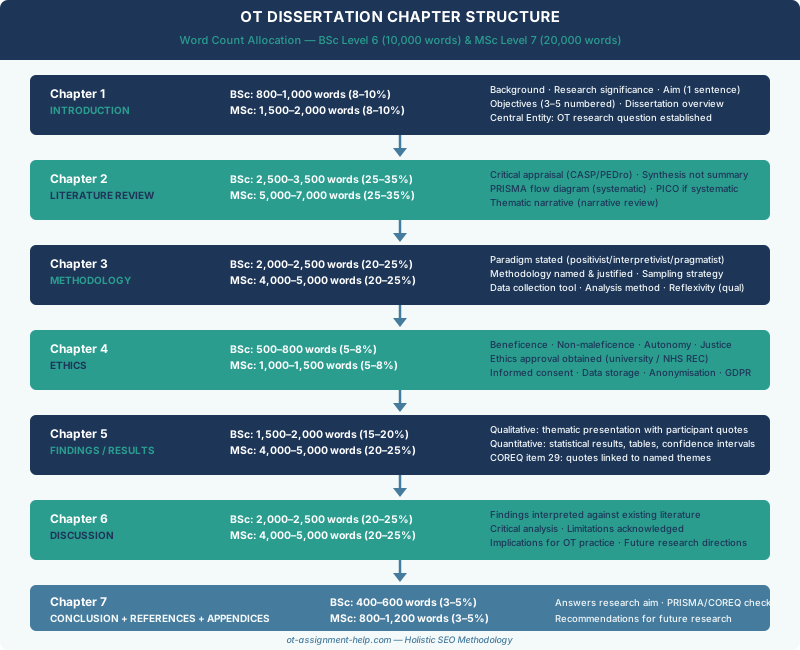
Word Count Allocation by Chapter — BSc Level 6 and MSc Level 7
Word count allocation errors are one of the most frequent structural weaknesses in OT dissertations. The proportions below are consistent across most HCPC-approved UK programmes; always apply them against your institution's specific word count with the permitted tolerance (typically ±10%).
| Chapter | BSc Level 6 — 10,000 words | MSc Level 7 — 20,000 words | Key Content Required |
|---|---|---|---|
| 1. Introduction | 800–1,000 words (8–10%) | 1,500–2,000 words (8–10%) | Background, significance to OT, research aim (1 sentence), objectives (3–5 numbered), dissertation overview |
| 2. Literature Review | 2,500–3,500 words (25–35%) | 5,000–7,000 words (25–35%) | PICO (systematic) or thematic narrative; CASP/PEDro appraisal; PRISMA flow (systematic); synthesis not summary |
| 3. Methodology | 2,000–2,500 words (20–25%) | 4,000–5,000 words (20–25%) | Paradigm stated; methodology named and justified; sampling; data collection; analysis method; reflexivity (qualitative) |
| 4. Ethics | 500–800 words (5–8%) | 1,000–1,500 words (5–8%) | Ethics approval (university/NHS REC); consent process; data storage; anonymisation; GDPR compliance |
| 5. Findings / Results | 1,500–2,000 words (15–20%) | 4,000–5,000 words (20–25%) | Qualitative: thematic sections with quotes; Quantitative: statistical results, tables, confidence intervals |
| 6. Discussion | 2,000–2,500 words (20–25%) | 4,000–5,000 words (20–25%) | Findings interpreted against literature; critical analysis; limitations; OT practice implications |
| 7. Conclusion | 400–600 words (3–5%) | 800–1,200 words (3–5%) | Direct answer to research aim; contributions summarised; future research recommendations |
A research proposal at BSc Level 6 follows a condensed version of this structure — background and rationale (800–1,000 words), aim and objectives (200–300 words), literature review summary (1,500–2,000 words), methodology (1,500–2,000 words), ethics plan (500–800 words), and timeline (200–300 words) — totalling 4,800–6,300 words. The research proposal presents the planned study without data; it is judged on the clarity of the research question, the rigour of the methodology justification, and the completeness of the ethics plan, not on findings.
Choosing a Research Methodology for Your OT Dissertation
Research methodology selection in an OT dissertation depends on the nature of the research question, not on the student's familiarity with a method. The three broad options — qualitative, quantitative, and mixed methods — are distinguished first by the type of knowledge they generate: qualitative methodology produces meaning, experience, and interpretation; quantitative methodology produces numerical measurement of effects, prevalence, or association; mixed methods produces both simultaneously or sequentially. The research question must drive the choice, not the availability of participants or the student's comfort with statistics.
Qualitative methodology is appropriate when the research question asks about experience, meaning, perception, or process: "What is the experience of occupational therapy for adults recovering from stroke?"; "How do OT practitioners understand the concept of client-centredness in mental health settings?"; "What factors influence engagement in occupation-based activity groups?" These questions cannot be answered numerically. They require an interpretivist paradigm, small purposively sampled participant groups (3–30 depending on methodology), semi-structured or unstructured interview data, and analysis that produces rich descriptive or interpretive findings. Reporting requires COREQ (Tong et al., 2007) compliance.
Quantitative methodology suits research questions about effectiveness, prevalence, or association: "Is constraint-induced movement therapy (CIMT) more effective than standard upper limb rehabilitation for improving ARAT scores in acute stroke survivors?"; "What is the prevalence of sensory processing difficulties in school-aged children referred to OT services?" These questions require a positivist paradigm, numerical data, and statistical analysis in SPSS or R. Reporting requires CONSORT for RCTs or STROBE for observational studies.
Mixed methods suits questions that neither approach alone can answer: "Is the intervention effective and acceptable to participants?" A pragmatist paradigm justifies combining both data types. Convergent design collects qualitative and quantitative data simultaneously. Sequential explanatory design collects quantitative data first and then uses qualitative data to explain the numerical findings. Sequential exploratory design uses qualitative findings to develop a quantitative instrument or hypothesis. Mixed methods is the most complex design and is most appropriate at MSc Level 7; BSc Level 6 students should ensure their methodology justification is robust before committing to a mixed design.
Qualitative OT Dissertations — IPA, Phenomenology, and Grounded Theory
IPA (Interpretative Phenomenological Analysis) is the most commonly used qualitative methodology in UK occupational therapy dissertations. Developed by Jonathan Smith (1995), IPA investigates the meaning of lived experiences for individuals through a double hermeneutic process: the researcher interprets the participant's own interpretation of their experience. IPA requires a small homogeneous purposively sampled group of 3–8 participants, semi-structured interviews of 60–90 minutes, audio-recorded and transcribed verbatim, and a six-stage analysis process: (1) reading and re-reading transcripts; (2) initial noting of descriptive, linguistic, and conceptual comments; (3) developing experiential themes from the comments; (4) searching for connections across themes; (5) moving to the next case; (6) looking for patterns across cases. The foundational reference is Smith, Flowers and Larkin (2009) Interpretative Phenomenological Analysis: Theory, Method and Research. COREQ reporting is required. IPA suits OT dissertation topics focused on patient experience of OT intervention, occupational identity in chronic illness, and meaning of occupation in recovery.
Phenomenology takes two principal forms for OT dissertations. Descriptive phenomenology, following Husserl and Giorgi's adaptation, focuses on the essence of an experience — what it is like — through epoché (bracketing prior assumptions) and reducing the data to essential structural descriptions. Interpretive or hermeneutic phenomenology, following Heidegger and van Manen, focuses on meaning within a life-world context without bracketing: the researcher's own understanding is part of the interpretive process. OT application areas include the lived experience of disability, embodied experience of occupation after acquired injury, and the experience of returning to meaningful activity post-stroke. Both forms use semi-structured or unstructured interviews and produce findings that answer what and how rather than how many.
Grounded Theory generates theory grounded in the data inductively. Charmaz's (2014) constructivist version is the most commonly cited in OT dissertations. It uses theoretical sampling — sampling continues until theoretical saturation is reached, typically requiring 15–30 participants — and constant comparative analysis to develop a substantive theory. Grounded theory is more ambitious than IPA and is more achievable at MSc Level 7 than BSc Level 6 due to the sample size and analytical complexity. OT application areas include developing a theory of client engagement in OT, understanding the process of occupational adaptation after chronic condition diagnosis, and theorising the role of occupation in mental health recovery.
Thematic Analysis (Braun and Clarke, 2006; revised and expanded in Thematic Analysis: A Practical Guide, 2022) is a qualitative analytical method rather than a standalone methodology. It is used within IPA, phenomenology, or as the analytical method within a generic qualitative study. The six-phase process is: (1) familiarise yourself with the data; (2) generate initial codes; (3) search for themes; (4) review themes; (5) define and name themes; (6) write up. Inductive coding is recommended for most OT student dissertations. Students must clarify in the methodology chapter that thematic analysis is the analytical method, not the overarching methodology — failure to state the philosophical underpinning (interpretivist paradigm, constructivist or critical realist position) is a common reason markers query the methodology chapter at Level 6 and above.
Quantitative and Mixed Methods OT Dissertations — RCTs, Cohort Studies, and SCED
A Randomised Controlled Trial (RCT) is the gold standard for testing OT intervention effectiveness. Random allocation removes selection bias; blinding reduces detection and performance bias. Assessor blinding is feasible in OT research (the assessor administering the outcome measure does not know which group the participant was in); therapist and client blinding is not feasible because the therapist cannot be unaware of the OT intervention they are delivering. CONSORT reporting is required. RCTs are most feasible at Level 7 or OTD level; NHS REC approval is required for RCTs recruiting NHS patients.
Cohort studies follow a group of participants forward from a defined starting point (prospective) or look back at existing records (retrospective) without randomisation. OT application: following a cohort of stroke OT clients from inpatient admission through community discharge, measuring IADL independence at 6 weeks, 3 months, and 12 months using FIM or Barthel Index. STROBE reporting is the relevant standard. Cross-sectional surveys collect data at a single time point to assess prevalence or associations. OT application: a survey of OT practitioners' use of standardised assessments in mental health settings, with descriptive statistics, chi-square, and Pearson correlation analysis. Cross-sectional surveys are most feasible for BSc Level 6 because NHS REC approval is not typically required when recruiting OT practitioners rather than NHS patients.
Single-Case Experimental Design (SCED) is particularly well suited to OT research because OT client populations are often small and interventions are individually tailored. The A-B design introduces an intervention after a documented baseline; A-B-A adds a withdrawal phase; A-B-A-B adds reintroduction. Data are presented as graphed time series with visual analysis and Tau-U statistical analysis. SCED is feasible at BSc Level 6 with careful ethics planning and is a strong design choice for students working with rare conditions or specialist populations where group designs are impractical. Mixed methods designs most commonly used in OT research are sequential explanatory — quantitative effectiveness data followed by qualitative experience data from the same sample — and convergent parallel, where both data types are collected simultaneously and integrated at the interpretation stage.
Tell Us Your Research Question — We'll Recommend the Right Methodology
Not sure whether your OT research question suits IPA, thematic analysis, or a systematic review? We'll review your brief and advise before any work begins.
Get a QuoteEthics Applications for OT Student Research — University Committee and NHS REC
Ethics approval is required for all OT dissertation research involving human participants. Two approval routes exist in UK OT programmes, and selecting the wrong route, or beginning participant recruitment before approval is obtained, will invalidate the research and require resubmission.
University Ethics Committee approval is required for research involving human participants that does not use NHS patients, NHS staff, or NHS patient data. The application typically includes: a research proposal summary, the PICO or research question, a participant information sheet (PIS), an informed consent form, a data storage and anonymisation plan, and a risk assessment. Turnaround is typically 4–8 weeks. University ethics is not required for desk-based research: systematic literature reviews and secondary analysis of publicly available datasets do not require ethics approval. Most BSc Level 6 qualitative studies with non-clinical participants and cross-sectional surveys of OT practitioners fall into the university ethics route.
NHS Research Ethics Committee (NHS REC) approval is required when the research involves NHS patients as participants, NHS staff recruited in their professional capacity, NHS patient records or data (even anonymised if sourced from NHS systems), or research conducted on NHS premises. The application is submitted via the Health Research Authority (HRA) through the IRAS (Integrated Research Application System) online form. The application includes a full study protocol, a site-specific assessment for each NHS Trust involved, and R&D department approval at each Trust. Full committee review takes 3–6 months; proportionate review for lower-risk studies takes 4–8 weeks. Beginning NHS REC before participant recruitment is non-negotiable: NHS Trusts will not permit research activity on their premises or with their patients without HRA approval documentation.
HCPC research ethics principles apply to OT student researchers throughout the research process. Standard 10 (confidentiality), Standard 2 (duty of care), and Standard 9 (professional boundaries) apply even when the student is acting as a researcher rather than as a clinician. This is particularly important when recruiting OT clients as research participants, where the therapeutic relationship creates a power imbalance that may compromise voluntary consent. UK GDPR and the Data Protection Act 2018 require that all personal data collected be lawfully processed (via consent or legitimate interest), anonymised or pseudonymised at the earliest opportunity, stored on secure encrypted university systems, and deleted after the retention period specified in the ethics application (typically 5–10 years for research data).
What Is a Participant Information Sheet and Consent Form in OT Research?
A participant information sheet (PIS) is a required component of every ethics application for research involving human participants. The PIS must state: the study title and purpose; what participation involves (time commitment, the nature of interview questions or other tasks, how many contact points); the risks and benefits of participation; the confidentiality and anonymisation process; the right to withdraw at any point without giving a reason and without consequence; and the researcher's and supervisor's contact details. Language must be in plain English at approximately a Grade 8 reading age with no unexplained technical terminology. A PIS is typically 2–4 pages.
The informed consent form is a separate one-page document on which the participant confirms they have read the PIS, had the opportunity to ask questions, understand that participation is voluntary, agree to participate, and agree to the use of their data as described. Both participant and researcher sign and date the form; the original is retained by the researcher and a copy given to the participant. Digital consent via a secure university platform (OneDrive forms or REDCap) is acceptable for email-recruited participants. Consent cannot be obtained retrospectively — it must precede all data collection. Applications that omit the right to withdraw statement from the PIS, or that fail to specify the data storage location and retention period, are grounds for ethics rejection. These are the two most common PIS failures in student ethics submissions.
PRISMA 2020 and COREQ — Reporting Standards for OT Dissertations
PRISMA 2020 and COREQ are the two reporting standards most relevant to OT dissertations. Selecting the correct one is determined by the research design: PRISMA 2020 (Page, McKenzie et al., 2021, BMJ) applies to systematic reviews; COREQ (Tong et al., 2007, International Journal for Quality in Health Care) applies to qualitative studies. Using the wrong standard — or omitting both — signals to markers that the student does not understand the relationship between design and reporting rigour.
PRISMA 2020 is a 27-item checklist covering title and abstract, introduction (rationale, objectives, PICO), methods (eligibility criteria, information sources, search strategy, selection process, data collection, risk of bias assessment, certainty of evidence), results (study selection PRISMA flow diagram, study characteristics, risk of bias results, results per outcome), and discussion (evidence summary, limitations, conclusions). The PRISMA flow diagram is a mandatory visual element in the Methodology or Results chapter. It documents four stages: Identification (total records from all databases), Screening (records screened after duplicate removal), Eligibility (full texts assessed with reasons for exclusion listed), and Included (studies meeting all inclusion criteria). The number of studies in the Included stage of the flow diagram must exactly match the number of studies described in the Findings chapter — inconsistency between these two figures is one of the most frequently penalised errors in MSc systematic review dissertations. The complete PRISMA 2020 checklist must be included in the Appendix with page numbers indicating where each item is addressed in the dissertation text.
COREQ provides a 32-item checklist for qualitative studies across three domains. Domain 1 — Research Team and Reflexivity (items 1–9) addresses the researcher's credentials, prior relationship with participants, and participant awareness of the researcher's background. This is presented as a reflexivity statement in the Methodology chapter. Domain 2 — Study Design (items 10–22) covers theoretical framework, participant selection, setting, data saturation, and whether an interview guide is included in the appendix. Domain 3 — Analysis and Findings (items 23–32) requires a coding tree in the appendix, quotes linked to specific named themes, and evidence of member-checking if used. OT students most commonly fail COREQ on items 4–5 (researcher's prior relationship with participants not declared), items 16–17 (interview guide not provided in the appendix, theoretical saturation not addressed), and item 29 (participant quotes not explicitly linked to the named theme they are cited as illustrating).
BSc Level 6 vs MSc Level 7 OT Dissertations — Key Differences
The difference between a BSc Level 6 and an MSc Level 7 occupational therapy dissertation is not primarily word count — it is the level of independent intellectual contribution required and the rigour of methodological positioning expected. At Level 6, the student must demonstrate understanding of research methodology and the ability to synthesise existing literature or conduct a small primary study; at Level 7, the student must demonstrate independent critical contribution and show that they can challenge, extend, or reframe existing OT knowledge.
| Criterion | BSc Level 6 | MSc Level 7 | OTD |
|---|---|---|---|
| Word count | 8,000–12,000 words | 15,000–25,000 words | 30,000–50,000 words or capstone portfolio |
| Distinction threshold | 70% | 70% (higher analytical rigour expected) | Doctoral committee or viva assessment |
| Methodology expectation | Methodology named and justified; paradigm awareness adequate | Paradigm named (positivist/interpretivist/pragmatist) and philosophically positioned; methodology justified at theoretical depth | Original knowledge contribution required; doctoral committee evaluation |
| Ethics requirement | University ethics committee for most designs; NHS REC if recruiting NHS participants | University ethics committee or NHS REC (more common at Level 7 due to larger primary studies) | NHS REC and institutional doctoral committee review; HCPC Advanced Practice standards relevant |
| PRISMA / COREQ compliance | Awareness expected; PRISMA diagram required for systematic reviews; COREQ awareness for qualitative studies | PRISMA 2020 checklist in Appendix with page references; COREQ 32-item compliance required for qualitative; GRADE for systematic reviews | Full reporting standard compliance required; GRADE mandatory for systematic reviews |
| Supervisory contact | 6–10 hours | 12–20 hours | Ongoing doctoral committee or programme-structured supervision |
| Viva voce | Some institutions use viva for borderline Level 6 cases | Some UK institutions require viva for MSc Level 7 dissertations | Viva voce typically required for OTD programme completion |
At MSc Level 7, the methodology chapter demands independent intellectual positioning that goes beyond describing methods. The student must name the research paradigm (positivist, interpretivist, or pragmatist), justify why this paradigm is epistemologically appropriate for the research question, and explain how the chosen methodology sits within it. A Level 7 student writing an IPA study who states "IPA is qualitative, therefore it suits my qualitative question" will lose marks on methodology rigour criteria; a student who states "IPA operates within an interpretivist epistemology, consistent with the double hermeneutic's premise that meaning is co-constructed between researcher and participant, which suits a research question concerned with the lived experience of occupation after acquired disability" demonstrates the analytical depth that Level 7 requires.
Occupational Therapy Research Proposal — Structure and Requirements
A research proposal in occupational therapy differs from a dissertation in one fundamental way: it plans and justifies a study that will or could be conducted, without collecting, analysing, or presenting data. The quality of a research proposal is judged on the clarity and specificity of the research question, the rigour of the methodology justification, and the completeness of the ethics plan, not on findings, because there are none.
A research proposal is frequently a separate assessment in OT programmes, assigned at Year 2 Level 5 or at the start of Level 6 or Level 7, before the student proceeds to the full dissertation. At some institutions the research proposal is the Level 6 final-year assessment; the dissertation is then the Level 7 major project. Students should confirm which applies to their programme before structuring the document.
The research proposal structure consists of six sections. Section 1 — Background and Rationale (800–1,200 words): establishes why this research is needed, identifies the gap in current OT evidence, and states the significance of addressing it for OT practice. Section 2 — Aim and Objectives (200–300 words): one clearly stated research aim in a single sentence; 3–5 specific, numbered, measurable objectives that decompose the aim. Section 3 — Literature Review Summary (1,500–2,500 words): key relevant studies critically reviewed using PICO or a thematic search approach; not a comprehensive systematic review but a focused synthesis of the most relevant existing evidence. Section 4 — Methodology (1,500–2,500 words): the research design named and justified by the nature of the research question; the sampling strategy described; the data collection tool described in sufficient detail to demonstrate feasibility; the analysis method described with the relevant foundational reference cited (Smith et al., 2009 for IPA; Braun and Clarke, 2006/2022 for thematic analysis; Charmaz, 2014 for constructivist grounded theory); a timeline for the study. Section 5 — Ethics Plan (500–800 words): which ethics committee is required and why; the informed consent process; data storage and GDPR compliance; HCPC research ethics principles applied. Section 6 — Timeline (200–300 words): a Gantt chart or narrative timeline showing the projected phases of data collection, analysis, and write-up.
Is your OT research at BSc Level 6 or MSc Level 7 — and is it a research proposal or a full dissertation? A BSc Level 6 student writing a 10,000-word narrative literature review needs different support from an MSc Level 7 student writing a 20,000-word IPA qualitative study with a full NHS REC ethics application and COREQ 32-item reporting. This service supports both at both levels, and clearly distinguishes between the research proposal and the dissertation for students who are uncertain which assignment they have been given.
Common OT Dissertation Topics at BSc and MSc Level
At BSc Level 6, common dissertation topics fall into three clusters. Service evaluation studies using a cross-sectional survey design — for example, a survey of OT practitioners' use of standardised assessments in a specific clinical setting — are feasible within the Level 6 timeline and typically require only university ethics approval. Small qualitative primary studies using IPA — for example, the lived experience of paediatric OT for parents of children with DCD — are also well-suited to Level 6 given IPA's small sample requirement of 3–8 participants. Systematic or narrative literature reviews on topics with an established OT evidence base — sensory integration for ASD, CIMT for stroke, cognitive rehabilitation for TBI, falls prevention OT — are the most common Level 6 design and require PRISMA compliance at Level 6 if systematic.
At MSc Level 7, common topics include systematic reviews with GRADE evidence certainty assessment of a specific OT intervention; IPA studies of OT practitioner or client experience, often examining a nuanced clinical phenomenon; mixed methods service evaluations combining COPM pre-post data with IPA participant interviews; and grounded theory studies developing theory about OT engagement or occupational adaptation. Topics with strong existing evidence — CIMT for stroke, sensory integration for ASD, occupation-based cognitive rehabilitation for TBI — suit systematic review at Level 7. Topics with emerging or limited evidence — telehealth OT, digital OT tools, occupational justice interventions — are excellent candidates for scoping or narrative reviews, where the contribution is in mapping the landscape rather than synthesising effectiveness data.
For help with the literature review chapter of your dissertation, see our occupational therapy literature review assignment help page. For the evidence-based practice components of your dissertation methodology and discussion, see our evidence-based practice in occupational therapy assignments page.
Using COPM and Standardised OT Assessments as Dissertation Outcome Measures
COPM (Canadian Occupational Performance Measure) is the most frequently used client-centred outcome measure in OT dissertation research. COPM uses 10-point performance and satisfaction scales; a clinically meaningful change is defined as 2 or more points on either scale (Law et al., 1994). It can be administered as a semi-structured interview in which participants identify occupational performance problems and rate their importance, performance, and satisfaction. This makes COPM suitable both as a quantitative outcome measure (pre-post comparison of performance and satisfaction scores) and as a source of qualitative data on the occupations that matter most to participants. Ethics approval is required before administering COPM to research participants; NHS REC approval is required if recruiting OT clients from NHS services.
AMPS (Assessment of Motor and Process Skills) provides logit-scale motor and process skill quality measures and requires a certified rater for standardised administration. FIM (Functional Independence Measure) and Barthel Index measure ADL independence across 18 and 10 items respectively and are widely used in physical rehabilitation dissertation research as primary outcome measures. Selecting an outcome measure for a dissertation requires alignment with the PICO Outcome component, validation of the tool in the study population, and feasibility of administration within the dissertation timeline. Administering a standardised tool that requires certification (AMPS, MOHO-based assessments) without the required training will invalidate the research. For the use of these assessment tools in OT academic assignments more broadly, see our occupational therapy case study assignment help page. For comprehensive guidance on the psychometric properties — reliability, validity, responsiveness, and minimum clinically important differences — that dissertation students must report when justifying their chosen outcome measures, see our resource on COPM and standardised measures as OT dissertation outcome measures.
Viva Voce Preparation for OT Dissertations
Viva voce (oral examination) is required at some UK institutions for MSc Level 7 dissertations, and is occasionally used at Level 6 for borderline cases. The viva typically lasts 20–40 minutes, is conducted by a panel of two examiners (internal and external or two internal), and requires the student to defend their methodology choices, explain their findings, and address limitations. The methodology chapter is the section most commonly challenged in OT dissertation vivas: examiners test whether the student understands why they made the methodological decisions documented, not merely that they can describe what those decisions were.
Common viva questions for OT dissertations include: "Why did you choose IPA over thematic analysis, and what would you have lost by using thematic analysis instead?"; "How did you ensure data saturation, and at what point did you determine it had been reached?"; "How do your findings contribute to OT practice, and what would need to change in clinical settings to implement your recommendations?"; "If you were to repeat this study, what would you change in the methodology and why?" Preparation requires re-reading the dissertation in full 48 hours before the viva, preparing concise direct answers to methodology justification questions, and being able to articulate COREQ or PRISMA compliance decisions in plain language. For full dissertation structure and methodology guidance at all levels, see our occupational therapy dissertation and research proposal help overview.
Ready to Get Expert Help With Your OT Dissertation or Research Proposal?
Full dissertation support and individual chapter help — IPA, systematic review, ethics applications, PRISMA and COREQ compliance, BSc Level 6 and MSc Level 7. Delivered by OT-qualified professionals.
Request a Quote NowFrequently Asked Questions — OT Dissertation and Research Proposal
How do I know if my OT dissertation research requires NHS ethics approval?
NHS Research Ethics Committee (REC) approval is required if your research involves NHS patients as participants (including service users of NHS OT services), NHS staff recruited in their professional capacity, NHS patient records or data (even anonymised if sourced from NHS systems), or research conducted on NHS premises. If your dissertation is a systematic literature review, secondary analysis of publicly available data, or involves recruiting participants outside the NHS — university students, members of the public, or non-NHS OT practitioners — university ethics committee approval is typically sufficient. When in doubt, contact your supervisor and the university's research ethics office before beginning recruitment: beginning data collection without the correct approval invalidates the study and cannot be remedied retrospectively.
What is IPA and why is it commonly used in OT dissertations?
IPA (Interpretative Phenomenological Analysis) is a qualitative research methodology developed by Jonathan Smith (1995) that investigates the meaning of lived experiences for individuals through a double hermeneutic process, in which the researcher interprets the participant's own interpretation of their experience. It is particularly well suited to OT dissertation research because occupational therapy is inherently concerned with how individuals experience and make sense of their daily occupations — and IPA's focus on individual meaning and experience aligns directly with this client-centred perspective. IPA requires small purposively sampled groups of 3–8 participants, semi-structured interviews of 60–90 minutes, and a double hermeneutic analytical process. The foundational reference is Smith, Flowers and Larkin (2009) Interpretative Phenomenological Analysis: Theory, Method and Research. IPA is the most commonly used qualitative methodology in UK OT dissertations at Level 6 and Level 7.
What is the difference between a research proposal and a dissertation in occupational therapy?
A research proposal is an academic assignment that plans and justifies a research study that will or could be conducted — it describes the aim, methodology, ethics approach, and timeline without collecting or presenting data. It is typically 4,000–8,000 words depending on the qualification level. A dissertation is the completed research product: it includes all sections of the proposal, plus the executed study with data collection, analysis, findings, and discussion. A dissertation is typically 8,000–25,000 words. Some OT programmes assign the research proposal as a separate assessment in Year 2 or the first semester of Year 3, with the full dissertation as the Year 3 or final-year major project. If you are unsure which assignment you have been given, check the assessment brief for the word "proposal" — if the brief specifies that you do not need to collect data, it is a research proposal, not a dissertation.
Can I use COPM as a data collection tool in my OT dissertation?
Yes — COPM (Canadian Occupational Performance Measure) is a validated client-centred outcome measure used widely in OT research as a primary data collection tool. For a dissertation, COPM can be administered as a semi-structured interview to assess participants' self-reported occupational performance and satisfaction. Its 10-point performance and satisfaction scales provide quantitative data suitable for pre-post comparison in a pilot or feasibility study, while the qualitative content of the interview can provide thematic data for an IPA or thematic analysis study. Ethics approval is required before administering COPM to research participants. If recruiting NHS OT clients as participants, NHS REC approval is likely to be required. Ensure the COPM administration is included in your ethics application's data collection procedure description.
Does an OT MSc dissertation need to include a PRISMA flow diagram?
Yes, if your MSc dissertation uses a systematic review methodology. PRISMA 2020 (Page et al., 2021) is the current reporting standard and requires a PRISMA flow diagram illustrating four stages: Identification (total records identified from all databases), Screening (records remaining after duplicate removal and title/abstract screening), Eligibility (full texts assessed with reasons for exclusion), and Included (studies meeting all inclusion criteria). The diagram belongs in the Methodology or Results chapter, and the complete 27-item PRISMA 2020 checklist with page numbers must be included as an Appendix. For qualitative MSc dissertations, COREQ (Tong et al., 2007) is the relevant reporting standard — a 32-item checklist, not a flow diagram. Using PRISMA for a qualitative study, or COREQ for a systematic review, indicates a mismatch between research design and reporting standard that will be flagged in the marking.