Occupational Therapy Assessment Tools Assignment Help — COPM, AMPS, FIM, Barthel Index and MOHOST
Standardised OT assessments — including COPM, AMPS, FIM, Barthel Index, and MOHOST — appear in OT case study, clinical reasoning, and evidence-based practice assignments at every level from BSc Level 5 to MSc Level 7. Assignments require not just score reporting but score interpretation, tool selection rationale, and psychometric property awareness. Selecting the wrong tool for a given population or misinterpreting a score band loses marks at every academic level. This page covers all five tools with their exact scoring parameters, interpretation thresholds, and the psychometric framework for critical appraisal at Level 6 and above.
OT Assessment Categories — Standardised, Performance-Based, Self-Report and Screening
Occupational therapy assessments categorise into performance-based, self-report, and proxy-report formats — a classification that drives tool selection rationale in assignments. Performance-based or observational assessments require the OT to observe actual task performance: AMPS and the Kitchen Task Assessment are performance-based, avoiding self-report bias and remaining valid when the client has cognitive impairment or communication difficulties. Self-report assessments require the client to rate their own performance, satisfaction, or impairment: COPM and DASH are self-report tools, carrying high face validity and client-centredness, but their validity is compromised when significant cognitive impairment affects insight or communication. Proxy-report assessments use a carer, family member, or clinician to rate on the client's behalf: MOHOST and Barthel Index (in some contexts) are proxy-reportable, reducing self-report validity concerns but introducing a carer-perspective bias that assignments should acknowledge.
Standardised assessments have published psychometric properties, specific administration protocols, scoring manuals, and population norms — all five tools covered on this page are standardised. Non-standardised assessments are informal clinical tools without published norms and carry lower evidence weight in assignments. Screening tools identify the presence or absence of difficulty — MoCA and Allen Cognitive Level Screen are screening tools. Comprehensive tools describe the nature and extent of difficulty in detail — AMPS and Vineland Adaptive Behaviour Scales are comprehensive tools used after screening identifies a domain of concern.
The matching principle for clinical reasoning in assignments: performance-based assessments are more valid for clients with cognitive impairment or communication difficulties; self-report is more valid for cognitively intact clients with clear occupational goals. Justifying assessment choice using this framework earns clinical reasoning marks.
COPM — Client-Centred Occupational Performance Measure — Full Scoring and Application
COPM identifies occupational performance priorities through a client-directed semi-structured interview across three occupation categories: self-care (personal care, functional mobility, community management), productivity (paid and unpaid work, household management, play and school), and leisure (quiet recreation, active recreation, socialisation). The client, not the OT, defines which occupational problems matter most — this client-centredness is COPM's primary theoretical claim.
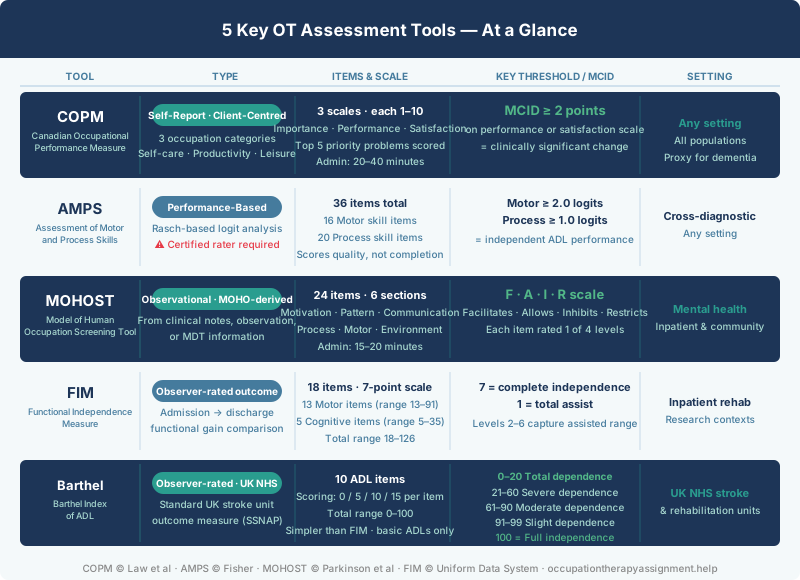
Three scales, each rated 1–10, structure the assessment. The importance scale (1 = not important at all; 10 = extremely important) is used during problem identification to prioritise which occupational problems to score. The top five most important problems are carried forward. The performance scale (1 = not able to do it at all; 10 = able to do it extremely well) captures the client's self-rated ability. The satisfaction scale (1 = not satisfied at all; 10 = extremely satisfied) captures how satisfied the client is with their current performance level. Both performance and satisfaction are scored for each of the five priority problems.
COPM score calculation: sum all selected performance scores and divide by the number of problems to produce a mean performance score. Repeat for satisfaction. For example: five problems scored 3, 4, 2, 5, 4 on performance — sum 18 ÷ 5 = COPM performance score of 3.6. Administration takes 20–40 minutes. COPM is validated across multiple populations including stroke, dementia, mental health, paediatrics, and acquired brain injury.
COPM Score Calculation and Clinically Significant Change — What OT Assignments Must Report
A minimum 2-point change on the performance or satisfaction scale represents clinically significant change — the smallest improvement large enough to be meaningful beyond measurement error. A client whose COPM performance score improves from 3.2 to 4.9 (a change of 1.7 points) has not demonstrated clinically significant improvement; a change from 3.2 to 5.5 (a change of 2.3 points) meets the threshold. Assignments that report "the client's COPM score improved" without stating the numeric change and comparing it to the 2-point threshold omit the clinical reasoning component of outcome evaluation. For proxy administration in moderate-to-severe dementia, the carer reports on behalf of the client, guided by the OT — this adaptation must be explicitly documented in the assignment as proxy administration.
AMPS — Assessment of Motor and Process Skills — Logit Scores and Certified Administration
AMPS measures the quality of ADL motor and process skill performance through direct observation of the client completing two or three familiar ADL tasks chosen by the client. What AMPS measures is not whether the task is completed, but how — the efficiency, safety, effort, and independence of each skill action during performance.
Motor skills are assessed across 16 items covering posture, mobilises, stabilises, aligns, positions, walks, reaches, bends, grips, manipulates, coordinates, moves, lifts, calibrates, flows, and endures. Process skills are assessed across 20 items covering paces, attends, heeds, chooses, uses, handles, inquires, initiates, continues, sequences, terminates, searches and locates, gathers, organises, restores, navigates, notices and responds, accommodates, adjusts, and benefits. The 36 items total are rated according to the quality of performance — errors, effort, safety, and independence are each considered.
Raw AMPS skill ratings are converted to logit measures using Rasch analysis, creating an equal-interval scale that allows meaningful comparisons across different tasks, different clients, and different populations. Interpretation thresholds: ADL motor score at or above 2.0 logits indicates independent functional ADL motor performance; ADL process score at or above 1.0 logits indicates independent functional ADL process performance. Both scores must be reported and interpreted separately in OT assignments — the motor and process thresholds differ and both domains contribute distinct clinical information.
AMPS requires completion of a certified AMPS training course: OT students on placement are not qualified to administer AMPS independently. In assignments, AMPS should be described as administered by a certified supervising OT, or recommended as a next step requiring a certified rater. Writing "I administered the AMPS" in a student placement case study misrepresents professional scope of practice.
Interpreting AMPS Logit Scores — Below Threshold and Above Threshold in OT Assignments
ADL motor below 2.0 logits indicates difficulty with the physical aspects of ADL performance — moving, reaching, gripping — and directs OT intervention toward motor-based ADL goals such as upper limb strengthening, grading task demands, and adapting equipment. ADL process below 1.0 logits indicates difficulty with organisation, sequencing, and adaptive aspects of task performance — initiating, problem-solving during tasks — and directs OT intervention toward cognitive rehabilitation, routine structuring, and environmental cueing. Reporting only one threshold or combining both into a single interpretation misses the clinical distinction the Rasch dual-domain structure is designed to provide.
MOHOST — Model of Human Occupation Screening Tool — Six Sections and Rating Scale
MOHOST profiles occupational functioning across six domains using a four-point rating scale, derived directly from the Model of Human Occupation (MOHO). Its six sections map onto MOHO's theoretical constructs: Section 1 Motivation for Occupation covers occupational values, interests, and personal causation (MOHO volition); Section 2 Pattern of Occupation covers roles, habits, and routines (MOHO habituation); Section 3 Communication and Interaction Skills covers interpersonal communication in occupational contexts; Section 4 Process Skills covers cognitive aspects of occupational performance (MOHO performance capacity — cognitive dimension); Section 5 Motor Skills covers physical aspects of occupational performance (MOHO performance capacity — motor dimension); Section 6 Environment covers physical, social, and cultural environmental factors influencing occupational participation.
The four-point rating scale applies to each of the 24 items across the six sections: Facilitates (F) — the factor actively supports occupational participation; Allows (A) — the factor neither facilitates nor inhibits participation; Inhibits (I) — the factor begins to impede participation and requires OT attention; Restricts (R) — the factor severely limits occupational participation and is the most clinically significant rating. Administration takes 15–20 minutes and can be completed from clinical notes, OT session observation, or multidisciplinary team information — it does not require a separate formal testing session.
MOHOST is primarily used in mental health OT settings — acute inpatient psychiatric units, community mental health teams, rehabilitation units, and forensic OT. Its strength in mental health assignments is that it provides a structured observational profile across all MOHO domains simultaneously, connecting assessment findings to the theoretical framework in a format examiners can follow.
MOHOST Rating Scale — F, A, I, R — Applying the Four-Point Scale in OT Assignments
Each MOHOST rating must be supported by a specific clinical observation or documented behaviour — not a general impression. "Section 1 Motivation for Occupation rated Facilitates (F)" is an incomplete entry. "Section 1 Motivation for Occupation rated Facilitates (F): the client reports high interest in cookery and actively requests cooking sessions, demonstrating intact volition and personal causation" is a complete MOHOST documentation entry that connects the rating to observed evidence and to the MOHO theoretical construct. Assignments that apply the F-A-I-R scale without observation-based justification for each rating receive limited credit for clinical reasoning.
FIM — Functional Independence Measure — Motor and Cognitive Subtotals
The FIM quantifies the level of assistance required for ADL performance across 18 items using a seven-point scale, where 7 = complete independence (no helper, no device needed), 6 = modified independence (uses device or takes more time), 5 = supervision or setup (helper present but no physical assistance given), 4 = minimal assist (the person provides 75% or more of the effort), 3 = moderate assist (the person provides 50–74% of the effort), 2 = maximal assist (the person provides 25–49% of the effort), and 1 = total assist (the person provides less than 25% of the effort).
The 18 items divide into 13 motor items — eating, grooming, bathing, upper body dressing, lower body dressing, toileting, bladder management, bowel management, transfer to bed and chair, transfer to toilet, transfer to tub or shower, locomotion by walking or wheelchair, and stair negotiation — and 5 cognitive items: comprehension, expression, social interaction, problem solving, and memory. The motor subtotal ranges from 13 to 91; the cognitive subtotal from 5 to 35; the total FIM from 18 to 126. FIM is used primarily in inpatient rehabilitation settings as an admission-discharge comparison tool that quantifies functional gain during the rehabilitation episode.
| FIM Level | Score | Description | Patient Effort |
|---|---|---|---|
| Complete independence | 7 | No helper, no device, within reasonable time | 100% |
| Modified independence | 6 | Uses device, takes more time, or safety concern | 100% |
| Supervision / setup | 5 | Helper required but gives no physical assistance | 100% |
| Minimal assist | 4 | Patient provides ≥75% of effort | ≥75% |
| Moderate assist | 3 | Patient provides 50–74% of effort | 50–74% |
| Maximal assist | 2 | Patient provides 25–49% of effort | 25–49% |
| Total assist | 1 | Patient provides less than 25% of effort | <25% |
Barthel Index — Ten ADL Items, Scoring, and Interpretation Bands
The Barthel Index measures functional dependence across ten ADL items using a 0/5/10/15 scoring system. The ten items are: feeding, bathing, grooming, dressing (upper and lower body), bowel control, bladder control, toilet use, transfers from bed to chair, mobility on a level surface, and negotiating stairs. Not all items score up to 15 — most items score 0/5/10, while mobility and transfers score up to 15 — giving a maximum total of 100 despite only ten items.
Five interpretation bands apply to the 0–100 total score. A Barthel of 0–20 indicates total dependence: the person requires 24-hour nursing care for all ADLs. Barthel 21–60 indicates severe dependence: the person requires substantial help with most ADLs. Barthel 61–90 indicates moderate dependence: the person requires help with some ADLs but manages others independently. Barthel 91–99 indicates slight dependence: the person manages nearly all ADLs but requires minimal assistance with one or two tasks. Barthel 100 indicates full independence across all ten ADL items.
The Barthel Index is the standard outcome measure in UK NHS stroke units and is a required data point in the Sentinel Stroke National Audit Programme (SSNAP) at both admission and discharge. Reporting an admission Barthel score, a discharge Barthel score, the change score, and its functional interpretation — not merely the numerical change — is the complete outcome evaluation format that earns marks in stroke OT case study assignments.
Barthel Index vs FIM — Choosing the Right Tool for OT Assignments
The Barthel Index is appropriate when the clinical context is a UK NHS stroke or rehabilitation unit, when basic ADL measurement is the priority, and when a simple, widely-understood measure is needed for UK clinical records. FIM is appropriate when the context is a formal inpatient rehabilitation programme, when capturing cognitive functioning separately from motor functioning is required, or when greater sensitivity to small functional changes in the severe dependence range is needed. FIM's seven-point scale detects smaller incremental changes than Barthel's 0/5/10/15 structure, making it more sensitive for severely dependent patients. In assignments, the justification "I used the Barthel Index because it is the standard SSNAP outcome measure for UK stroke OT and gives a widely understood functional dependence classification" is stronger than "I used it because it is commonly used."
Psychometric Properties — Validity, Reliability and MCID in OT Assessment Assignments
Psychometric properties determine whether an OT assessment tool produces valid and reliable measurements — and critical appraisal of these properties is required at Level 6 and above. Validity asks whether the tool measures what it claims to measure. Content validity asks whether the tool covers all relevant aspects of the construct — the Barthel Index has limited content validity for IADL assessment, a limitation to acknowledge when using it in community OT assignments. Construct validity asks whether the tool measures the theoretical construct it claims to. Criterion validity asks whether the tool correlates with another established gold-standard measure of the same construct.
Reliability asks whether the tool produces consistent measurements. Inter-rater reliability measures agreement between different raters scoring the same client — an Intraclass Correlation Coefficient (ICC) at or above 0.75 is the accepted threshold for good inter-rater reliability in OT research. Test-retest reliability measures consistency of the same rater scoring the same client on two occasions separated by time — important for outcome monitoring. Internal consistency measures consistency across items within the tool, typically expressed as Cronbach's alpha with a threshold of 0.7 or above.
Sensitivity is the tool's ability to detect true positives — people who have the difficulty. Specificity is the tool's ability to correctly identify true negatives — people who do not have the difficulty. A highly sensitive screening tool misses few cases; a highly specific tool generates few false positives. These properties are discussed at MSc Level 7 when justifying tool selection for screening versus comprehensive assessment purposes.
MCID (Minimum Clinically Important Difference) is the smallest change in score that represents a meaningful difference to the person. For COPM, the MCID on performance or satisfaction scales is a 2-point change. Acknowledging the MCID when evaluating intervention outcomes is a Level 6 expectation — reporting that "scores improved" without comparing the change to the MCID threshold is an incomplete outcome evaluation.
With five different OT assessment tools available — COPM, AMPS, MOHOST, FIM, and Barthel — how do you choose the right one for your assignment, and what clinical reasoning justifies the selection?
Assessment Tool Selection — Matching OT Tools to Clinical Context in Assignments
Tool selection rationale is a clinical reasoning academic skill, not a description of common practice. The selection decision depends on four factors: the purpose of the assessment (screening versus outcome measurement versus quality-of-performance assessment versus occupational profiling); the client's cognitive status (intact cognition supports self-report validity; impaired cognition favours performance-based tools); the clinical setting (UK NHS stroke unit standardises on Barthel and SSNAP; inpatient rehabilitation favours FIM; mental health uses MOHOST; community OT centres on COPM); and rater qualification (AMPS cannot be administered without AMPS certification).
Quick selection guide: screening for cognitive impairment — MoCA or ACLS; functional outcome measurement in UK stroke — Barthel Index; quality of ADL performance with certified rater — AMPS; client-centred occupational goal identification — COPM; MOHO-based occupational profiling in mental health — MOHOST; admission-discharge functional gain in rehabilitation — FIM. For comprehensive OT case study structure guidance on where assessment documentation appears within a case study assignment, see our case study assignment help page. For how psychometric appraisal integrates with evidence-based practice in OT assignments, see our EBP assignment help page.
Assessment Tools in Condition-Specific OT Assignments — Where Each Tool Appears
Knowing which tools are validated and used in specific condition contexts is essential for accurate case study assignment writing. For stroke OT assignments: Barthel Index (admission/discharge SSNAP requirement), FIM (inpatient rehabilitation), COPM (client-centred goal identification), AMPS (quality of ADL performance), and DASH (upper limb function). For dementia OT assignments: MoCA (cognitive screening, 0–30 with mild CI 18–25), MMSE (widely documented in UK records), AMPS (functional assessment by observation, valid when self-report is unreliable), and COPM with proxy administration. For mental health OT assignments: MOHOST (MOHO-based observational profiling across six sections), COPM (client-identified occupational priorities), and OCAIRS (Occupational Circumstances Assessment Interview and Rating Scale). For paediatric and autism OT assignments: Sensory Profile 2 (four-quadrant sensory processing), MABC-2 (motor coordination, percentile-based), Vineland Adaptive Behaviour Scales, and CAPE (Children's Assessment of Participation and Enjoyment). For additional depth on assessment tools in condition-specific contexts, see our stroke OT case study assignment help, dementia OT assignment help, and autism OT assignment help pages.
FAQ — OT Assessment Tools Assignment Questions
What is the clinically significant change for COPM and why does it matter in OT assignments?
Clinically significant change on COPM requires a minimum 2-point improvement on the performance or satisfaction scale — this means the change exceeds measurement error and is considered meaningful to the client. In OT assignments, this threshold matters for outcome evaluation: if a client's COPM performance score improves from 3.2 to 4.9 (a change of 1.7 points), this does not meet the 2-point threshold and the OT must acknowledge this in the outcome section. If it improves from 3.2 to 5.5 (a change of 2.3 points), this is clinically significant improvement that can be cited as evidence of intervention effectiveness. Reporting "the score improved" without stating the numeric change and comparing it to the threshold is an incomplete outcome evaluation.
Can a student on placement administer the AMPS?
No. AMPS administration requires completion of a certified AMPS training course delivered by an approved AMPS trainer. OT students on placement are not qualified to administer AMPS independently. In case study assignments, AMPS should be described as administered by the supervising certified OT, or noted as a recommended next step requiring a certified rater. Writing "I administered the AMPS" in a student placement case study misrepresents professional scope of practice and may be flagged by markers as a clinical competency error.
What is the difference between MOHOST and COPM and when would you use each in an OT assignment?
COPM is a client-directed self-report tool: the client identifies their occupational performance priorities through a semi-structured interview. It is most appropriate when the client has sufficient communication ability and insight to self-report, and when identifying client-centred goals is the primary purpose. MOHOST is an observational screening tool derived from MOHO: the OT observes and rates the client's occupational functioning across six domains using the F-A-I-R scale. It is appropriate in mental health settings where client insight may be limited, or where a broad MOHO-based occupational profile is needed. Both tools can be used in the same case study — COPM for client-centred goal identification and MOHOST for theoretical MOHO-based functional profiling — but each must be justified by its specific purpose.
What does an ICC of 0.75 or above mean for OT assessment tool reliability in an assignment?
An Intraclass Correlation Coefficient (ICC) at or above 0.75 is the accepted threshold for good inter-rater reliability — it means that when two different raters score the same client on the same tool, their scores agree at a level considered acceptable for clinical and research use. In OT assignments at Level 6 and above, citing a specific ICC value demonstrates psychometric literacy: "The Barthel Index demonstrates acceptable inter-rater reliability (ICC 0.87–0.99 in stroke populations), making it a reliable measure for comparing admission and discharge functional status." ICC values below 0.75 indicate poor inter-rater agreement and would be a limitation to identify in critical appraisal sections.
What are the limitations of the Barthel Index that I should acknowledge in an OT assignment?
Four limitations are relevant to OT assignments. First, the Barthel measures only basic ADLs: IADL performance — cooking, managing finances, community mobility — is not captured, meaning functional independence beyond basic self-care is underestimated. Second, it measures independence level only: quality of performance, safety, and efficiency are not assessed, unlike AMPS which measures how tasks are performed. Third, there is a ceiling effect: a Barthel of 100 does not indicate full occupational independence — significant difficulties with IADLs, work, and leisure may remain. Fourth, the 0/5/10/15 scoring structure means small incremental changes in the moderate-to-severe dependence range may not be detected, making FIM more sensitive for measuring small gains during intensive inpatient rehabilitation. Acknowledging at least two of these limitations in a critical appraisal section demonstrates Level 6 analytical depth.
Get Expert Help With Your OT Assessment Tools Assignment
COPM score calculation, AMPS logit thresholds, MOHOST F-A-I-R ratings, FIM motor and cognitive subtotals, Barthel interpretation bands, psychometric appraisal — all covered by OT assignment specialists.
Request a Free Quote