Autism Occupational Therapy Assignment Help — Sensory Integration, ASD Assessments and Neurodiversity-Affirming Practice

Occupational therapy addresses autism through three primary clinical lenses: sensory processing differences across seven sensory systems (tactile, proprioceptive, vestibular, visual, auditory, gustatory, and olfactory), motor coordination challenges frequently co-occurring with developmental coordination disorder, and IADL participation difficulties driven by executive function demands and sensory complexity. Autism OT academic assignments must reflect neurodiversity-affirming practice principles alongside NICE NG142 guideline requirements, and they must demonstrate clinical assessment literacy with specific tools (Sensory Profile 2, MABC-2, Vineland Adaptive Behaviour Scales) and evidence-based intervention rationale. This service provides expert autism OT assignment help for BSc and MSc students across all these areas.
Get Expert Help With Your Autism OT Assignment — Request a Free Quote
OT-specialist writers with paediatric and autism experience. Sensory Profile 2, Ayres SI fidelity criteria, NICE NG142, and neurodiversity-affirming language applied correctly.
Request a QuoteAutism Characteristics Relevant to OT Assignments — What the Assessment Must Address
Autism presents with sensory processing differences across seven sensory systems, and these differences are the primary driver of occupational performance challenges in most autism OT case study assignments. The seven systems are: tactile (touch and skin sensation), proprioceptive (body position and movement feedback), vestibular (balance and spatial orientation), visual (light, colour, movement in the environment), auditory (sound frequency, volume, and proximity), gustatory (taste and oral texture), and olfactory (smell). Both hypo-responsivity (under-registration: threshold too high, needs more input to register a response) and hyper-responsivity (over-registration: threshold too low, overwhelmed by ordinary sensory input) can occur within the same individual across different systems. A student who addresses only one or two sensory systems in an autism OT assignment demonstrates limited clinical breadth; addressing all seven with specific occupational performance implications demonstrates the depth that earns distinction-level marks.
Motor coordination challenges co-occur in approximately 50% of autistic individuals, most commonly presenting as Developmental Coordination Disorder (DCD). The MABC-2 is the standardised motor assessment used for DCD screening in autism OT assignments. DCD in autism affects handwriting, self-care ADLs (dressing, personal hygiene), and sports participation. Executive function difficulties (planning, task initiation, cognitive flexibility, working memory) underpin IADL performance and are a frequently underaddressed priority in undergraduate OT assignments. IADL difficulties in autism are often more significant than basic ADL difficulties, and recognising this as a critical analysis point demonstrates the clinical reasoning depth that Level 6 and Level 7 assessors reward.
Restricted interests and repetitive routines affect IADL variability, occupational flexibility, and goal-setting approaches. In assignment writing, routine disruption must be framed as an occupational performance consideration, not a behavioural problem to be eliminated. Social communication differences affect participation in group-based OT interventions, require AAC consideration, and necessitate adapted COPM administration approaches in some cases.
Sensory Processing Differences Across Seven Systems — OT Assignment Implications
| Sensory System | Hyper-responsivity (Low threshold) | Hypo-responsivity (High threshold) | OT Assessment Indicator | OT Intervention Direction |
|---|---|---|---|---|
| Tactile | Clothing sensitivity, refusal of grooming, avoidance of messy play, distress from unexpected touch | Under-registering pain or temperature, handling objects roughly, seeking deep pressure | SP2 Touch subscale; tactile discrimination testing | Graded tactile exposure; adapted clothing; deep pressure input |
| Proprioceptive | Avoidance of physical contact; dislikes weight-bearing activities | Crashing, bumping, seeking heavy work; poor grading of force; toe walking | SP2 Body Position subscale; MABC-2 balance | Heavy work activities; proprioceptive input before fine motor tasks |
| Vestibular | Motion sickness; gravitational insecurity; avoids swings or heights | Spinning and rocking for vestibular input; seeks fast movement | SP2 Movement subscale; balance assessment | Linear movement before rotary; slow, predictable vestibular input |
| Visual | Sensitivity to fluorescent light, busy visual environments; uses peripheral vision | Misses visual cues; needs high visual contrast to engage | SP2 Visual subscale; classroom environment observation | Reduce visual clutter; consistent lighting; visual supports and schedules |
| Auditory | Covers ears, distressed by sudden sounds, dislikes crowded noisy environments | Does not respond to name; seeks loud music or noise | SP2 Auditory subscale; audiological screening context | Noise-reduction tools; predictable soundscapes; ear defenders for transitions |
| Gustatory | Restricted food repertoire based on texture, temperature, or taste; gagging | Mouthing non-food items; craves intense flavours | SP2 Oral subscale; feeding history; IADL meal preparation assessment | Graded food introduction; oral motor activities; mealtime environment modification |
| Olfactory | Distressed by environmental smells (cleaning products, food, perfume); avoids rooms | Smells objects and people excessively; does not register smoke or hazardous smells | SP2 Smell subscale; home and school environment observation | Fragrance-free products; advance preparation for unavoidable odours; safety awareness |
Motor Coordination and IADL Difficulties in Autism — Co-occurring Challenges for OT
DCD co-occurs in approximately 50% of autistic individuals and is assessed with the MABC-2 (Movement Assessment Battery for Children, 2nd edition). A total test score at or below the 5th percentile, combined with functional impact on ADL or school participation and no other neurological explanation, meets DSM-5 criteria for DCD. In autism OT assignments, DCD must be documented as a separate co-occurring condition with its own assessment rationale and intervention plan, not subsumed into the general autism presentation.
IADL difficulties in autism are frequently more significant than basic ADL difficulties and are less often addressed in undergraduate assignments. Executive function underpins IADL performance: planning a meal requires task initiation, sequencing, cognitive flexibility when ingredients change, and working memory for concurrent steps. Sensory processing adds further complexity: grocery shopping involves crowded aisles (auditory and visual overload), unfamiliar textures (tactile), and unexpected interactions (social communication). Identifying IADL as a priority, rather than focusing only on basic self-care, demonstrates critical analysis of occupational need and earns higher marks at Level 6 and above.
OT Autism Assessments — Sensory Profile 2, MABC-2, Vineland, and More
The Sensory Profile 2 profiles sensory processing across four quadrants defined by two axes: neurological threshold (low = becomes over-stimulated with minimal input; high = needs more input to register a response) and self-regulation style (active = the person behaviorally adjusts their environment; passive = the person allows sensory input to affect them without adjusting). The four quadrant names must appear in any autism OT assignment that uses the SP2: Seeker (high threshold, active regulation), Avoider (low threshold, active regulation), Sensor (low threshold, passive regulation), and Bystander (high threshold, passive regulation).
Sensory Profile 2 — Four Quadrants Explained for OT Assignments
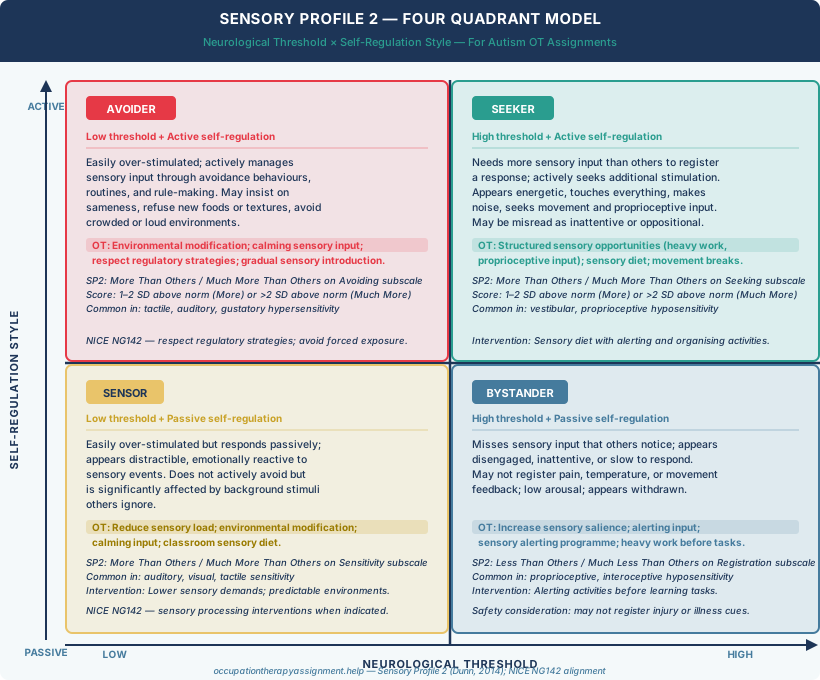
The Seeker quadrant (high threshold, active self-regulation) characterises autistic individuals who actively seek additional sensory input. Behaviours appear as touching everything, seeking movement, making noise, and craving proprioceptive feedback. OT intervention: structured sensory opportunities such as heavy work activities, sensory diet with alerting input, and movement breaks before fine motor tasks. The Avoider quadrant (low threshold, active self-regulation) characterises individuals who actively manage sensory over-stimulation through avoidance behaviours: insisting on sameness, refusing new foods, avoiding crowded environments. OT intervention: environmental modification to reduce sensory demands; respect for regulatory strategies; gradual and consensual introduction of new sensory experiences. The Sensor quadrant (low threshold, passive self-regulation) characterises individuals who are passively over-stimulated: they appear distractible, emotionally reactive, and easily overwhelmed by background stimuli others ignore. OT intervention: reduce environmental sensory load; calming sensory input; classroom sensory diet. The Bystander quadrant (high threshold, passive self-regulation) characterises individuals who miss sensory cues others notice: they appear disengaged, inattentive, and slow to respond. OT intervention: increase sensory salience; alerting activities before tasks requiring attention; safety monitoring for pain and temperature under-registration.
SP2 score interpretation uses four bands: Much More Than Others (more than 2 SD above the norm, significant difference from age peers); More Than Others (1 to 2 SD above the norm, difference noted); Similar To Others (within 1 SD, typical range); Less Than Others or Much Less Than Others (below the normative threshold). Many autistic individuals show mixed profiles across sensory systems, meaning a single quadrant label does not represent the whole person. Assignments must report SP2 results system by system, not collapse them into a single quadrant characterisation.
The MABC-2 (Movement Assessment Battery for Children, 2nd edition) provides standardised motor assessment across three components (manual dexterity, aiming and catching, balance) with three age bands (3 to 6 years, 7 to 10 years, 11 to 16 years). A total test score at or below the 5th percentile places the child in the Movement Difficulty band. The Vineland Adaptive Behaviour Scales (3rd edition) documents functional independence across communication, daily living skills, socialisation, and motor domains. Vineland normed data includes an autism spectrum sample, making it particularly relevant for autism OT assignments. The CAPE (Children's Assessment of Participation and Enjoyment) documents leisure participation frequency, involvement, and enjoyment, and is useful for documenting restricted participation patterns in autism case studies. The ADOS-2 (Autism Diagnostic Observation Schedule, 2nd edition) is a diagnostic tool administered by psychologists or speech-language pathologists. In OT assignments, the ADOS-2 appears as the diagnostic context for the case, not as an OT assessment output. Students who present the ADOS-2 as an OT assessment tool will lose marks for clinical role confusion.
OT Autism Interventions — From Ayres SI to CO-OP and AAC
Ayres Sensory Integration delivers intervention through five fidelity criteria that distinguish it from general sensory activities: (1) SIPT-informed assessment (Sensory Integration and Praxis Tests, used to identify the specific sensory processing profile before treatment planning); (2) active child participation (the child initiates and directs the activity, not the therapist); (3) enhanced sensory opportunities (a controlled sensory environment with specialised equipment including suspended swings, ball pits, tactile media, and proprioceptive input sources); (4) just-right challenge (activity is graded to the child's current capacity, promoting adaptive responses at the edge of their ability); (5) therapeutic alliance (the quality of the relationship between therapist and child is central to the therapeutic process, not incidental to it). When all five criteria are met, the intervention is Ayres Sensory Integration. When any criterion is absent, the intervention is a sensory-based activity, which carries a different and weaker evidence base.
| Intervention | Mechanism | Protocol Requirements | Evidence Level | Best-Use Population |
|---|---|---|---|---|
| Ayres Sensory Integration (ASI) | Child-directed sensory-motor play in enriched environment; therapist grades challenge to promote adaptive responses | Five fidelity criteria; SIPT-informed assessment; certified therapist; specialist equipment | Level 2 moderate; ongoing Cochrane review research; NICE NG142 recommends as an option when indicated | Autistic children with sensory processing difficulties; early childhood; school-age |
| JASPER (Joint Attention Symbolic Play Engagement Regulation) | Targets joint attention, symbolic play, and social engagement through OT and SLT collaboration | Structured parent and therapist training; session protocol; fidelity monitoring | Level 2 moderate; RCT evidence in early childhood ASD | Early childhood autism; pre-verbal and early verbal; social participation goals |
| DIR/Floortime | Child-led relationship-based play across four engagement levels; builds floor-up social-emotional development | Therapist training required; parent coaching integral; four levels: shared attention, engagement, intentional communication, shared problem-solving | Level 3 moderate; emerging RCT evidence; widely used in paediatric OT and mental health | Young autistic children; relationship-building goals; CAMHS paediatric OT contexts |
| CO-OP (Cognitive Orientation to Occupational Performance) | Metacognitive strategy training using Goal-Plan-Do-Check; child discovers own motor solutions | Goal-Plan-Do-Check cycle taught explicitly; guided discovery questioning; child requires sufficient language and metacognition | Level 1–2 strong for DCD; growing evidence for autism; NICE DCD guidelines recommend task-oriented approaches | Autistic children with motor goals and sufficient language capacity; DCD co-occurrence |
| Visual Supports | Visual schedules, task cards, environmental labels reduce anxiety through predictability scaffolding | Individualised to child; introduced collaboratively; reviewed and updated regularly | Level 3 moderate; strong expert consensus; NICE NG142 supports use for routine and IADL support | All autism presentations; particularly beneficial with communication differences and routine difficulties |
| AAC (Augmentative and Alternative Communication) | OT contributes device selection, positioning, upper limb access method, and IADL integration; collaborative with SLT | OT scope: access method, positioning, ADL integration; SLT scope: language and vocabulary; joint working required | Level 2–3 moderate; strong clinical consensus for non-verbal and minimally verbal autism | Non-verbal or minimally verbal autistic individuals; complex communication needs |
| IADL Skill Training with Task Analysis | Activity analysis breaks IADL tasks into sequential steps graded for sensory demands; autism-specific adaptations include sensory modification and predictability scaffolding | Individualised task analysis; sensory demand mapping per step; gradual introduction with client-led pacing | Level 3 strong; evidence-based practice standard for IADL OT across conditions | All autism presentations; particularly adolescent and adult IADL independence goals |
CO-OP Approach — Motor Learning in Autism OT Assignments
The CO-OP approach (Cognitive Orientation to daily Occupational Performance) teaches motor skill acquisition through metacognitive strategy training rather than therapist-directed repetition. The child identifies their own movement problem, generates a plan using the Goal-Plan-Do-Check framework, executes the plan, and evaluates whether it worked. If the plan did not work, the child revises the strategy independently through guided discovery questioning from the OT ("What was your plan?" "Did it work?" "What would you try differently?"). The OT coaches rather than demonstrates, keeping the child as the active agent in their own motor learning. CO-OP has been validated for DCD and has growing research support for autism, making it appropriate for autism OT assignments where motor goals are present (handwriting, dressing, ball skills) and the client has sufficient language and metacognitive capacity. For clients with limited language, CO-OP is less appropriate; task repetition with visual support scaffolding and sensory modification is a more accessible alternative. Including CO-OP with its Goal-Plan-Do-Check mechanism in an MSc-level autism assignment demonstrates current literature awareness that distinguishes it from undergraduate-level intervention selection.
AAC as an OT Domain — What to Include in Autism Assignments
AAC encompasses low-tech (PECS picture exchange communication system, communication boards, symbol-based visual aids) and high-tech (speech-generating devices, tablet-based AAC apps such as Proloquo2Go, eye-gaze communication systems) tools. OT's specific contribution to AAC is positioning for device access, upper limb access assessment (pointing accuracy, eye gaze calibration, switch access method), and integration of AAC into IADL contexts (using the device during meal preparation, shopping, or personal care routines). The SLT leads language and vocabulary development within the AAC system. In an autism OT assignment, defining OT's specific scope within the AAC process (access, positioning, IADL integration) rather than describing AAC as a whole demonstrates professional boundary awareness. Students who describe the entire AAC process without defining the OT-specific role demonstrate insufficient professional identity clarity, which affects marks on professional standards criteria at Level 6 and Level 7.
NICE Autism Guidelines NG142 — What OT Assignments Must Reference
NICE guideline NG142 recommends occupational therapy involvement in the management of autism spectrum disorder in children and young people under 19 in England. The full title is "Autism spectrum disorder in under 19s: support and management" (NICE, 2013, updated 2021). The OT-relevant recommendations within NG142 include: sensory processing interventions as an option when sensory processing difficulties are identified and indicated by assessment; support for daily living skills and IADL participation; school-based occupational participation and inclusion support; and management of co-occurring conditions, particularly anxiety and depression, which are common in autistic children and young people.
| NG142 Recommendation Area | What NG142 States | OT Assignment Implication |
|---|---|---|
| Sensory processing interventions | Offer sensory integration approaches as an option when sensory processing difficulties are identified as contributing to behaviour or daily functioning | Justifies Ayres SI or sensory diet as an OT intervention choice; must be linked to SP2 assessment results showing a specific sensory processing profile |
| Daily living skills support | Provide support to develop daily living and self-care skills in autistic children and young people | Directly justifies IADL skill training with task analysis as OT's role; IADL goals are guideline-aligned |
| School participation and inclusion | Work with schools to support participation and address barriers to educational inclusion | Justifies EHCP/IEP OT contribution, classroom sensory diet, and visual support recommendations |
| Co-occurring mental health conditions | Identify and address co-occurring anxiety, depression, and mental health needs in autistic individuals | Requires acknowledgement of anxiety and depression in case studies; OT addresses occupational impact of co-occurring conditions |
| What NG142 does NOT recommend | Does not recommend interventions that aim to eliminate or suppress autistic characteristics without the individual's consent or wellbeing at the centre | Assignments must not recommend interventions framed around eliminating autism; goals must address occupational participation, not trait removal |
NICE NG228 "Autism in adults: diagnosis and management" (NICE, 2023) applies to autistic adults and is relevant to MSc-level OT assignments covering adult autism practice. NG228 adds recommendations for mental health co-morbidity management and reasonable adjustments in healthcare settings. Always cite the current version of the relevant guideline and verify the date when writing assignments, as NICE updates guidelines periodically.
Neurodiversity-Affirming Language — Academic Standards for Autism OT Assignments
Language in autism OT assignments reflects the philosophical and ethical framework the student brings to clinical practice, and it is a genuine marking criterion at Level 5 and above. Two competing language conventions exist and both are represented in current academic and professional literature.
Identity-first language ("Autistic person," "Autistic child") is preferred by many autistic self-advocacy organisations including the Autistic Self Advocacy Network and reflects the neurodiversity paradigm: autism is an integral part of the person's identity, not a separate condition they carry. Many autistic adults and young people prefer this convention. Person-first language ("person with autism," "child with autism") was historically preferred in clinical and educational settings and reflects person-centred practice principles: the person is first and the condition is one of many characteristics. Some families and medical professionals continue to prefer this convention.
Current academic best practice in UK OT programmes is to acknowledge both perspectives, use the preferred language of the individual being discussed when known, and state clearly in the assignment introduction which convention has been adopted and why. In case studies using fictional or composite clients, a brief introductory sentence acknowledging the language debate is sufficient. The terms to avoid in OT academic assignments are: "suffering from autism" (pathologises the condition); "afflicted by autism" (similarly pathologising); "high-functioning" or "low-functioning" (widely rejected in the neurodiversity community as reductive; replaced in DSM-5 by level descriptors 1, 2, and 3); and "autistic traits" in a stigmatising context (use "autistic characteristics" or specify the functional occupational impact instead). RCOT and HCPC both endorse person-centred and individual-preference-respecting language, aligning with neurodiversity-affirming standards.
When writing an autism OT case study, how do Sensory Profile 2 results drive intervention selection? The connection must be made explicitly in the assignment. An Avoider profile (low threshold, active self-regulation) directs the intervention toward environmental modification and calming strategies; a Seeker profile (high threshold, active self-regulation) directs toward structured sensory opportunities and sensory diet with alerting input; a Sensor profile (low threshold, passive self-regulation) directs toward sensory load reduction and environmental modification; a Bystander profile (high threshold, passive self-regulation) directs toward sensory alerting programmes. This SP2 result to intervention reasoning chain must be documented explicitly to earn clinical reasoning marks. Which assessment result from your case study is driving your intervention plan?
Ayres SI vs Sensory-Based Activities — The Distinction That Costs Marks in Autism Assignments
Students who describe sensory activities and call them "sensory integration therapy" receive mark deductions for clinical imprecision. Ayres Sensory Integration (ASI) is only present when all five fidelity criteria are met: SIPT-informed assessment, active child participation, enhanced sensory opportunities (specialised equipment and environment), just-right challenge (activity graded to optimal level), and therapeutic alliance (relationship quality central to the process). When any of these criteria is absent, the intervention is a sensory-based activity (SBA), not Ayres SI. A weighted vest used by a classroom teacher without SP2 assessment, a trained OT, or a graded challenge protocol is an SBA. A spinning activity on a playground without fidelity adherence is an SBA. This matters academically because ASI and SBAs carry different evidence bases: ASI has Level 2 moderate evidence with ongoing Cochrane review research; general SBAs have Level 3 limited evidence and cannot be cited as ASI-equivalent support in assignment arguments.
The AOTA (American Occupational Therapy Association) and the RCOT (Royal College of Occupational Therapists) both distinguish between ASI delivered with fidelity and sensory-based activities delivered without it. In assignments, state clearly which category the described intervention belongs to and justify the evidence cited accordingly. A student who writes "sensory integration therapy (Level 2 evidence)" when describing a sensory activity without fidelity criteria has misrepresented the evidence base. For a full treatment of evidence levels for OT interventions, see our evidence-based practice OT assignment help page, and for help structuring a sensory integration literature review see our occupational therapy literature review help page.
Structuring an Autism OT Case Study Assignment — From Sensory Assessment to Occupation-Based Goals
An autism OT case study maps clinical content across five sections. The Occupational Profile documents the child's developmental history, family context, school participation, and previous therapy. It establishes the macro-context: who this child is, what occupations are disrupted, and what the family's priorities are. In the Assessment section, the SP2 quadrant profile with percentile interpretation is reported system by system, MABC-2 results are reported as a percentile with interpretation band, and Vineland domain scores contextualise functional independence levels. Clinical Reasoning links assessment results to occupational performance priorities: the SP2 Avoider profile explains why meal preparation involves sensory breakdown; the MABC-2 Movement Difficulty score explains why self-care dressing is slow and distressing; the Vineland Daily Living Skills score quantifies the IADL independence gap. Goals must be written in occupational participation terms, not deficit terms: "Yassin will independently prepare a simple breakfast using his visual task card within 20 minutes" not "Yassin will improve sensory tolerance." The Intervention Plan names the selected approaches (Ayres SI or CO-OP) with their fidelity criteria, aligns recommendations with NICE NG142, and frames goals in neurodiversity-affirming language throughout. For full case study structure and marking criteria guidance, see our OT case study structure and marking criteria page. For broader paediatric OT assignment support covering DCD, CP, ADHD, and school-based OT alongside autism, see our paediatric occupational therapy assignment help page. For detailed guidance on interpreting and justifying the Sensory Profile 2, MABC-2, and other paediatric assessments used in autism OT assignments, including their psychometric properties and evidence base, see our resource on autism OT assessment tools and Sensory Profile. For sensory integration evidence in OT assignments, including how to cite ASI evidence at the correct hierarchy level, see our sensory integration evidence in OT assignments guide.
Need Help Applying Sensory Profile 2 or Ayres SI Fidelity Criteria to Your Case Study?
Our experts cover all ASD assessments and interventions for BSc and MSc OT assignments. All seven sensory systems, SP2 quadrant interpretation, NICE NG142 alignment, and neurodiversity-affirming language applied correctly.
Request a Quote NowFrequently Asked Questions — Autism OT Assignments
What is the difference between Ayres Sensory Integration and sensory-based activities in an OT autism assignment?
Ayres Sensory Integration (ASI) meets five specific fidelity criteria: SIPT-informed assessment, active child participation, enhanced sensory opportunities (specialised equipment and environment), just-right challenge (activity graded to optimal level), and therapeutic alliance. Only when all five criteria are present can the intervention be described as Ayres SI in an assignment. Sensory-based activities (weighted vests, sensory bins, brushing protocols) without adherence to these fidelity criteria are a different category of intervention with a weaker evidence base. Students who conflate the two receive mark deductions for clinical imprecision. Always specify which category the assignment is discussing and justify the evidence level accordingly. ASI carries Level 2 moderate evidence; general sensory-based activities carry Level 3 limited evidence and cannot be cited as ASI-equivalent support.
Should I use identity-first or person-first language in my autism OT assignment?
Acknowledge both perspectives in the assignment introduction. Identity-first language ("Autistic person") is preferred by many autistic self-advocacy organisations and reflects the neurodiversity paradigm. Person-first language ("person with autism") was historically preferred in clinical and educational settings and reflects person-centred practice origins. Current UK academic best practice is to use the preferred language of the individual when known; in assignments with fictional clients, acknowledge both approaches and state the language choice made. Avoid "suffering from autism," "autistic traits" in a stigmatising context, and functioning labels ("high/low-functioning"). These terms are anachronistic in academic assignments and may result in marks being lost on the professional identity and values criterion.
What does a Sensory Profile 2 Avoider score mean for OT intervention planning in an assignment?
An Avoider profile represents low sensory threshold combined with active self-regulation: the autistic individual becomes over-stimulated more easily than age peers and actively manages this through avoidance behaviours, rule-making, and insistence on sameness (for example, insisting on the same route, refusing new foods, avoiding crowded places). In an OT assignment, an Avoider SP2 result directs the intervention plan toward: environmental modification to reduce sensory demands; gradual and respectful introduction of sensory experiences at the individual's own pace; collaboration with family to understand and accommodate regulatory strategies; and IADL modifications that reduce sensory complexity. The Avoider profile does not warrant forced sensory exposure, which contradicts both neurodiversity-affirming practice and NICE NG142 recommendations.
Which NICE guideline applies to autism occupational therapy for adults?
NICE NG228 "Autism in adults: diagnosis and management" (published 2023) covers autism in adults and is relevant to MSc-level OT assignments covering adult autism practice. NG142 applies to under-19s. Both guidelines support OT involvement. NG228 adds recommendations for managing mental health co-morbidities (anxiety, depression) that are common in autistic adults, and these frequently appear in MSc-level OT case studies. NG228 also addresses reasonable adjustments in healthcare settings, relevant to OT assessment and intervention delivery. Always check the NICE guideline version date when writing assignments, as guidelines are updated periodically and using an outdated version may result in inaccurate recommendations.
What is the CO-OP approach and when should I use it in an autism OT assignment?
CO-OP (Cognitive Orientation to daily Occupational Performance) is a metacognitive strategy training approach that teaches motor skill acquisition through self-discovery rather than therapist-directed repetition. The Goal-Plan-Do-Check cycle enables the child to identify their own movement problem, generate a strategy, execute it, and evaluate whether it worked. CO-OP is used in autism OT assignments when: (1) the assignment goals include motor skills such as handwriting, dressing, or ball skills; (2) the client has sufficient language and metacognitive capacity; (3) the student wants to demonstrate a contemporary, evidence-based alternative to drill-based motor training. CO-OP has been validated for DCD and has growing research support for autism, making it particularly suitable for case presentations where DCD co-occurs with autism. For clients with limited language, CO-OP is less appropriate, and task-based repetition with visual support scaffolding and sensory modification is more accessible.