Occupational Science for OT Students — Concepts, Identity and Justice
Occupational science is the systematic study of the form, function, and meaning of occupations, a discipline established by Elizabeth Yerxa in 1990 at the University of Southern California as a distinct academic foundation for occupational therapy practice. This page explains the foundational concepts of occupational science tested across OT degree programmes at Level 4 through Level 7: the definition and origin of the discipline, occupation as a theoretical construct, occupational justice and its subtypes, MOHO-derived constructs of identity and competence, Wilcock's doing-being-becoming-belonging framework, and the three dimensions of occupational form, performance, and meaning.
What Is Occupational Science? Definition and Origin
Occupational science is the systematic, academic study of occupation as a human phenomenon. Its subject matter is the form, function, and meaning of the occupations that people engage in across the lifespan. Elizabeth Yerxa established the discipline in 1989, when she founded the first doctoral programme dedicated to occupational science at the University of Southern California. The first formal definition of occupational science as a distinct discipline appeared in published form in 1990, marking the point at which occupational science separated itself from occupational therapy as an independent academic field.
The purpose of occupational science is to generate foundational knowledge about occupation itself. It is a pure academic discipline in the sense that its primary goal is the production of theoretical and empirical knowledge rather than the direct delivery of clinical care. Occupational therapy, by contrast, is a regulated health profession: its primary goal is the application of occupation-based knowledge to enable people to participate in the occupations that are meaningful and necessary to them. Occupational science generates the knowledge base; occupational therapy applies it in client-centred practice. Students who cite occupational science literature in OT assignments are not confusing the two fields; they are demonstrating the theoretical grounding that underpins practice.
The founding rationale for establishing occupational science as a separate discipline came from Yerxa's argument that occupational therapy had become over-reliant on borrowed theoretical frameworks, drawing its conceptual vocabulary primarily from medicine, psychology, and social science rather than from a discipline centred on occupation itself. Yerxa contended that occupational therapy needed its own basic science: a systematic academic discipline whose sole focus was the study of occupation as a human phenomenon, not disability, pathology, or impairment. That argument produced occupational science, and the discipline has since developed its own body of research, its own journals, and its own theoretical constructs, many of which have been operationalised back into occupational therapy models, most notably the Model of Human Occupation (MOHO).
Occupational Science vs Occupational Therapy: Understanding the Distinction
The distinction between occupational science and occupational therapy is conceptually important and frequently tested in OT assignments. Occupational science is the academic discipline that produces theoretical and empirical knowledge about occupation as a human phenomenon. Occupational therapy is the health profession that translates that knowledge into clinical practice with individual clients. The direction of the relationship is one-way at the foundational level: occupational science informs occupational therapy. The reverse is also present in applied research, where practice generates questions that occupational science investigates, but the primary relationship is science to practice.
For OT students, understanding this distinction matters when referencing theoretical sources. When an essay cites Yerxa, Wilcock, or Clark on the nature of occupation, it is drawing on occupational science literature. When it cites MOHO, OTPF, or CMOP-E, it is drawing on occupational therapy models that have incorporated occupational science knowledge. Recognising the source of a concept positions the student to write with greater theoretical precision and to attribute ideas accurately in academic work.
Occupation as a Concept: Definition, Categories, and Purposeful Engagement
Occupation, in OT theory, refers to the purposeful and meaningful activities that people engage in as part of daily life. Occupation carries both instrumental value, meaning that it achieves practical goals and enables participation in daily routines, and intrinsic value, meaning that it constitutes who people are and expresses their identity, roles, and sense of purpose. This dual nature of occupation is foundational to both occupational science and occupational therapy: occupation is not simply a means to an end but is itself the therapeutic medium and the focus of study.
The Occupational Therapy Practice Framework, fourth edition (OTPF-4), classifies occupation into eight recognised categories. Activities of daily living (ADL) are the personal self-care tasks performed on or for oneself, including bathing, dressing, feeding, functional mobility, and personal hygiene. Instrumental activities of daily living (IADL) are the more complex tasks that support daily life and the management of the household and community, including home management, financial management, care of others, and community mobility. Rest and sleep are the restorative occupations that prepare the person for waking engagement, encompassing sleep hygiene, rest, and sleep participation. Education includes both formal learning activities in institutional settings and informal learning pursuits. Work covers employment, volunteering, and vocational pursuits across paid and unpaid contexts. Play refers to the exploratory and participatory activities engaged in primarily during childhood and developmental phases, focused on enjoyment and development rather than outcome. Leisure refers to the discretionary activities a person pursues outside of obligatory commitments, chosen for personal interest and enjoyment. Social participation refers to involvement in community, family, and peer relationships through shared occupational engagement.
Alongside these categorical classifications, occupation as a theoretical construct is understood to have three dimensions: form, performance, and meaning. Occupational form is the observable, objective structure of the occupation as it exists independently of any individual. Occupational performance is the actual doing, the engagement of a specific person in an occupational form within a specific context. Occupational meaning is the subjective significance and personal value that the person attributes to their engagement in that occupation. These three dimensions are introduced here and developed in detail in the dedicated section below. Together, they provide a conceptual structure that students can apply in activity analysis, occupational profiling, and case study assignments to describe occupation in its full theoretical complexity rather than as a simple observable behaviour.
Occupational Justice: Rights, Deprivation, and Marginalisation in OT Theory
Occupational justice describes the right of every person to participate in meaningful occupation across the lifespan regardless of health status, ability, or social position. Townsend and Wilcock formally conceptualised occupational justice in 2004, drawing on Wilcock's earlier work on occupation and health from 1993 and 1998. The concept extends social justice principles into the specific domain of occupation, arguing that access to meaningful occupational participation is not merely a therapeutic goal but a fundamental human right. When that right is systematically denied or structurally constrained, occupational injustice results.
Occupational justice as a framework identifies multiple distinct mechanisms through which occupational injustice operates. Townsend and Wilcock identified occupational apartheid, occupational deprivation, occupational imbalance, and occupational marginalisation as the four primary subtypes of occupational injustice. Each names a different structural or relational mechanism by which people are denied their right to occupational participation. Understanding the differences between these subtypes is essential for OT students writing critical analysis essays at Level 5 and above, where markers assess the precision with which students can identify and apply occupational justice concepts.
The theoretical significance of occupational justice for occupational therapy practice lies in its reframing of occupational participation from a clinical concern to an ethical and political one. When a client cannot access meaningful occupation, the framework asks whether the barrier is located within the person, in which case OT intervention addresses the impairment, or within the social, political, or economic structure, in which case OT advocacy addresses the environment. Occupational justice provides the theoretical vocabulary for that distinction, and it aligns occupational therapy with wider agendas in disability rights, health equity, and social inclusion.
Occupational Apartheid, Deprivation, Imbalance, and Marginalisation: Definitions and Differences
Occupational apartheid refers to the systematic exclusion of groups from meaningful occupation through social, political, or economic structures. The term draws an explicit analogy with racial apartheid to name the deliberate or structurally entrenched segregation of populations from occupational participation. An example is the exclusion of people with severe disabilities from employment and community participation through inaccessible environments, discriminatory employment practices, and institutional attitudes that position disabled people as recipients of care rather than contributors to community life. Occupational apartheid operates at the systemic and structural level.
Occupational deprivation refers to external circumstances that prevent a person from engaging in occupations they need or want. Unlike apartheid, deprivation may not be deliberately targeted at a particular group but arises from structural circumstances that remove access. A refugee in temporary accommodation who is legally prohibited from working, unable to maintain prior vocational occupation due to documentation barriers, and without access to familiar cultural occupations is experiencing occupational deprivation. The mechanism is the removal of access through circumstances outside the individual's control.
Occupational imbalance refers to a mismatch between the amount and type of occupation a person engages in and their occupational needs. Imbalance can arise from either excess, too much obligatory occupation of one type, or deficit, too little meaningful occupation across valued domains. An unpaid family carer whose entire daily schedule is consumed by caregiving responsibilities, with no time or energy remaining for self-care, leisure, or personally valued activities, is experiencing occupational imbalance. The mechanism is disproportionality rather than exclusion.
Occupational marginalisation refers to the denial of occupational choice through others' expectations, social norms, or cultural values rather than through structural exclusion or circumstantial deprivation. A child with autism whose sensory preferences are routinely dismissed, whose choices about occupational environments are overridden by carers and educators, and who is denied the right to direct their own participation is experiencing occupational marginalisation. The mechanism is relational and attitudinal: the person is present in occupational contexts but their agency and choice within those contexts are denied.
Occupational Identity, Competence, and Adaptation: MOHO Constructs from Occupational Science
Occupational identity, within MOHO, comprises a composite sense of who one is and wishes to become as an occupational being, integrating past occupational experiences, present occupational roles, and future occupational aspirations through the lens of occupation (Kielhofner, MOHO). It is not a single trait or fixed attribute but a dynamic, constructed narrative that a person holds about themselves as an occupational being: what they have done, what roles they occupy, what they value, and who they intend to become through occupation. This construct draws directly from occupational science's positioning of occupation as constitutive of identity, meaning that who we are is expressed in and shaped by what we do.
Occupational competence is defined within MOHO as the degree to which a person sustains a pattern of occupational participation that reflects their occupational identity. It is the behavioural expression of identity: where identity describes the person's sense of who they are and wish to become, competence describes the extent to which their actual pattern of occupational engagement matches that identity. A person who holds a strong identity as a worker but who cannot sustain work participation due to the consequences of illness or injury experiences a gap between identity and competence. That gap is a clinically significant finding in MOHO-based assessment and a frequent focus of goal-setting in OT practice.
Occupational adaptation is the third construct in this sequence and refers to the integration of occupational identity and competence achieved through ongoing occupational engagement. Adaptation is a positive change state: it describes the process by which a person reconstructs their occupational identity and re-establishes occupational competence in the context of changed circumstances, whether those circumstances involve acquired disability, life transition, or occupational disruption. The relationship between the three constructs follows a clear sequence: identity provides the direction and motivation for occupational participation; sustained competence in occupational engagement builds and reinforces that identity; when identity and competence are sufficiently integrated over time, occupational adaptation is achieved.
Students should be careful to maintain a distinction between occupational identity and professional identity in OT assignments. Occupational identity is the person's sense of themselves as an occupational being, a MOHO construct drawn from occupational science theory. Professional identity is the student's or practitioner's developing sense of themselves as an occupational therapist. Both concepts appear in OT degree assignments, but they belong in different sections and serve different analytical purposes. Conflating them is a common error in reflective writing assignments.
Wilcock's Doing, Being, Becoming, Belonging: A Framework for Understanding Occupation
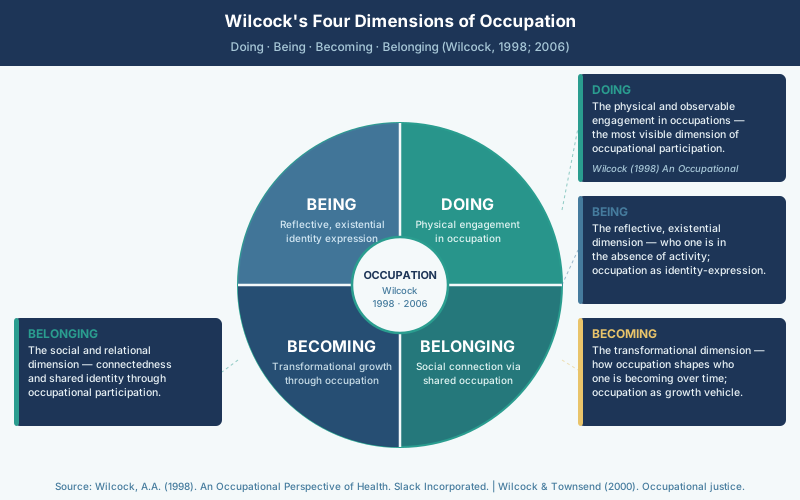
Wilcock's framework characterises occupation across four dimensions, challenging purely instrumental views of occupation by positioning occupational engagement as intrinsically valuable for human health and well-being. The framework emerged from Wilcock's theoretical work on occupation and health and was developed across her publications from the 1990s onward. It provides a structure for understanding occupation that goes beyond task performance to include the existential, developmental, and social dimensions of occupational life.
Doing is the first and most immediately recognisable dimension. It refers to the physical and observable engagement in occupations: the active, practical performance of tasks and activities in daily life. Doing is the most readily visible dimension of occupation and is the primary focus of traditional rehabilitation approaches. In OT assignments, documenting what a client does, their current occupational performance, is the starting point for occupational profiling and assessment. However, a complete occupational profile requires all four dimensions.
Being is the second dimension and refers to the reflective, existential aspect of occupation. It captures who a person is in the absence of activity, the sense of self that is expressed through occupational engagement rather than simply produced by it. Being encompasses personal values, beliefs, and identity as they are manifest in occupational life. In OT assignments, the being dimension is addressed when students document what occupations mean to a client, what occupations reflect the client's sense of self, and how occupational disruption has affected the client's sense of identity and purpose.
Becoming is the third dimension and refers to the transformational nature of occupational engagement. It describes how participation in occupation shapes who a person is becoming over time, positioning occupation as a vehicle for growth, development, and change. The becoming dimension is particularly relevant in goal-setting and intervention planning, where OT practice is oriented not only toward restoring prior function but toward enabling the client to achieve their aspirational occupational identity. In student assignments, becoming is addressed when documenting future occupational goals and the developmental trajectory that intervention supports.
Belonging is the fourth dimension and refers to the social and relational aspect of occupational participation: the sense of connectedness, community, and shared identity that comes from engaging in occupation with others. Belonging recognises that many occupations are inherently social and that participation in shared occupational contexts generates a sense of membership, inclusion, and relational identity. The belonging dimension is the most frequently omitted in student essays and occupational profiles, yet it carries equal definitional weight to the other three. Documenting how a client's occupational participation connects them to others, to community, and to shared identity is as important as documenting performance, self-expression, or growth.
In OT assignments, Wilcock's framework is applied in occupational profiling and goal-setting documentation to ensure that all four dimensions of occupation are addressed for each client. A student who uses only the doing dimension is producing a partial occupational profile. A student who addresses all four dimensions demonstrates a holistic understanding of occupation that is consistent with the theoretical foundations of the profession and with the expectations of marking criteria at Level 5 and above.
Occupational Form, Occupational Performance, and Occupational Meaning: Three Dimensions of Occupation
Occupational form denotes the observable, objective structure of an occupation that exists independent of any individual person: the cultural, physical, and social context that constitutes the activity as it exists in the world. Occupational form is what the activity is as an objective phenomenon, regardless of who is performing it or what it means to them. The form of making a cup of tea, for example, includes the physical actions involved, the materials required, the cultural context in which that activity takes place, and the social conventions that surround it. Occupational form exists before any particular person engages with it and persists after they have finished.
Occupational performance is the actual engagement of a specific person in an occupational form in a specific context. It is the doing of the activity by a particular individual, shaped by that person's physical, cognitive, and psychosocial capacities, by the specific environment in which the activity takes place, and by the personal meaning the person brings to the engagement. Occupational performance is what can be observed and assessed in OT practice: it is the focus of standardised assessment tools, activity analysis, and intervention planning.
Occupational meaning is the subjective significance and value that a person attributes to their engagement in an occupation. It is what the occupation means to that specific person: how it connects to their identity, their roles, their values, and their sense of purpose. Two people may engage in the same occupational form with identical performance quality and yet attach entirely different meanings to the activity. Occupational meaning is captured in occupational profiling and is the dimension of occupation most directly connected to Wilcock's being and belonging dimensions.
For OT students, these three dimensions map clearly onto different types of assignment tasks. Occupational form is analysed objectively in activity analysis assignments, where the task is to describe the activity as it exists in the world, independent of any client. Occupational meaning is captured in occupational profiling sections of case study assignments, where the task is to document what the occupation means to the client. Occupational performance is assessed and targeted in intervention planning sections of case study assignments, where the task is to identify performance gaps and design occupation-based interventions to address them.
| Dimension | Definition | Assignment Application |
|---|---|---|
| Occupational Form | Observable, objective structure of the occupation independent of the person | Activity analysis: describe the form objectively |
| Occupational Performance | The actual engagement of a specific person in an occupational form in context | Case study: assess how the client performs the occupation |
| Occupational Meaning | The subjective significance the person attributes to occupational engagement | Occupational profile: capture what the occupation means to the client |
How Do Occupational Science Concepts Shape the Language of OT Academic Assignments?
Occupational science concepts do not remain in the theoretical realm of lecture notes. They appear directly in assignment marking criteria, in the vocabulary of occupational justice essays, in the MOHO constructs used to organise case study analysis, and in the framework that underpins occupational profiling at every degree level. A student who understands the distinction between occupational deprivation and occupational marginalisation writes a more precise critical analysis essay than one who conflates them. A student who can name all four of Wilcock's dimensions produces a more complete occupational profile than one who documents only the doing. The concepts on this page are not background reading; they are the analytical vocabulary that examiners assess. Assignments at Level 5 and above increasingly require students to demonstrate theoretical grounding in the foundational concepts of the discipline: the origin of occupational science, the relationship between occupation and identity, the mechanisms of occupational injustice, and the dimensions through which occupation can be understood and described. Precision in using these concepts distinguishes a first-class answer from a competent one.
Occupational Justice and the Social Model of Disability: A Contextual Bridge for OT Students
Occupational justice and the social model of disability share a foundational concern: both frameworks locate the source of participation barriers in social structures rather than in the individual. The social model of disability, developed within disability studies and disability rights movements, argues that disability is produced by social, environmental, and attitudinal barriers rather than by impairment itself. It distinguishes between impairment, the physical or cognitive difference, and disability, the disadvantage created by a society that fails to accommodate that difference. Occupational justice operates with a similar structural logic but names the barriers in occupation-specific terms: apartheid, deprivation, imbalance, and marginalisation. Where the social model identifies the conditions that disable people, occupational justice identifies the conditions that deny people their right to occupational participation.
For OT students, the connection between these two frameworks is analytically important in critical analysis essays that address disability, access, and participation. Occupational justice provides the OT-specific vocabulary; the social model provides the broader sociological and political context in which that vocabulary operates. An essay that deploys both frameworks demonstrates the ability to connect OT theory to wider academic discourse, which is precisely what Level 5 and Level 6 marking criteria reward. The Royal College of Occupational Therapists (RCOT) has published occupational justice position statements, and the World Federation of Occupational Therapists (WFOT) has developed an occupational justice framework that reinforces the alignment between occupational therapy's professional stance and the structural analysis of the social model of disability. Together, these frameworks give students a coherent theoretical platform for addressing structural barriers to participation at advanced degree levels.
Occupational Justice in Critical Analysis OT Essays
In critical analysis essays at Level 5 and above, occupational justice is most effectively deployed when students identify which specific subtype applies to the scenario or population under analysis. The four subtypes serve different analytical purposes in essay writing. Occupational apartheid is most applicable in structural critique essays that address systemic exclusion of population groups from occupational participation, for example, essays examining access to employment for people with mental health conditions. Occupational deprivation is relevant in essays addressing populations whose circumstances remove access to occupation through no individual failing, such as essays on incarceration, forced displacement, or prolonged hospitalisation. Occupational imbalance is most commonly applied in reflective practice essays and in essays addressing caseload management, burnout, or occupational engagement in caregiving populations. Occupational marginalisation is the most appropriate subtype for person-centred practice essays, where the focus is on the denial of individual choice and agency in occupational participation through relational or attitudinal barriers.
Occupational Science Concepts in MOHO-Based OT Assignments
MOHO explicitly draws on occupational science theory as its foundational knowledge base. Kielhofner developed MOHO as a practice model that operationalises occupational science concepts within a framework designed for clinical application. Occupational identity and occupational competence, two of MOHO's central constructs, are occupational science concepts that Kielhofner translated into assessable and observable clinical constructs. This theoretical lineage is not merely historical: understanding that MOHO's constructs originate in occupational science deepens a student's ability to apply MOHO in assignments because it reveals why MOHO uses the language it does and where that language comes from.
In MOHO case study assignments, students who understand the occupational science foundation of MOHO can articulate why MOHO uses occupation-centred language rather than medical or rehabilitative language. MOHO does not describe clients in terms of deficits or diagnoses; it describes them in terms of volition, habituation, performance capacity, and environment. That framing derives directly from occupational science's positioning of occupation as the central organising concept for understanding human beings. A student who can explain that theoretical derivation, rather than simply applying MOHO constructs mechanically, produces an answer that demonstrates genuine theoretical depth. That depth is what distinguishes assignments that achieve first-class marks from those that demonstrate competent but surface-level application of theory. For students on OT practice placement, the ability to connect MOHO's clinical language back to its occupational science roots is particularly valuable in reflective writing that asks students to articulate the theoretical basis of their practice decisions.
For students applying occupational science theory to OT framework assignments, see our guides to OTPF occupation categories and occupational science theory and CMOP-E and Canadian occupational science in OT assignments. For occupational analysis and activity analysis work, see our activity analysis assignment help guide.
Working on a MOHO-Based Case Study?
Get expert help applying MOHO constructs and occupational science theory to your assignment.
MOHO Assignment HelpFrequently Asked Questions: Occupational Science for OT Students
What is the difference between occupational science and occupational therapy?
Occupational science is a pure academic discipline that studies occupation as a human phenomenon. Occupational therapy is a health profession that uses occupation as its therapeutic medium. Occupational science generates the theoretical knowledge base; occupational therapy applies that knowledge in clinical practice. A student who cites occupational science literature in an OT essay demonstrates theoretical grounding rather than confusion between the two fields.
What is occupational deprivation and how is it different from occupational marginalisation?
Occupational deprivation refers to externally imposed barriers that prevent a person from engaging in occupations they need or want, such as incarceration, forced displacement, or prolonged hospitalisation. Occupational marginalisation refers to the denial of the right to occupational choice through others' expectations, norms, or cultural values. Deprivation is a structural circumstance that removes access; marginalisation is a relational process that undermines choice. Both are Townsend and Wilcock constructs, but they name different mechanisms of occupational injustice.
How does the doing, being, becoming, belonging framework apply to OT practice?
Wilcock's framework is used in occupational profiling and goal-setting in OT practice and in assignments. Clinicians use it to capture all four dimensions of occupation rather than focusing only on performance. In assignments, it provides a structure for describing a client's occupational needs holistically: what they do, who they are, who they are becoming through occupation, and their sense of social belonging through shared occupational participation.
What is occupational identity and how does it relate to MOHO?
Occupational identity is a MOHO construct drawn from occupational science theory. Within MOHO, it describes a composite sense of who a person is and wishes to become as an occupational being, integrating their volition, habituation, and performance capacity into a narrative sense of self. It is used in MOHO-based case studies to describe a client's sense of purpose, roles, values, and future occupational aspirations.
Is occupational justice the same as social justice?
Occupational justice is a specific application of social justice principles to the domain of occupation. It extends social justice by naming occupation-specific forms of injustice: apartheid, deprivation, imbalance, and marginalisation. It goes further by arguing that participation in meaningful occupation is itself a human right, not merely a therapeutic goal. Social justice provides the broader ethical framework; occupational justice provides the OT-specific vocabulary for addressing injustice in practice and in academic writing.