Dementia Occupational Therapy Assignment Help — Cognitive Levels, Environmental Modification and Mental Capacity Act
Alzheimer's disease, comprising 60–70% of dementia diagnoses, vascular dementia with its characteristic stepwise decline, Lewy body dementia defined by its triad of fluctuating cognition, visual hallucinations, and parkinsonism, and frontotemporal dementia presenting with either behavioural change or progressive language impairment — each type produces distinct occupational performance consequences that dementia OT assignments must address with specificity. Assessment priorities differ by type: cognitive screening and IADL monitoring for Alzheimer's, ADL performance and fatigue management for vascular dementia, falls risk and fluctuating capacity assessment for Lewy body dementia, and safety and carer support for frontotemporal dementia. Every dementia OT assignment that conflates these four presentations as interchangeable loses marks at Level 6 and above.
Dementia Types and OT Assessment Implications — What Every OT Assignment Must Address
Alzheimer's disease characterises itself through hippocampal and cortical atrophy producing progressive episodic memory loss, followed by semantic and working memory impairment as the disease advances. The typical OT assessment trajectory follows the functional decline: early stage presents with IADL difficulties — managing finances, cooking, medication management — while basic ADL performance remains largely intact. OT assessment in early Alzheimer's prioritises IADL functional assessment, home safety screening, and early goal-setting around what the person most wants to maintain.
Vascular dementia characterises itself by stepwise decline following cerebrovascular events, with executive function and processing speed more prominently affected than episodic memory in early presentations. This distinction matters for OT assessment: the client may have intact long-term memory but significant difficulty initiating, sequencing, and completing ADL tasks. OT assessment prioritises ADL performance observation rather than verbal recall measures.
Lewy body dementia characterises itself through three defining features — fluctuating cognition, recurrent visual hallucinations, and spontaneous parkinsonism — that each carry OT assessment implications. Fluctuating cognition means a single MoCA score captured at one session may misrepresent the client's typical function: the client who scores 22 on Monday may score 14 on Wednesday. OT capacity assessment must therefore be time-specific and decision-specific. Visual hallucinations interact with environmental design: patterned walls, poor contrast, and reflective surfaces worsen the experience. Parkinsonism affects motor skill performance and falls risk assessment.
Frontotemporal dementia (FTD) characterises itself in two primary variants: the behavioural variant presents with personality change, disinhibition, loss of empathy, and socially inappropriate behaviour — OT assessment focuses on carer stress, safety monitoring, and structured activity to manage behavioural symptoms. The language variant, primary progressive aphasia, progressively impairs communication while sparing other cognitive domains initially — OT assessment must address AAC (augmentative and alternative communication) needs and IADL safety.
Mixed dementia, Alzheimer's pathology combined with vascular changes, is the most common subtype in people over 80 and produces additive functional decline affecting both memory and executive function simultaneously.
| Dementia Type | Prevalence / Pattern | Primary OT Assessment Focus | Key OT Consideration |
|---|---|---|---|
| Alzheimer's | 60–70% of diagnoses; progressive | IADL monitoring, home safety, COPM for occupational goals | Memory aids, routine maintenance, early advance planning |
| Vascular | Stepwise decline post-CVE; executive function affected early | ADL observation (AMPS), fatigue assessment, cardiovascular activity | Initiation and sequencing support rather than memory cueing |
| Lewy Body | Triad: fluctuating cognition + hallucinations + parkinsonism | Time-specific capacity assessment, falls risk, environmental contrast | Assess during known "good periods"; schedule-sensitive assessment |
| Frontotemporal | Younger onset (50s–60s); behavioural or language variant | Safety assessment, carer education, AAC in language variant | Behavioural management strategies; carer strain assessment |
| Mixed | Most common in over-80s; Alzheimer's + vascular pathology | Both memory and executive function addressed in assessment | Combined cueing and initiation support strategies |
OT Dementia Assessments — MoCA, MMSE, AMPS, COPM and Allen Cognitive Level Screen
The MoCA screens cognitive function across eight domains: visuospatial and executive function, naming, memory, attention, language, abstraction, delayed recall, and orientation. Its total score range is 0–30. Mild cognitive impairment falls in the range 18–25; moderate impairment 10–17; severe impairment below 10. MoCA is preferred over MMSE for OT assignments involving early or mild dementia because its broader domain coverage and sensitivity to mild cognitive impairment in the 18–25 range captures the client group most likely to present to community OT services.
The MMSE screens the same 0–30 range with mild impairment at 21–26, moderate at 11–20, and severe at or below 10. MMSE remains widely documented in UK clinical records for moderate-to-severe dementia and frequently appears in case study background information provided to students. When a case study provides an MMSE score, interpret it using the bands above; when selecting an assessment tool in the assignment, justify MoCA on the grounds of its greater sensitivity to the mild impairment range.
The AMPS (Assessment of Motor and Process Skills) assesses the quality of occupational performance through direct observation across 16 motor skill items and 20 process skill items. ADL motor performance at or above 2.0 logits indicates independent functional motor performance; ADL process performance at or above 1.0 logits indicates independent functional process performance. In dementia, AMPS is particularly valuable because it assesses what the person actually does — rather than what they report or what a carer estimates — making it more valid than self-report measures when insight is impaired. AMPS requires a certified rater.
The COPM identifies occupational performance priorities through a client-directed semi-structured interview using three 1–10 scales: importance, performance, and satisfaction. In moderate-to-severe dementia, direct self-report validity is compromised, and carer proxy administration is used — a carer who knows the person well responds on their behalf, guided by the OT. In mild dementia with intact communication, direct client report remains appropriate. COPM clinically significant change requires a minimum 2-point improvement on performance or satisfaction scales.
The Allen Cognitive Level Screen (ACLS) uses a leather lacing task to screen which cognitive level the person is functioning at. It indicates the appropriate cueing strategy and activity grading for OT intervention. The Kitchen Task Assessment evaluates performance on a familiar cooking task and maps to Allen Cognitive Level functioning — both tools assess cognitive level through functional task performance rather than verbal questioning, making them more valid for dementia than paper-based cognitive tests.
MoCA vs MMSE — Which Cognitive Screen to Use in Dementia OT Assignments
MoCA detects mild cognitive impairment at scores 18–25, a range where MMSE often shows scores in the normal band (21–26), missing early impairment. MoCA covers visuospatial and executive function in addition to memory and orientation, which are the domains most relevant to IADL difficulties in early dementia. For an OT case study involving a client at the mild dementia stage — the most common community OT presentation — MoCA is the more defensible assessment choice. Justify the selection explicitly: stating "MoCA was selected because of its sensitivity to mild cognitive impairment in the 18–25 range, which reflects this client's community OT presentation" demonstrates the clinical reasoning examiners credit at Level 6.
Allen Cognitive Levels — The OT-Specific Cognitive Framework for Dementia Assignments
Allen Cognitive Level 1 describes automatic actions only: the person responds to sensory stimulation but produces no purposeful engagement with objects or the environment. OT approach centres on sensory stimulation — tactile, auditory, and olfactory input — with 24-hour care required for all ADLs. This level characterises the most advanced stage of dementia.
Allen Cognitive Level 2 describes postural actions: the person produces gross motor movement — sitting up, reaching — but has very limited problem-solving capacity. Familiar routine actions can be supported through full physical and verbal cueing. OT approach uses rote repetition of basic personal care tasks with consistent technique each time.
Allen Cognitive Level 3 describes manual actions: the person engages in repetitive use of familiar objects through hand-to-object interaction. Task sequencing for novel activities is not possible. OT approach uses simple repetitive hand-based activities with familiar objects; complex sequencing demands are removed entirely.
Allen Cognitive Level 4 describes goal-directed actions with familiar cues: the person manages familiar daily routines with prompting and visible environmental cues, but cannot initiate novel problem-solving. This is a pivotal level in dementia OT practice — the intervention environment must be structured around familiar routines and visible cues (labels, colour coding, consistent object placement). Novel tasks must not be introduced. OT cueing strategy: verbal prompts plus visible cues plus familiar routine structure.
Allen Cognitive Level 5 describes exploratory actions: the person can adapt to novel situations with guidance, problem-solve with support, and engage with new materials under OT direction. IADL retraining becomes possible at this level. OT approach involves gradually introducing new activities with guided exploration and graded support withdrawal.
Allen Cognitive Level 6 describes planned actions — full independence: the person plans ahead, problem-solves independently, and performs at normal cognitive function. OT role shifts from cueing and compensation to prevention and health promotion.
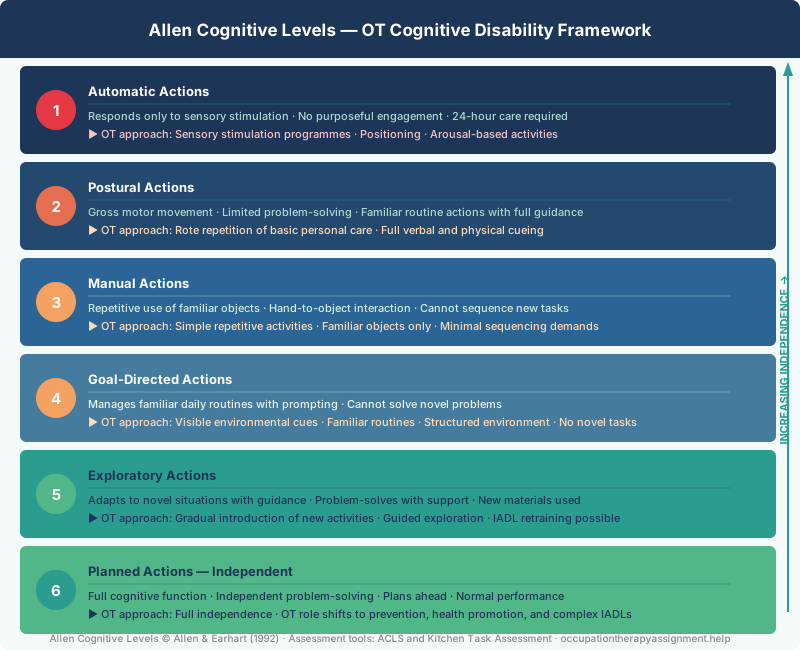
The critical academic skill at Level 6 is connecting the ACL score to its OT intervention implication. Writing "the client is at ACL Level 4" earns no marks. Writing "the client at ACL Level 4 manages familiar routines with prompting; OT intervention uses visible environmental cues, maintains familiar activity sequences, and avoids introducing novel tasks" demonstrates the clinical reasoning examiners credit.
OT Dementia Interventions — Meaningful Occupation, Environmental Modification and Carer Education
Meaningful occupation maintains personhood and wellbeing in dementia. Tom Kitwood's personhood model underpins OT's intervention approach: occupation is not merely therapeutic activity but the means through which identity, belonging, and comfort are expressed and sustained even as cognitive function declines. OT intervention planning must connect activity selection to the person's life history — what they valued, what they did, what gives their life meaning — not simply to what is available or manageable at their current ACL level.
Cognitive Stimulation Therapy (CST) is a structured programme of themed activities targeting cognitive function and social participation in mild-to-moderate dementia. The standard protocol delivers 14 group sessions twice weekly, each 45 minutes, using themes including physical games, sound, childhood, food, current affairs, word association, and creative activities. CST has Cochrane systematic review evidence demonstrating improvement in cognitive function and quality of life, and is NICE NG97 recommended. OT delivers or facilitates CST and adapts themes to participants' life history and ACL level.
Reminiscence therapy uses structured recall of past experiences through sensory triggers — photographs, music, objects from earlier decades — to promote engagement, positive affect, and reduction of behavioural and psychological symptoms of dementia (BPSD). OT uses reminiscence within the life history framework, connecting recalled memories to current occupational engagement.
Life history work involves constructing a life history profile or book with the person and their family, documenting occupational history, preferences, values, and significant life events. OT uses the life history profile to guide activity selection, environmental personalisation, and communication with care staff.
Environmental Modification Standards for Dementia — Specific OT Design Requirements
A minimum 30% luminance contrast ensures surfaces and edges are distinguishable for people with perceptual impairment in dementia: a dark toilet seat on a pale toilet, a contrasting floor-wall junction at skirting board level, and contrasting handrails against walls all meet this standard. Colour contrast for way-finding in care homes and hospital wards distinguishes zones by function — a blue door for the bathroom, a red door for the toilet — supporting independent navigation.
Signage height is recommended at 1.5 metres, placed at eye level for a person leaning on a walking aid or frame. Standard door-top height signage is inaccessible for people with forward-flexed posture from parkinsonism or frailty. Lighting must reach a minimum 500 lux in task areas — kitchen surfaces, bathroom, and reading areas — because dementia increases the illumination threshold needed for safe ADL performance. Patterned floors and walls cause perceptual confusion: a patterned carpet can be misinterpreted as objects or steps, generating falls risk. Plain surfaces and reduced visual noise are the design standard.
| Modification Type | Specific Standard | Rationale for OT Assignments |
|---|---|---|
| Edge and surface contrast | Minimum 30% luminance contrast | Reduces falls; supports independent navigation; toilet seat, handrails, skirting |
| Colour way-finding | Distinct colour per zone or function | Enables independent location of bathroom, bedroom, lounge in care settings |
| Signage height | 1.5 metres from floor | Accessible to person using walking aid with forward-flexed posture |
| Task area lighting | 500 lux minimum | Dementia raises illumination threshold for safe ADL performance |
| Floor and wall pattern | Plain surfaces; no bold patterns | Prevents perceptual misinterpretation of patterns as steps or objects |
Carer Education as an OT Intervention in Dementia Assignments
NICE NG97 explicitly recommends carer support and education as a key component of dementia management. OT carer education covers three areas: cueing strategy coaching matched to the person's ACL level (Level 4 requires verbal prompts and visible cues; Level 3 requires hand-over-hand guidance with familiar objects; Level 2 requires full physical assistance with consistent technique); activity modification to match remaining abilities; and carer wellbeing assessment. The Zarit Burden Interview is a validated measure of carer strain used in OT dementia practice — its inclusion in an assignment demonstrates awareness that carer wellbeing is a legitimate OT concern, not incidental to the clinical plan. Documenting carer education in a dementia OT case study requires stating what was taught, how the carer demonstrated competency, and what the follow-up plan is.
Mental Capacity Act 2005 — Application in Dementia OT Assignments
The Mental Capacity Act 2005 assumes capacity unless it has been established otherwise: Principle 1 is the starting point for every dementia OT decision involving restriction, modification, or intervention without explicit consent. The five statutory principles govern all OT practice with people who may lack capacity and must be applied in sequence in dementia OT assignments.
Principle 1: A person must be assumed to have capacity unless it is established that they lack capacity.
Principle 2: A person must be supported to make their own decision before being treated as lacking capacity — OT's role includes using simplified language, visual communication aids, and familiar environments to support decision-making.
Principle 3: A person is not to be treated as unable to make a decision merely because they make an unwise decision — a person with mild dementia who chooses to live alone with risk present is not lacking capacity on that basis alone.
Principle 4: Any act or decision made under the Act must be in the person's best interests — when capacity is lacking, OT contributes to MDT best interests discussions, considering the person's past wishes, values, and preferences as expressed through life history work.
Principle 5: Regard must be had to whether the purpose can be achieved in a less restrictive way — this principle governs OT environmental modification decisions; if a grab rail achieves the safety goal without restricting the person's independence, it is preferred over removing access to the area entirely.
The two-stage capacity assessment determines first whether there is an impairment or disturbance in the functioning of the mind or brain (dementia meets this criterion), and second whether that impairment means the person is unable to understand, retain, use or weigh, or communicate a decision. Both stages must be documented in dementia OT case study assignments that involve capacity-relevant decisions.
Fluctuating Capacity in Lewy Body Dementia — OT Assessment Implications
Fluctuating cognition, a defining feature of Lewy body dementia, means that capacity must be assessed at the time of the specific decision — not on a general basis from a previous assessment. A client who scores 22 on MoCA in the morning may have significantly reduced cognitive function by the afternoon. Best practice requires scheduling OT assessment for the person's known "good periods" and documenting the time and clinical context of the capacity assessment. In assignments, students who apply a single MoCA score to all capacity decisions for a Lewy body dementia client fail to demonstrate understanding of the time-specific and decision-specific nature of capacity assessment under the MCA.
NICE Dementia Guideline NG97 — What OT Assignments Must Apply
NICE guideline NG97 ("Dementia: assessment, management and support for people living with dementia and their carers," 2018) recommends cognitive stimulation therapy as a group activity for mild-to-moderate dementia, occupational therapy for ADL assessment and environmental modification, carer support and education, assistive technology assessment, and post-diagnostic support coordination. OT-specific recommendations include functional assessment of ADL, home environmental assessment and modification, assistive technology prescription, and cognitive rehabilitation for mild dementia.
At Level 6 and Level 7, citing NG97 as a single reference is insufficient. The assignment should identify which specific recommendation supports the intervention choice. Students should reference the relevant NG97 section — for example, NG97 recommendation 1.4.3 recommends offering activities based on the person's interests and history, which supports life history work as an OT intervention. Specific recommendation citation is what distinguishes Level 6 critical engagement with evidence from Level 5 descriptive citation.
Beyond cognitive screening and functional decline — how does personhood and meaningful occupation shape the OT approach to dementia assignments, and which theoretical framework positions the OT role within person-centred dementia care?
Kitwood's Personhood Model and Meaningful Occupation in Dementia
Tom Kitwood's personhood model defines personhood in dementia as a standing or status bestowed upon one human being by others, in the context of relationship and social being, implying recognition, respect, and trust. OT's role in dementia is to preserve personhood through meaningful occupation even as cognitive function declines — a framing that positions OT as central to dementia care, not peripheral to medical management.
Kitwood identifies five psychological needs in dementia: identity (knowing who one is), comfort (security and closeness), attachment (bonds of feeling), occupation (involvement in activity), and inclusion (being part of a group). Each need maps to OT intervention: life history work addresses identity; therapeutic relationship and consistent routines address comfort; group activities and peer engagement address attachment and inclusion; meaningful activity grading addresses occupation. Assignments that frame OT dementia interventions through Kitwood's five needs demonstrate theoretical depth at Level 6. For the occupational science foundations underpinning this personhood and occupation framework, see our occupational science for OT students resource. For applying MOHO's volition and habituation constructs to dementia OT case studies, see our MOHO applied to OT case study assignments page. For guidance on selecting, administering, and critically appraising the cognitive and functional assessments used in dementia OT assignments — including the MoCA, MMSE, ACL, and AMPS — see our resource on OT assessment tools assignment help.
Assistive Technology for Dementia — OT Prescription and Capacity Considerations
Assistive technology for dementia is prescribed by OT within the Mental Capacity Act framework. GPS trackers for safety and wandering management require a capacity assessment before prescription: if the person has capacity, informed consent is required; if capacity is lacking, a best interests decision involving family and carers is needed, applying the least restrictive Principle 5. Medication dispensers with automated reminders are appropriate for mild-to-moderate dementia at Allen Cognitive Level 4 — the person can respond to prompts but cannot reliably self-manage medication sequences. Simplified phones with large buttons and reduced interface complexity are selected by OT based on the person's remaining manual and cognitive ability. In OT assignments, AT prescription must document what AT was prescribed, why it was selected, the MCA consent process followed, and how the OT confirmed appropriate use.
FAQ — Dementia Occupational Therapy Assignment Questions
What is the difference between MoCA and MMSE for a dementia OT case study — which should I use?
MoCA (0–30; mild CI 18–25) is more sensitive to mild cognitive impairment than MMSE (0–30; mild 21–26) because it covers visuospatial function, executive function, and language in addition to orientation and memory. In an OT case study, MoCA is preferred when the client presents with early or mild dementia — the range most likely in community OT settings. Justify the choice explicitly: "MoCA was selected because of its sensitivity to the mild cognitive impairment range (18–25) relevant to this community OT case." MMSE is more widely documented in UK inpatient records for moderate-to-severe dementia and should be interpreted using its own severity bands when it appears in the case study background.
How do I apply Allen Cognitive Levels to intervention planning in a dementia OT assignment?
Each ACL maps to a specific OT cueing and activity approach. ACL Level 4 (goal-directed with familiar cues) directs OT to use a structured familiar environment, verbal and visual prompts, and maintain consistent routines — novel tasks must not be introduced. ACL Level 3 (manual actions) directs OT to use familiar objects in repetitive hand-based activities, provide hand-over-hand guidance for ADLs, and remove complex sequencing demands. The key academic skill is connecting the ACL score to a justified intervention with specific cueing strategies. "The client is at ACL Level 4" is not a complete clinical reasoning statement. "The client at ACL Level 4 manages familiar routines with prompting; OT intervention therefore uses visible environmental cues, maintains familiar activity sequences, and avoids novel tasks" demonstrates the reasoning examiners credit.
What are the five principles of the Mental Capacity Act 2005 and how do they apply to an OT dementia case study?
The five MCA 2005 principles are: (1) assume capacity unless proven otherwise; (2) support the person to decide before assuming incapacity; (3) an unwise decision does not mean incapacity; (4) act in best interests when capacity is lacking; (5) use the least restrictive means. In a dementia OT case study, these apply when recommending a restriction of activity — removing car keys requires Principle 1 first, then a two-stage capacity assessment, then Principle 5: is there a less restrictive safety option? GPS trackers require consent if capacity is present, or a best interests process if lacking. Environmental modifications invoke Principle 5: the least restrictive modification that achieves the safety goal is required.
What is Cognitive Stimulation Therapy and how should I describe it in an OT dementia assignment?
Cognitive Stimulation Therapy (CST) is a structured group programme of 14 themed sessions, twice weekly, each 45 minutes, designed to improve cognitive function and quality of life in mild-to-moderate dementia. Themes include physical games, sound, childhood, food, current affairs, word association, and creative activities. CST is NICE NG97 recommended and has Cochrane systematic review evidence demonstrating improvement in cognitive function and quality of life. In an OT dementia assignment, describe CST with its protocol parameters, evidence level, and connection to OT's role in cognitive stimulation and meaningful occupation — not as a generic "activities group."
How do I write about a client with Lewy body dementia in an OT assignment — what is different from Alzheimer's?
Lewy body dementia requires three specific OT assignment considerations. First, fluctuating cognition: capacity must be assessed at the time of the decision; a good MoCA score in the morning does not predict afternoon function — schedule assessments for known "good periods." Second, visual hallucinations: environments with patterns, poor lighting, or confusing reflections worsen hallucinations — OT environmental modification specifically targets visual noise reduction. Third, parkinsonism: affects OT functional assessment through slower movement, rigidity, and falls risk — AMPS process skills may be more impaired than motor skills initially. Students who acknowledge these three features specifically, rather than treating all dementias as identical, receive marks for clinical discrimination.
Get Expert Help With Your Dementia OT Assignment
Allen Cognitive Levels, Mental Capacity Act application, environmental modification standards, NICE NG97, Kitwood personhood — all covered by OT assignment specialists with older adult and dementia OT expertise.
Request a Free Quote